Best Mediterranean Food at Disney World: Where to Eat, What to Order, and What to Skip
Published June 11, 2026 · Updated October 14, 2026
At a Glance
- Best for: EPCOT grazers, date nights, lighter midday meals, and groups that actually share plates
- Start here: Spice Road Table in EPCOT’s Morocco pavilion — the most straightforward Mediterranean-style sit-down in a park, with World Showcase Lagoon views
- Worth leaving the park for: Disney Springs and resort restaurants, when you want a slower, better table-service meal instead of a squeezed-in park lunch
- Best time to go: Late lunch (around 1:30–2:30 p.m.) or early dinner — you dodge the peak dining crush and still leave room for evening snacks
- Don’t miss: Mezze-style small plates, dips, grilled proteins, and seafood — anything built to pass around the table
- Skip: The “safe” entrée you could get at any food court, especially at a restaurant whose whole strength is shareable plates. Also skip building a plan around rumored off-menu items — ask politely, but have a backup.
- Money move: Treat it as a snack dinner — one dip, one protein-heavy plate, free cups of ice water from a quick-service counter — instead of paying entrée-per-person prices
- Allergy note: Add the allergy to your Advance Dining Reservation in My Disney Experience (ADRs open 60 days out at 6:00 a.m. Eastern), ask for the allergy-friendly menu when seated, then tell your server directly. Prep details matter more than the ingredient list — ask about shared fryers and prep surfaces. Several Disney Springs table-service spots handle this well; Raglan Road is notable for gluten-free versions of many dishes and a separate fryer.
This guide is for planners who want something fresher than burgers, fries, and theme-park chicken tenders — without burning one of their limited table-service meals on the wrong restaurant. The biggest win is knowing where Mediterranean food at Disney World is genuinely worth a reservation versus where it’s a pleasant-but-forgettable detour, and then ordering the small plates the kitchen is actually good at. Order to share, drink the free water, and you’ll eat better and spend less on the same park day.
What “Mediterranean” Actually Means at Disney World
Here’s the honest version: Walt Disney World does not really have a Mediterranean restaurant scene — it has a Mediterranean style of eating scattered across a handful of restaurants that are labeled something else. Once you stop hunting for a category and start hunting for a format, this whole trip-planning problem gets easy.
If you search “Mediterranean” expecting a row of Greek tavernas and Levantine grills, you will be disappointed. What you actually get is three overlapping groups:
- Moroccan and Middle Eastern small plates in EPCOT’s World Showcase — the closest thing to a true Mediterranean-style park meal, built around mezze, dips, and grilled proteins.
- Greek, Italian, and coastal-influenced dishes at Disney Springs and the resort hotels, where the menu is broadly “Mediterranean-adjacent” even when the sign out front says something else entirely.
- Seafood-and-vegetable-forward menus that simply eat Mediterranean — grilled fish, olive oil, citrus, herbs, fresh produce — without ever using the word.
That third group is the one planners miss, and it’s where most of the good meals live.
Why the distinction changes your plan
When you’re choosing a cuisine label, you’re locked into one or two restaurants and you’ll force a bad reservation to make the plan work. When you’re choosing a way of eating, suddenly a dozen menus qualify and you can pick based on location, timing, and crowd levels instead.
The pattern you’re actually shopping for:
- Shared plates instead of one giant entrée per person
- Grilled proteins over fried
- Dips, flatbreads, and spreads as the backbone of the table
- Fresh vegetables and acid — lemon, citrus, vinegar, yogurt
- A menu that leaves you walking, not napping
Score any restaurant against those five and you’ll know in thirty seconds whether it fits — regardless of what the cuisine tag says.
How the three groups stack up
| Where | What it really is | Best for | The trade-off |
|---|---|---|---|
| EPCOT World Showcase (Spice Road Table) | Mediterranean small plates, lagoon-side | Grazing, drinks, splitting with 2–4 people | Park-priced; small plates add up fast if you over-order |
| Disney Springs table service | Coastal/Italian/seafood-leaning menus | A slower, better-executed sit-down meal | You’re leaving the park, so it costs you half a day |
| Resort restaurants | Seafood and vegetable-forward fine-ish dining | Date nights, no-kid dinners, lighter meals | Transit time; requires an actual Advance Dining Reservation |
Start here: Spice Road Table in EPCOT is the most straightforward Mediterranean-style park meal, and it does not require you to leave the day you already planned. Go late lunch or early dinner — you dodge the peak dining rush and still leave appetite room for World Showcase snacks later, which is the whole point of eating light in EPCOT.
Pro tip: Order the shared plates and skip the “safe” entrée. At a small-plates restaurant, the generic chicken-or-pasta option is almost always the weakest thing in the kitchen — it exists for the one person at the table who doesn’t want to try anything. If you order it, you’ve paid Mediterranean prices for food you could have gotten at any quick-service counter in the park.
Menus rotate — verify before you commit
This is the part that burns people. Disney menus change seasonally and sometimes without notice, so a dish you read about months ago may simply not exist when you sit down. Before you build a meal around a specific item:
- [ ] Pull up the restaurant’s current menu in My Disney Experience the week of your trip.
- [ ] Re-check the day before — items and hours shift.
- [ ] Confirm there are at least two things each person in your group will eat.
- [ ] Note any allergy or dietary need on your Advance Dining Reservation in My Disney Experience.
- [ ] Ask for the allergy-friendly menu when you’re seated, and tell your server directly — even if it’s already on the reservation.
- [ ] If gluten is the issue, ask about shared fryers and shared prep surfaces specifically, not just ingredients.
- [ ] Have a backup restaurant in the same area picked out in case the menu is too limited for your group.
On allergies, the useful lesson comes from Disney Springs: several table-service restaurants there keep separate allergy-friendly menus or can flag gluten-free versions of popular dishes, and Raglan Road in particular is known for gluten-free versions of many items plus a dedicated fryer. That’s not a Mediterranean restaurant — the point is the tactic. Ask about the kitchen’s allergy process, not just the ingredient list, and do it at booking, at check-in, and again before ordering.
The one thing to remember: you’re not booking a cuisine, you’re booking a format. Pick the restaurant whose menu matches shared-plates-and-grilled-everything, verify the current items in My Disney Experience, and keep a backup in the same neighborhood.
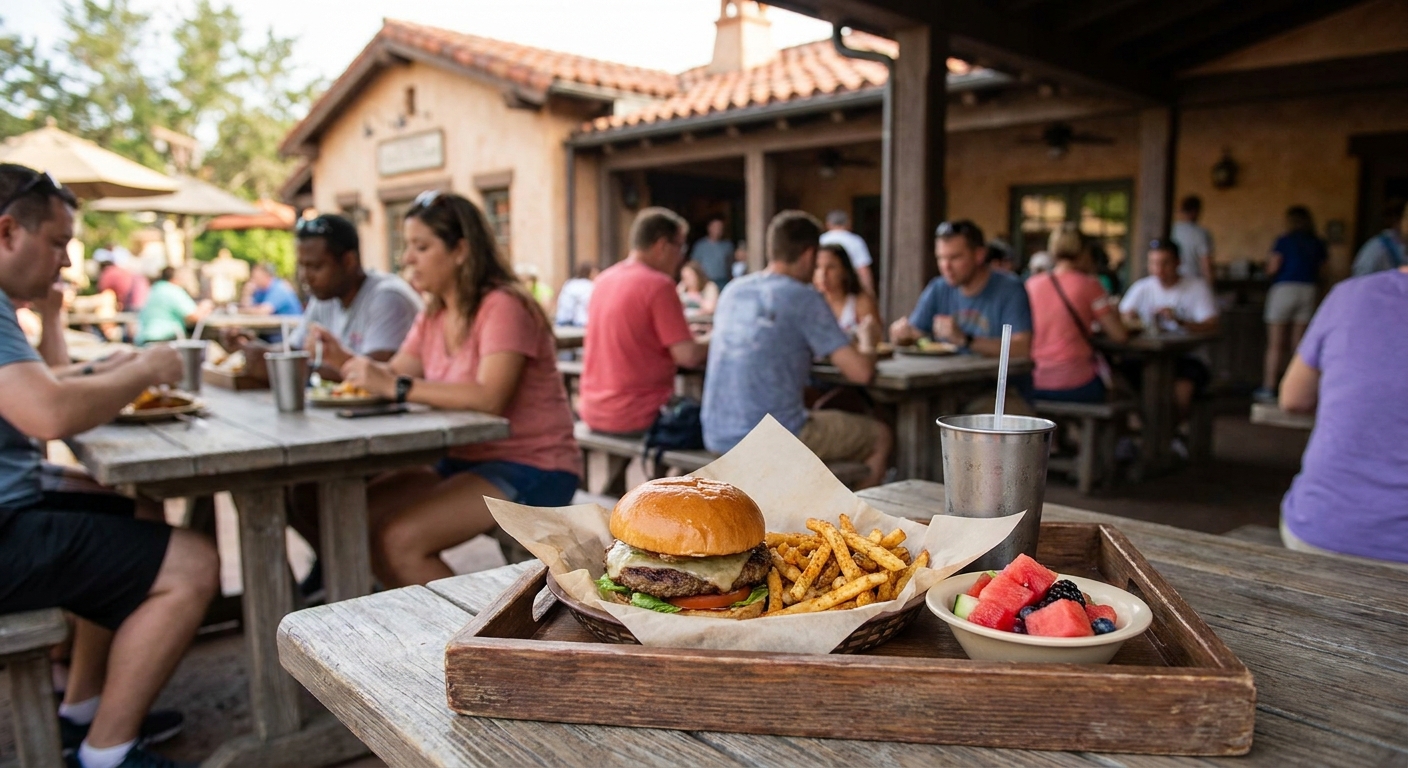
The Short Answer: Where to Eat, Ranked by Situation
If you’re inside a park and want Mediterranean-style food without blowing up your day, Spice Road Table in EPCOT’s Morocco pavilion is the straightforward answer — and if you’re willing to leave the parks, Disney Springs and the resorts give you a better, slower meal.
That’s the whole decision in one line. Here’s how it breaks down by what kind of day you’re actually having.
The ranked shortlist
| Your situation | The pick | Why | If you wait too long |
|---|---|---|---|
| In a park, tight schedule | Morocco pavilion counter service | Fastest path to grilled proteins and shareable sides without a reservation | Nothing lost — but you’ll eat in a crowded 12:30 p.m. wave instead of a calm 2 p.m. one |
| EPCOT grazing day | Spice Road Table, split across small plates | Mezze-style ordering lets you eat lightly, then keep snacking around World Showcase | Walk-ups tighten through late afternoon; dinner seating near fireworks time is the hardest to get |
| Slower date-night dinner | A Disney Springs or resort table-service restaurant | More kitchen, more space, no 20-minute line pressure behind you | Prime 6:30–8:00 p.m. slots go first; you’ll be eating at 4:45 or 9:15 |
| Family with picky eaters | Quick service with build-your-own plates | Everyone assembles their own; no one is stuck with a $30 entree they poke at | Little risk — this is the flexible option on purpose |
| Allergy-first group | Table service with a reservation | You get the allergy-friendly menu, a chef conversation, and time to ask about shared fryers | ADRs open 60 days before arrival at 6:00 a.m. Eastern; the restaurants with the best allergy reputations fill first |
| Budget-first group | “Snack dinner” — one dip, one protein plate, free ice water | A shared mezze spread often lands well under full entree-per-person pricing | Zero downside. This is the move most people skip |
How to read that table
Spice Road Table is the default in-park answer, not the best meal on property. It’s the most straightforward sit-down Mediterranean-style option inside a park — small plates, seafood, a World Showcase Lagoon view. It is not a destination restaurant, and if your whole trip has one nice dinner in it, spend that dinner outside the parks where the kitchen isn’t feeding a parade of guests on a schedule.
The Morocco pavilion’s counter-service option is the faster alternative and, honestly, the smarter one on a hot day with a full ride plan. A heavy table-service meal at 1 p.m. costs you ninety minutes and the energy to use the afternoon well.
Timing beats everything
Late lunch or early dinner is the sweet spot — roughly 1:30 to 2:30 p.m., or 4:30 to 5:30 p.m. You dodge the two biggest dining crushes, you get a calmer room, and you leave appetite for the evening snacks that are half the point of an EPCOT day.
Pro tip: Mediterranean food is the one cuisine at Disney World where “snack dinner” doesn’t feel like a compromise. A dip, one protein-heavy plate, and free cups of ice water from any quick-service counter reads as a real meal — not a sacrifice — because the food is built for sharing in the first place. Do this once mid-trip and you’ve funded a nicer meal somewhere else.
Book in this order
- [ ] Lock the one slower sit-down dinner first — ADRs open 60 days before arrival at 6:00 a.m. Eastern in My Disney Experience
- [ ] Add allergy or dietary notes to the reservation while you’re booking, not later
- [ ] Leave your in-park Mediterranean meals unreserved; those are flexible by design
- [ ] Pick a backup restaurant in the same area for every reservation you care about
- [ ] Set a Drop Watch on anything that shows “no availability” — cancellations free up constantly, and SupaPark pings you the second a table opens so you can grab it in My Disney Experience
What to skip
Skip the generic “safe” order — the plain grilled chicken, the burger hiding on the menu — at any restaurant whose strength is small plates. You’ve just paid sit-down prices for something you could get at a counter in any park. And skip chasing off-menu or “secret” items as a plan; ask politely once you’re there, but never build a meal around something that may not exist today.
EPCOT: Morocco Pavilion and the Best In-Park Mediterranean Meal
If you want a real Mediterranean-leaning meal inside a Disney World park, Morocco in EPCOT’s World Showcase is the answer — and the small-plates format is the whole reason it works.
Morocco sits between France and Japan on the World Showcase promenade, and it’s one of the quietest pavilions in the park most of the day. That’s a gift, not a warning sign. Fewer people browsing means faster seating, calmer service, and the ability to graze instead of committing to a $40-per-head entrée situation. The food leans mezze-style: dips served with bread, grilled meats and seafood, couscous and tagine-style preparations, and sauces that run citrusy and spiced rather than heavy.
Table Service vs. Quick Service
| Table service (Spice Road Table) | Quick service / counter options | |
|---|---|---|
| Best for | Sharing plates, evening shows, slower pace | Fast lunch, flexible portions, hot days |
| Seating | Waterfront, reservable, shaded | Mostly open-air, first-come |
| Timing cost | 60–90 minutes | 20–30 minutes |
| Reservations | Book 60 days out at 6:00 AM ET in My Disney Experience | None needed |
| The catch | You’re paying for the view as much as the food | Harder to assemble a full shared spread |
Spice Road Table is where I’d start: it’s the most straightforward Mediterranean-style park meal you can book, and the lagoon-facing patio is the real asset. Those tables face the water where EPCOT’s nighttime show plays, which means a dinner that ends around showtime can double as your viewing spot — no standing in a crowd on the promenade for 45 minutes. That’s the single most underrated dining-as-strategy move in World Showcase.
Pro tip: Book the latest table that still lands you seated before the nighttime show, then order in two waves — dips and a cold plate first, grilled proteins second. You stay at the table longer without the awkward “check dropped, show hasn’t started” gap, and nobody has to guard a railing spot.
Why Small Plates Are the Point
The mistake people make here is ordering like it’s a steakhouse: one entrée each, no sharing, everyone locked into a single flavor for an hour. Morocco’s menus reward the opposite. Dips with bread, a couple of grilled items, something with seafood, and a couscous or tagine-style dish gives a table four or five flavors instead of one, and it usually lands cheaper per person than four separate entrées.
Skip the generic “safe” order you could get at any counter in any park. If the restaurant’s strength is small plates, a plain chicken dish is a wasted meal slot.
Ordering Strategy by Party Size
- Two people: Two dips with bread, one grilled protein, one seafood item. Split everything. You’ll leave satisfied with room for a snack later — which matters in World Showcase, where the next thing you want to eat is 200 feet away.
- Four people: Three to four shareable plates plus one couscous or tagine-style dish as the anchor. Order fewer items than feels right, eat, then add. Disney portions on shared plates are more generous than they look on a menu.
- Six people: Ask for two tables’ worth of plates ordered as one round and put the bread and dips at both ends of the table. Six people fighting over one dip is how a good meal turns into a negotiation. Add a second round only after the first clears.
When It’s Quiet vs. Packed
- Quiet: Late lunch, roughly 1:30–3:00 PM, and the last 90 minutes before park close.
- Packed: the hour before the nighttime show, and any day a festival has the promenade crowded — that’s when waterfront seating gets claimed early.
- Best overall window: late lunch or early dinner. You dodge the peak dining crush and still have appetite left for the rest of World Showcase.
The Kid Who Won’t Touch Any of It
This is solvable, and you don’t have to abandon the meal.
- [ ] Order bread and a mild dip immediately — bread alone saves most meltdowns.
- [ ] Ask the server for the plainest grilled protein with sauce on the side.
- [ ] Ask whether a kids’ option exists before you assume it doesn’t.
- [ ] Have a backup: France and Japan are both a two-minute walk, so one adult can grab something while the table keeps eating.
- [ ] Order free ice water for everyone — it’s available at virtually every quick-service counter, and hydrated kids are negotiable kids.
Allergy note: add the detail to your Advance Dining Reservation in My Disney Experience, ask for the allergy-friendly menu when you’re seated, and tell the server directly anyway. Ask about shared grill and fryer space specifically — ingredient lists don’t cover cross-contact.
The takeaway: treat Morocco as a grazing stop with a view, not an entrée destination. Book a table that ends into the nighttime show, order in waves, and keep bread on the table from minute one.
EPCOT World Showcase: Other Pavilions That Eat Mediterranean
Morocco gets the Mediterranean headline, but the smartest Mediterranean meal in EPCOT isn’t one meal — it’s four stops around the lagoon that add up to a better dinner than most table-service bookings. World Showcase is built for grazing, and the Mediterranean playbook — small plates, grilled protein, seafood, citrus, bread and dips — is exactly what a walk-and-share route does best.
Italy: the coastal half of the menu is the good half
Italy’s restaurants lean heavy by default — cream sauces, cheese-forward pastas, the kind of plate that ends your park day at 2 p.m. The move is to order like you’re on the coast, not in a dining room: look for the seafood pasta, the lighter tomato-and-olive-oil preparations, the salumi and cheese boards, and the simpler grilled items. Order one pasta to share rather than one each, and you’ve turned a sit-down into a stop.
Italy’s lounge and outdoor seating is also the most underrated part of the pavilion. A shared board, a glass of something, and a seat in the shade for 30 minutes is a legitimate strategy on a hot afternoon — not a compromise.
Skip: the biggest, creamiest, most “safe” pasta on the menu. If a pavilion’s strength is sharing plates, a single giant entree is the one order you’ll regret.
Japan: the seafood-forward stop that keeps you moving
Mediterranean eating and Japanese eating overlap more than people expect — both reward raw or lightly cooked seafood, rice or grain bases, vinegar and citrus, and portions that don’t flatten you. Japan’s quick-service and counter options are where you get a cold, protein-heavy plate that leaves room for three more stops. If someone in your group wants “fresh, not fried,” this is the pavilion that delivers it without a reservation.
Festival booths: the real Mediterranean variety, when they’re running
EPCOT runs rotating festivals through the year, and the booths are where Greek-adjacent and broadly Mediterranean items actually show up — grilled lamb or chicken skewers, dips with bread, seafood bites, olives and cheese, small portions priced like snacks instead of entrees. Lineups change by festival and by year, so treat any specific booth item as a “check today’s list” thing rather than a plan.
- Booth portions are small on purpose — two or three items usually equals a meal.
- Share everything; it doubles the number of things you get to try.
- Festival booths are often faster than quick-service counters at peak lunch.
Pro tip: Build your graze route backwards from your fireworks viewing spot. Most people eat their way clockwise and then sprint across the lagoon at showtime. Start at the pavilion farthest from where you want to stand, and your last stop puts you already in position — no rushing, no bad sightline.
A sample walk-and-graze route
Rough timing for a late-afternoon start, which is the sweet spot: you miss the peak lunch rush and still have appetite for evening snacks.
| Stop | What to get | Rough spend per person | Time |
|---|---|---|---|
| 1. Morocco | Mezze-style plate, dips, bread | around $15–20 | 30–40 min |
| 2. Festival booth (whatever’s running) | Grilled skewer or seafood bite | around $8–12 | 15 min |
| 3. Italy | Shared seafood pasta or a cheese/salumi board | around $15–25 | 30–40 min |
| 4. Japan | Cold seafood plate or a lighter counter item | around $12–18 | 20 min |
| 5. Any pavilion | One shared dessert, split three or four ways | around $6–10 | 15 min |
Prices drift every season, so use those as shape, not gospel. The structure matters more: one anchor stop with real plates, two or three snack-sized stops, one dessert shared rather than bought per person.
Run the route like a plan, not a wander
- [ ] Pick your anchor stop first (usually Morocco or Italy) and build around it
- [ ] Start between 2:00 and 4:00 p.m. to dodge the lunch and dinner peaks
- [ ] Order one item per stop, not one item per person
- [ ] Ask for free ice water at every quick-service counter you pass
- [ ] Check the day’s festival booth lineup before you commit to a direction
- [ ] Keep one backup pavilion in mind in case a line is 20+ deep
Where SupaPark saves you the legwork
Festival booth lineups and pavilion menus shift, and walking the full lagoon to scout them costs you an hour you don’t have. SupaPark’s dining catalog and live park data let you check what’s actually available before you pick a direction, and if your anchor stop is a table-service booking you couldn’t get, Drop Watch pings you the moment a cancellation frees one up — you grab it in My Disney Experience. Free at supapark.com.
The takeaway: one Mediterranean meal in EPCOT is fine. Four shared stops around the lagoon, ordered light and timed for mid-afternoon, is the version veterans actually do.
Disney Springs: When It’s Worth Leaving the Park
Leave the park for a Mediterranean-leaning dinner only if you’re already done riding — Disney Springs is a great destination meal and a terrible mid-day detour.
Here’s the honest math. You don’t need a park ticket to eat at Disney Springs, the dining rooms are quieter, the menus are broader, and table-service kitchens generally give you more allergy confidence than a counter during a lunch rush. What you pay instead is time: bus or drive, parking garage, the walk across the complex, then the meal itself. Budget two to three hours door to door if you’re eating sit-down. That’s fine on a rest day. It’s brutal if you’re trying to be back at EPCOT for fireworks.
Where the Mediterranean-ish cooking actually lives
Disney Springs doesn’t have a dedicated Greek or Levantine table-service restaurant, so stop looking for one. What it has is the shape of Mediterranean eating — coastal seafood, pasta, grilled proteins, shared starters — scattered across restaurants with other labels on the door.
What to look for on a menu, in priority order:
- Whole or simply grilled fish — the most reliably Mediterranean thing you’ll order anywhere on property.
- Shared appetizers that function as mezze: dips, marinated vegetables, olives, charred bread.
- Pasta with seafood or vegetables rather than heavy cream.
- Citrus, herbs, and olive oil doing the work instead of butter and cheese.
Skip the entrée-per-person default. Three starters and one fish split across two people eats better and costs less than two full entrées.
Is it worth the trip?
| Your situation | Disney Springs or stay in-park? |
|---|---|
| Mid-day, still have rides left | Stay in park — quick service, no contest |
| Dedicated non-park day | Disney Springs, with an ADR |
| After park close, parks closing at 9 or later | Stay in park or resort — Springs kitchens wind down |
| Serious allergy in the group | Disney Springs table service, allergy noted in advance |
| Group that likes sharing plates | Disney Springs, early dinner |
| Tight budget | Stay in park — “snack dinner” wins |
Walking up without a reservation
It’s possible. It’s just not comfortable at 6:30 or 7:00 PM, which is when everyone who finished a park day shows up at once. Expect real waits at the popular table-service spots on weekend evenings and holiday weeks.
Two workarounds that reliably beat the crowd:
- Eat at 4:30–5:30 PM. Late lunch bleeding into early dinner is the softest window all day, and you still have appetite room for an evening snack.
- Sit at the bar. Most table-service restaurants here serve the full menu at the bar, and bar seats turn over far faster than tables. For two people, this is often a 10-minute wait instead of 70.
Pro tip: Build your Disney Springs night as the first or last night of the trip, not the middle. On arrival night you’re not sacrificing park hours and you’re not yet exhausted; on departure night you’re eating near the exits anyway. Veterans almost never spend a prime park evening on a Springs dinner.
The allergy case for going
If someone in your group has a gluten or allergen need, table service genuinely does more for you than a counter. Several Disney Springs restaurants — Chef Art Smith’s Homecomin’, Paddlefish, and Raglan Road among them — are known for allergy-friendly menu support when you ask. Raglan Road is the standout: gluten-free versions of many items, and a dedicated fryer for gluten-free orders, which is the detail that actually matters since cross-contact, not ingredients, is usually the problem.
None of those are Mediterranean restaurants. The transferable lesson is the process:
- [ ] Add the allergy note to your Advance Dining Reservation in My Disney Experience.
- [ ] Repeat it at check-in, before you’re seated.
- [ ] Tell your server directly, even though it’s already on the reservation.
- [ ] Ask specifically about shared fryers, grills, and prep surfaces — not just ingredients.
- [ ] For serious allergies, ask whether a chef or allergy-trained Cast Member can confirm the safest dishes.
- [ ] Have a backup restaurant in the same area in case the safe menu is too thin.
Booking it without the stress
Advance Dining Reservations open 60 days before your arrival at 6:00 AM Eastern in My Disney Experience — a different time and a different window from the 7:00 AM Lightning Lane Multi Pass booking, so don’t mix them up. Disney Springs tables are easier to land than the hardest in-park restaurants, but the good ones at 6:00 PM on a Saturday still disappear.
If your first pick is gone, don’t settle yet. Cancellations hit constantly inside 48 hours, and that’s where SupaPark’s dining Drop Watch earns its keep — set a watch on the restaurant and time you want, and you get pinged the moment a table frees up, then book it yourself in My Disney Experience. Free accounts at supapark.com get those alerts by email; paid plans push them instantly, which matters when a prime Saturday slot survives about four minutes.
Resort Restaurants Worth the Trip
The smart move: book a resort dinner for the day your family is most likely to melt down, not the day you have the fewest plans. A Mediterranean-leaning resort meal — Italian coastal, Greek-influenced, seafood-forward — buys you three things a park restaurant can’t: a quiet room, serious air conditioning, and a view that resets everyone’s mood before the evening stretch.
Why resort dining beats a park table mid-trip
Park restaurants are loud by design. You’re seated near an exit, surrounded by strollers, and the room is turning tables as fast as the kitchen allows. Resort dining rooms are built for people staying the night — slower service pacing, lower ceilings of noise, actual lighting.
That matters most on day three or four, when the heat has stacked up. Mediterranean menus are the right fit here because the format is forgiving: order a few mezze-style plates, dips with warm bread, a grilled fish or chicken, a salad with citrus and herbs. Nobody gets locked into a heavy entree they’re too hot to finish, and the kids who only want bread and olives are served just as well as the adult who wants branzino.
Match the resort to the park you’re already in
Transit is the whole game. The rule: pick a resort you can reach on the same transportation mode you’re already standing next to.
| You’re leaving | Best resort reach | How | Realistic door-to-door |
|---|---|---|---|
| Magic Kingdom | Monorail resorts (Contemporary, Polynesian, Grand Floridian) | Monorail or walk to Contemporary | 10–25 min |
| EPCOT (International Gateway) | BoardWalk, Yacht & Beach Club, Swan/Dolphin | Walk | 5–15 min |
| EPCOT or Hollywood Studios | Riviera, Caribbean Beach | Skyliner | 15–30 min |
| Hollywood Studios | BoardWalk area resorts | Boat or walk | 15–25 min |
| Animal Kingdom | Animal Kingdom Lodge | Bus | 25–40 min |
Those ranges assume you’re not fighting a park-close surge. Budget the high end if you’re leaving within an hour of fireworks, and add 15 minutes to any bus number — buses are the only mode where you can genuinely wait 20 minutes before you move.
The sequencing that makes it work
- [ ] Book the reservation for 6:00–6:45 PM, not 7:30 — early dinner means you’re seated before the resort’s own guests come back from their park day
- [ ] Leave the park 45–60 minutes before your reservation time, not 30
- [ ] Hit the restroom and refill water bottles before you leave the park, not at the resort
- [ ] Decide before dinner whether you’re going back in for fireworks — a vague “maybe” is how families end up doing neither well
- [ ] If you’re returning to the park, pick a resort on the same transport line you’ll ride back
Pro tip: The best-value version of this isn’t dinner at all — it’s a 3:30 PM late lunch or a lounge stop at a resort you can walk or boat to. You get the same air-conditioned room and the same shareable plates at off-peak pricing, you skip the hardest reservation window entirely, and you’re back in the park for the 5–7 PM stretch when wait times usually soften as the day-trip crowd clears out.
What to order, and what to skip
The strength of a Mediterranean-style menu is the small stuff. Order like it:
- Do: two or three dips or spreads with bread, one grilled protein, one vegetable or salad, split across the table
- Do: anything the kitchen does with whole or filleted fish — resort kitchens generally handle seafood better than park quick-service
- Skip: the “safe” burger-and-fries order for a hesitant eater. You just paid resort table-service prices for something available 200 feet from where you were standing an hour ago
- Skip: a large dessert unless you’re heading straight to the room or a long indoor break — it’s the fastest way to turn a reset into an early night
Expect a shared-plates dinner for a family of four to land somewhere in the range of a mid-tier table-service meal, around $40–60 per adult before drinks at most signature-adjacent rooms, less if you lean into appetizers and sides instead of entrees.
Allergies: table service is the safer bet
If someone in your group has a real dietary restriction, a resort table-service room gives you more control than a park counter. Note the allergy on your Advance Dining Reservation in My Disney Experience, repeat it at check-in, and tell your server before anyone orders. Ask for the allergy-friendly menu and ask the specific question that matters — shared fryer, shared grill surface, shared prep area. Ingredient lists don’t catch cross-contact; process questions do.
The takeaway
A resort dinner isn’t a day off from your plan — it’s the part of the plan that keeps the rest of it working. Pick the resort by transit mode, go early, order to share, and treat the air conditioning as the point. SupaPark’s Drop Watch can catch a cancellation at a resort room that looks fully booked, so you don’t have to keep refreshing My Disney Experience yourself — details at supapark.com.
Quick Service and Grab-and-Go Mediterranean-Style Orders
You don’t need a Mediterranean restaurant to eat a Mediterranean-style meal at Disney World — you need a grilled protein, something green, a sauce, a starch, and water, and you can assemble that at a counter in under 15 minutes.
That reframe is the whole trick. Most planners look for a dedicated Mediterranean quick-service spot, don’t find one in the park they’re standing in, and default to chicken tenders. Instead, stop looking for a cuisine and start looking for components. Nearly every park has counters serving grilled chicken or fish, hummus-adjacent dips, flatbread or pita, rice or couscous-style grains, and a side salad or fresh vegetable — just not always on the same plate.
The Five-Part Formula
Build every fast meal in this order. If you’re missing one part, add an à la carte side rather than upgrading to a bigger entree.
- [ ] Water first — ask for a cup of ice water before you order food
- [ ] A grilled protein — chicken, fish, or a legume-based option
- [ ] A fresh vegetable or salad component — side salad, cucumber/tomato, slaw
- [ ] A dip or sauce — hummus, tzatziki-style yogurt sauce, citrusy vinaigrette
- [ ] A bread or grain — pita, flatbread, rice, couscous-style side
Order water first and you’ll also discover you want less food than you thought. Most people who feel “starving” at 1:00 PM in July are actually dehydrated, and they order a second entree they don’t finish.
Pro tip: The cheapest Mediterranean upgrade on property isn’t an off-menu item — it’s free ice water. Most quick-service counters will hand you a cup if you ask, and there’s usually a dispenser near the fountain drinks. Hydration is what makes a lighter meal feel like a strategy instead of a sacrifice.
Where This Works Across the Property
You’re looking for counter types, not specific cuisines. These are the shapes to scan for on the My Disney Experience menu listings:
| Counter type | What to build from it | Where you’ll find it |
|---|---|---|
| Build-your-own bowl or platter | Grain base + grilled protein + sauce on the side | All four parks and Disney Springs |
| World Showcase small-plates and flatbread windows | Shareable dips, flatbreads, grilled skewers | EPCOT |
| Grilled-protein-and-sides counters | Chicken or fish plate, swap fries for the vegetable side | Magic Kingdom, Animal Kingdom, Hollywood Studios |
| Salad-and-wrap cases (grab-and-go coolers) | Prebuilt salad plus a side of pita or hummus | Every park; best for stroller-side eating |
| Market and bakery counters | Olives, cheese, bread, fruit for a graze plate | EPCOT, Disney Springs |
EPCOT is the easiest park for this because World Showcase is built around small plates and because Spice Road Table gives you a straightforward Mediterranean-style option if you’d rather sit. Animal Kingdom and Hollywood Studios take a little more hunting — that’s where the à la carte assembly matters most.
Assembling From Sides When Nothing Fits
When no single item works, order sideways. Check the kids’ menu and the sides list before you commit to an entree: a grilled protein from the kids’ side, a side salad, and a bread item frequently totals less than one adult entree and lands closer to what you actually wanted.
Three moves that consistently work:
- Ask for the sauce on the side. It turns a heavy plate into a lighter one and lets you share.
- Swap the starch. Many counters will trade fries for a vegetable or grain side if you ask at the register.
- Order one shareable plate first, then reassess. Groups routinely over-order on the first pass.
Keeping It Under Your Dollar Target
Pick a per-person number before you walk up — around $20 per adult is realistic for a satisfying counter build at most locations — then protect it:
- [ ] Water instead of bottled drinks or specialty beverages
- [ ] Start with fewer items than feels right
- [ ] Split one shareable plate before adding a second
- [ ] Hold dessert for a later snack instead of auto-adding it
- [ ] Pack sunscreen, ponchos, a fan, and a charger from home so you’re not paying in-park markup
The “snack dinner” is the quiet money-saver here: a dip, a protein-heavy plate, a bread side, and free ice water reads as a real meal without paying entree-per-person across the table.
On “Secret Menu” Items
Ask politely — “anything off-menu or limited today?” is a fine question at a register — but never build the plan around the answer. Availability changes constantly. And if anyone in your group has an allergy, ask for the allergy-friendly menu before you order and confirm shared-fryer and shared-grill details; at a counter, that conversation has to happen up front, not after the food lands.
Restaurant Comparison Table: Price, Pace, Setting, and Best For
The short version: Spice Road Table is the only true in-park Mediterranean sit-down worth planning around, and the rest of your “Mediterranean” day is really a smart-ordering problem — mezze, grilled proteins, and shareable plates pulled from EPCOT’s World Showcase and a handful of Disney Springs and resort kitchens.
Here’s how the realistic options stack up. “Door-to-door” means walk-up to walk-away, including the wait, not just the time food is on the table.
| Option | Where | Service | Price/adult | Door-to-door | Noise & setting | Kids | Allergy flex | ADR difficulty | Best for |
|---|---|---|---|---|---|---|---|---|---|
| Spice Road Table | EPCOT, Morocco | Table service | ~$30–50 | 75–100 min | Open-air, lagoon views, moderate buzz | OK for adventurous eaters | Good — ask for the allergy menu | Easy to moderate | The most straightforward Mediterranean-style park meal |
| Tangierine Café–style quick service | EPCOT, Morocco | Quick service | ~$15–25 | 25–40 min | Casual, indoor/shade, loud at peak | Strong — plates are splittable | Moderate — ask before ordering | None needed | Fast lunch that still tastes like real food |
| World Showcase mezze crawl (two or three pavilions) | EPCOT | Counters + kiosks | ~$20–35 | 45–75 min, spread out | You control it — eat where it’s quiet | Great, built-in walking breaks | Varies by stand | None | Grazers, big groups, picky families |
| Disney Springs table service with Mediterranean-leaning plates | Disney Springs | Table service | ~$35–60 | 90–120 min with transit | Lively, music-forward, can be loud | Fine, highchairs standard | Strongest — dedicated allergy menus on request | Moderate to hard | Serious allergy needs, long dinners, no park clock |
| Resort lounge small plates | Deluxe resorts | Lounge | ~$25–45 | 45–70 min | Quietest of the bunch | Mixed — bar seating limits space | Good, ask the bartender | Walk-up, often none | Date night, quiet reset, late dinner |
The two clear winners
Spice Road Table wins on efficiency: it’s the only option where “Mediterranean” and “sitting down inside a theme park” overlap without a bus ride. Book a late lunch or early dinner, order small plates for the table, and you’ll leave with room for evening snacks instead of a food coma.
The World Showcase mezze crawl wins on value and flexibility. Dips, a grilled protein, bread, and ice water from a counter adds up to something that feels like dinner at a fraction of entree-per-person pricing. It also solves the picky-eater problem — nobody is locked into one menu.
What most people should skip
- A Disney Springs detour purely for a Mediterranean lunch. The transit time eats an hour each way, and the food edge isn’t big enough to justify it mid-park-day. Go for dinner, or when allergies make table service the safer bet.
- The generic “safe” entree at a small-plates restaurant. If a kitchen’s strength is mezze and shareables, ordering the one chicken dish you could get anywhere is how you waste a meal.
Book it in the right order
- [ ] Advance Dining Reservations open 60 days before arrival at 6:00 AM Eastern in My Disney Experience — that’s separate from the 7:00 AM Lightning Lane Multi Pass window.
- [ ] Add the allergy or dietary note to the reservation when you book it.
- [ ] Ask for the allergy-friendly menu when you’re seated, not after you’ve ordered.
- [ ] Tell the server directly, even though it’s already on the reservation.
- [ ] Ask about shared fryers, shared grills, and shared prep space — cross-contact, not the ingredient list, is usually the real risk.
- [ ] Keep a backup in the same area in case the menu is thinner than expected.
Pro tip: The highest-value question at any of these restaurants isn’t “what’s on the secret menu” — it’s “what’s your allergy process?” Kitchens that can describe their process clearly are the ones that will actually get it right, and asking it at a lounge or table service often surfaces off-menu and lighter options nobody advertises.
One timing note
Late lunch (around 1:30–2:30 PM) or early dinner is the sweet spot across every option in the table. You skip the peak dining crush, waits shrink, and Mediterranean food’s real advantage — lighter, grilled, citrus-forward — keeps you functional for four more hours of walking instead of sending you back to the hotel. If you’d rather not refresh My Disney Experience hoping a booked-up table frees up, supapark.com’s Drop Watch catches the cancellation and pings you, and you grab it in My Disney Experience.
What to Order: The Best Dishes and Shared-Plate Strategy
The single biggest Mediterranean ordering mistake at Disney World is ordering like it’s an American restaurant — one entree per person. You end up with four plates of the same texture, two people who are too full, and nobody who tried the thing the kitchen is actually good at. Mezze-style menus are built to be stacked and shared. Order that way and the same budget gets you a better meal.
The Formula That Actually Works
Build every shared Mediterranean order in four layers, in this order:
- [ ] Dips and bread baseline — one dip per two people, plus one extra round of bread. This is your cheapest filler and it buys you time while the hot stuff cooks.
- [ ] One grilled protein anchor — lamb, chicken, beef, or a seafood plate. One per two to three people. This is the dish that makes the meal feel like dinner instead of snacking.
- [ ] Something cold and sharp — a salad, a cucumber-and-tomato style side, or anything with lemon or vinegar in it. Richness is the enemy on a hot park day.
- [ ] One wildcard — the dish you can’t get anywhere else on property. If the menu has it and you’ve never had it, that’s the one.
Rough math: two small plates per adult, plus one shared dip and bread gets most tables to comfortably full. Three per adult is a real dinner. Four is leftovers you can’t take home.
Three Real Orders
| Group | Order | Why it works |
|---|---|---|
| Two adults | 1 dip + bread, 1 grilled protein, 1 cold vegetable plate, 1 wildcard | Four plates, two of them shareable-light. Leaves room for an EPCOT snack later — which is the actual point of eating light in World Showcase. |
| Family of four, young kids | 2 dips + double bread, 1 grilled protein, 1 simple starch or fries-type side, 1 vegetable plate | Kids eat bread, dip, and plain protein. Don’t order a kid a mezze plate they won’t touch — order more bread and let them graze off the dip. |
| Group of six, splitting | 3 dips + bread for the table, 2 grilled proteins (pick two different ones), 2 cold salads/vegetables, 1 or 2 wildcards | Doubling up on proteins instead of adding more small plates is what keeps six people from leaving hungry. Easiest to split evenly, too. |
Pro tip: Order in two waves, not one. Put in dips, bread, and one cold plate first, eat for ten minutes, then decide on the protein and anything else. Tables consistently over-order in wave one because nobody’s eaten since the morning — and small plates arrive fast enough that wave two doesn’t slow you down. This also quietly caps the bill, because the second round is a decision instead of a reflex.
What to Double Up On (and What Not To)
- Double: dips, bread, grilled protein. These are the three things every group runs out of.
- Double: anything seafood-forward if the kitchen does it well — it’s usually the strongest category on a Mediterranean menu and the first thing a veteran orders.
- Don’t double: fried items. Two fried plates on a 90-degree afternoon is how you end up needing a two-hour air-conditioned break you didn’t plan for.
- Don’t double: the “safe” chicken option. If you’re at a place whose strength is small plates, a plain chicken entree is a wasted slot.
Drinks and the Dessert Decision
Water first, every time. Free ice water is available at most Disney World quick-service locations — ask at the counter if you don’t see a dispenser — and at table service, ordering water instead of specialty drinks is the easiest way to knock a meaningful chunk off a six-person check without eating less.
Dessert: skip it at the table unless you’re heading into a long indoor break. Mediterranean desserts tend to be dense and honey-sweet, which is exactly wrong before four more hours of walking. Hold that slot and spend it on a snack later in the evening — in World Showcase especially, your dessert options two hours from now are better than the ones on the table in front of you. If you are parked for the night, one dessert for the table is plenty; these are rich enough that six people can share two.
Say This to Your Server
Small, specific asks that reliably improve the plate:
- “Can we get the sauce on the side?”
- “Is there a vegetarian version of this plate?”
- “We’re walking the park after this — which of these is the lighter pick?”
- “Anything off-menu or limited today?” (Ask politely, don’t plan around the answer.)
- “Can I see the allergy-friendly menu?” — and if you have an allergy, note it on your Advance Dining Reservation in My Disney Experience and tell the server directly, then confirm shared fryer or shared grill details.
The takeaway: dips and bread for the table, one grilled protein per two or three people, something cold and acidic, and order it in two waves. That’s a better meal than four entrees, for less money, and you’ll still be able to walk afterward.
What to Skip and Why
The fastest way to waste a Mediterranean meal at Disney World is to order like you’re at a burger counter. Mezze-style restaurants are built around sharing — dips, grilled proteins, seafood, small plates — and the moment someone in your group defaults to the safest thing on the menu, you’re paying sit-down prices for food you could get at any quick-service window in the park.
Skip the “safe” order at a small-plates restaurant
The chicken tenders, the plain pasta, the burger — those exist on the menu to keep a picky eater fed, not to be the centerpiece of your meal. If you order them for the whole table, the restaurant’s actual strength never shows up.
Better move: order the shared plates for the table and let the picky eater have one safe item alongside them. Dips, olives, flatbread, and a grilled protein spread across four people usually costs less per person than four full entrees and gives everybody something they’ll remember.
| What people order | Why it disappoints | Order this instead |
|---|---|---|
| Burger or tenders at a mezze spot | Sit-down price, counter-service food | One shareable protein plate + dips for the table |
| Separate entree for each person | Over-ordering, no variety, bigger bill | Start with 2–3 plates, add more only if still hungry |
| Specialty drinks all around | Adds up fast, dehydrates you | Free ice water, plus one drink for whoever wants it |
| Automatic dessert | Heavy before more walking | Save it as a later snack, after the heat breaks |
Skip the mid-day Disney Springs detour for a quick lunch
Disney Springs has genuinely good table service, but it is not a quick lunch. Leaving a park mid-day means transportation out, parking or bus time, a wait at the restaurant, then the whole trip in reverse — easily two hours gone during the part of the day you’re already paying for.
Go to Disney Springs when the meal is the plan — a slower dinner, a date night, a resort-day lunch — not as a pit stop. If you’re in EPCOT and want something Mediterranean-leaning, Spice Road Table is the straightforward in-park option and it costs you zero travel time.
One honest exception: if your group has serious allergy needs, table service usually gives you more confidence than a rushed counter meal. Several Disney Springs restaurants handle allergy requests well — Raglan Road is notable for gluten-free versions of many dishes and a separate fryer, and Chef Art Smith’s Homecomin’ and Paddlefish offer allergy-friendly menu support on request. None of those are Mediterranean, but the lesson transfers: ask about the process, not just the ingredients.
Skip the giant dessert before four more hours of walking
Florida heat punishes a heavy finish. A big dessert at 1:00 PM is why your group hits a wall in a shaded bench at 3:00 PM and the afternoon plan quietly falls apart.
Pro tip: the cheapest Mediterranean “upgrade” isn’t an off-menu item — it’s free ice water. Most quick-service counters will hand you cups if you ask, and ordering water instead of bottled drinks across a family of four is the single easiest way to keep a shared-plates meal from creeping toward entree pricing.
Keep the meal light and the rest of the day survives:
- [ ] Water first, before you order anything else
- [ ] Grilled protein over fried
- [ ] Fresh vegetables and citrusy sauces instead of heavy cream sauces
- [ ] Dessert deferred to a later snack — unless you’re heading straight into a long indoor break
- [ ] Refillable bottle, sunscreen, and a charged phone for My Disney Experience and alerts
Skip building a plan around a “secret menu” item
Off-menu items are real at some locations, and they’re also inconsistent. Availability shifts with staffing, supply, and season. Walking into a restaurant with one specific unlisted dish as the goal is how you end up disappointed in front of a hostess stand.
Ask, but ask the right way — and have a backup before you commit:
- “Are there any off-menu or limited items today?”
- “Can I get that sauce on the side?”
- “Is there a vegetarian version of this plate?”
- “What’s the lighter option if we’re walking the park after this?”
- “Can I see the allergy-friendly menu?”
The real secret isn’t a phrase. It’s asking a Cast Member what’s actually good today, and knowing your second choice before you hear the answer.
Skip any sit-down meal that lands in your best touring window
A 90-minute table-service lunch at 11:30 AM eats the window when waits are still reasonable and your group still has energy. Late lunch or early dinner is the better slot — you dodge peak dining crowds, keep room for evening snacks, and leave the prime touring hours intact.
The one time a mid-day sit-down earns its place: when the air conditioning is the point. On a 95-degree August afternoon, a slow shared meal during the worst heat is a legitimate strategy, not a mistake. Just be honest about which one you’re doing.
Cost Breakdown: What a Mediterranean Meal Actually Costs
Mediterranean dining is the rare Disney World category where you can eat well for less — but only if you order like you’re sharing, not like you’re each getting an entree.
The trap is that mezze menus are priced per small plate, so four people ordering “a few things each” lands closer to a steakhouse bill than a counter-service lunch. Here’s roughly how the four common scenarios shake out.
The Four Scenarios
| Scenario | What you’re ordering | Rough food range | Drinks | All-in with tax + tip |
|---|---|---|---|---|
| Quick-service assembled plate, 1 person | Protein bowl or wrap, no sides | Low-to-mid teens, up to ~$20 | Free ice water | Food + tax only — no tip line |
| Shared-plates lunch for two | 3 small plates split, no dessert | ~$45–60 total | Water + one drink | Mid-$60s to mid-$70s |
| Table-service dinner, family of four | 2 dips, 2 entrees, 2 kid-friendly plates | ~$110–150 | Two sodas, two waters | $150–200 |
| Date-night dinner with drinks | 4 small plates, 2 cocktails or glasses of wine each | ~$70–90 food | ~$60+ in drinks | $180–220 |
Note the pattern in that last row: the drink order outruns the food. Two rounds of cocktails for two people can cost more than everything you ate. That’s the single biggest swing factor in a Mediterranean bill, because small plates invite lingering and lingering invites another round.
Menu prices move more than once a year at Walt Disney World. Treat every number above as a planning range and confirm current pricing in My Disney Experience before you commit a budget line.
The Hidden Costs Nobody Budgets For
- The second snack. Small plates are genuinely small. If you under-order at lunch, you’re buying a pretzel or a churro 90 minutes later — add $8–12 per person and you’ve erased the savings.
- Transit time. Leaving the park for Disney Springs or a resort restaurant is a real cost even if the food is better. Budget 45–75 minutes round trip, which is often an entire extra attraction you didn’t ride.
- The automatic dessert. Ordering it because it’s on the menu, then leaving half of it, is the most common unforced error in Disney dining.
- The missed table. If you had your heart set on a specific restaurant and didn’t get the reservation, you end up paying park-markup prices for whatever’s nearby instead.
Pro tip: Order one plate fewer than you think you need, eat, then decide. Mediterranean kitchens fire small plates fast, so adding a fourth dip takes five minutes — but un-ordering it takes a $14 bill. Under-ordering is reversible; over-ordering is not.
The Money-Savers That Actually Work
- [ ] Ask for free ice water at any quick-service counter — most locations will hand you cups, and if you don’t see a dispenser, ask at the register
- [ ] Share plates instead of ordering one entree per person; a dip, a grilled protein plate, and a vegetable side feeds two comfortably
- [ ] Book a late lunch at a dinner-quality restaurant — same kitchen, lighter crowds, and often a lunch menu instead of dinner pricing
- [ ] Skip the dessert at the table and buy one shared snack later, when you actually want it
- [ ] Pack sunscreen, a poncho, and a battery pack before the trip so you’re not paying in-park markup for basics
- [ ] Build the “snack dinner”: one dip, one protein-heavy plate, free water. It reads as a real meal without entree-per-person pricing
What I’d Actually Do
If you’re in EPCOT and want Mediterranean-style food without blowing the budget, treat a quick-service assembled plate plus free water as your baseline and spend the savings on one good table-service meal later in the trip. If you want the sit-down experience, do it as a shared-plates late lunch rather than a dinner with drinks — you’ll get the same food at a meaningfully lower all-in number.
And if the restaurant you want is booked, SupaPark’s Drop Watch catches the cancellation the second it frees up and pings you so you can grab it in My Disney Experience. That’s not a budget tip exactly, but getting the table you planned for beats paying walk-up prices somewhere you didn’t.
The money math in one line: drinks and dessert are where Mediterranean bills go sideways, not the food. Control those two and the rest of the meal is one of the better values on property.
Reservations: How to Actually Get the Table You Want
The real Mediterranean reservation problem isn’t that these tables are impossible — it’s that most planners aim at the wrong booking day. Advance Dining Reservations open 60 days before your arrival date at 6:00 AM Eastern in My Disney Experience. Not 180 days. Not 7:00 AM. If you’re in the app at 7 AM, you’re confusing ADRs with the Lightning Lane Multi Pass window — two different systems, two different clocks.
The 60-Day Morning, Done Right
Be logged in and loaded before 6:00 AM Eastern, because the first few minutes decide the whole trip’s dining.
- [ ] Confirm your resort or ticket dates are linked in My Disney Experience (this is what unlocks your 60-day window)
- [ ] Add every party member to your Family & Friends list days ahead
- [ ] Save a payment method so you’re not typing a card at 6:02 AM
- [ ] Decide your top three restaurants and the exact times you’d accept, in order
- [ ] Book the hardest table first, then work down — never start with the easy one
- [ ] Note allergies on the reservation as you book
- [ ] Set a mental “fix it later” window — you can always adjust times once the panic subsides
On-site guests get the whole length of their stay at once from day 60, which is exactly why some tables look gone before your trip’s later dates even open. That’s not bad luck. That’s the system.
What Actually Goes Fast — and What Doesn’t
Mediterranean and Mediterranean-leaning dining is one of the easier categories at Walt Disney World, which is good news for you.
| Type of table | How fast it goes | Realistic plan |
|---|---|---|
| Character meals and signature dinners | Often gone within the first 60-day minutes | Only chase if it’s a priority; otherwise skip |
| Popular Disney Springs sit-downs at 6–8 PM | Prime dinner slots thin out early | Book at 60 days or shift your time |
| EPCOT World Showcase small-plates spots like Spice Road Table | Usually available well inside 30 days | Comfortable mid-planning booking |
| Mediterranean-leaning quick service | No reservation needed at all | Walk up whenever you’re hungry |
| Lounges and bar seating | Frequently first-come, first-served | Your best same-day fallback |
The strategic read: if your group wants mezze plates, dips, grilled proteins, and seafood for sharing, you are shopping in a far less competitive aisle than the family hunting a princess breakfast. Spend your 60-day energy on the hard reservation and let the Mediterranean meal come later.
The Two Windows That Stay Open Longest
Late lunch and early dinner are where availability lives. Peak demand clusters around noon-to-1 and 6-to-8. Aim just outside it:
- Late lunch, roughly 2:00–3:30 PM — easiest to book, fastest service, and it leaves room for evening snacks instead of killing your appetite
- Early dinner, roughly 4:30–5:30 PM — frequently open close to your date, and you’re out before the fireworks crowd moves
- Very late dinner, last seating of the night — tends to open up, but only works if nobody in your group melts down after 9 PM
Pro tip: Search one guest fewer than your actual party, then call the restaurant or ask at check-in about adding a seat. Odd-numbered parties often find a table for 4 when a table for 5 shows nothing, and small adjustments at the host stand are far more routine than the app makes them look.
When Your First Choice Is Full
Full doesn’t mean closed. Disney dining moves constantly as guests cancel, re-plan, and shift park days — the inventory you were told didn’t exist reappears, usually at odd hours and usually only briefly.
Your three plays, in order:
- Keep a backup in the same area. If the EPCOT small-plates spot is booked, you want a second option a few minutes away, not across the resort.
- Try the walk-up list in My Disney Experience on the day. Availability varies by restaurant and crowd level, but it’s free to check and costs you nothing but a tap.
- Let something watch for the cancellation instead of refreshing all day. This is where SupaPark’s dining Drop Watch earns its keep: you set the restaurant, date, time range, and party size, and the moment a table frees up, SupaPark catches it and alerts you — then you book it in My Disney Experience. SupaPark only alerts; the reservation always happens with Disney, by you. Free accounts can set dining watches and get those alerts by email; paid plans add instant push so you hear about it in seconds rather than whenever you next check your inbox. Start at supapark.com.
The honest caveat: a drop is a drop. Someone else may tap first, and popular tables sometimes free up for a time you’d never have chosen. Set the watch wide — a two or three hour range instead of one exact slot — and you’ll catch far more.
The takeaway: Book the hard table at 60 days, slot your Mediterranean meal into a late lunch or early dinner where availability actually exists, and put a Drop Watch on anything that’s full instead of refreshing the app between rides.
Allergies, Gluten-Free, and Dietary Needs
The move: put the allergy in writing on the reservation, then say it out loud twice — once at check-in, once to your server before anyone orders. Disney’s kitchens handle dietary needs better than almost any restaurant group in the country, but that only works if the kitchen knows before the ticket hits the line. A note sitting silently in My Disney Experience is not the same as a server flagging it to a chef.
The four-step version that actually works
- [ ] Add the allergy or dietary note to your Advance Dining Reservation in My Disney Experience when you book (ADRs open 60 days before arrival, 6:00 AM Eastern).
- [ ] Mention it again at check-in, before you’re seated.
- [ ] Tell your server directly, even though it’s already on the reservation — this is the step that triggers the kitchen process.
- [ ] Ask for the allergy-friendly menu, then ask about shared fryers, shared grills, and shared prep surfaces specifically.
- [ ] For a serious allergy, ask whether a chef or allergy-trained Cast Member can come out and confirm the safest options.
That fourth item is the one people skip, and it’s the one that matters most with Mediterranean food. Falafel, fries, and pita chips are classic fryer items. Grilled chicken, lamb, and shrimp often share a grill surface with marinated proteins. A dish can be clean on paper and still be a problem in practice, so ask about the process, not just the ingredient list.
Table service vs. counter service when allergies are in play
| Table service | Quick service | |
|---|---|---|
| Who hears your allergy | Server, often a chef | Whoever’s at the register |
| Allergy-friendly menu | Almost always available on request | Usually available, but you have to ask |
| Cross-contact control | Better — dedicated prep is more feasible | Harder during a lunch rush |
| Ability to modify a dish | High | Limited to what’s pre-portioned |
| Best use | Your one confidence meal of the day | Fine for low-risk needs and preferences |
If someone in your group has a real allergy rather than a preference, spend one meal a day at table service and treat the rest as flexible. A rushed counter at 12:30 PM is the worst possible moment to be negotiating fryer logistics.
The Disney Springs backup worth knowing
Several Disney Springs table-service kitchens have a reputation for strong allergy support when you ask — Chef Art Smith’s Homecomin’ and Paddlefish among them. The standout is Raglan Road, which offers gluten-free versions of many menu items and runs a dedicated gluten-free fryer. That’s a genuinely rare setup, and it means gluten-free guests can have fried food without the usual asterisk.
No, Raglan Road is not Mediterranean. Don’t detour across the property for it mid-park-day. But if your group includes a celiac traveler and you’re already planning a Disney Springs evening, it’s the safest fried-food night on the whole property — and it’s a useful fallback if your Mediterranean pick turns out to have a menu that’s too narrow once the restrictions come off the list.
Pro tip: Keep a named backup restaurant in the same walking area as your first choice, picked before you leave the hotel. The failure mode isn’t “the restaurant couldn’t accommodate us” — it’s “they could, but the only safe option was a plain grilled chicken breast, and now one person is eating a sad dinner while everyone else shares mezze.” A backup 90 seconds away turns that into a non-event.
Why Mediterranean menus tend to work well here
This is the quiet advantage of steering your group toward Mediterranean-style food in the first place:
- Vegetarian: Hummus, baba ghanoush, tabbouleh, falafel, stuffed grape leaves, and grilled vegetable plates are the backbone of the cuisine, not an afterthought side dish.
- Pescatarian: Grilled fish and shrimp are standard mains rather than a single token option.
- Dairy-light: Many dishes are built on olive oil, lemon, and herbs instead of cream or cheese sauces. Just ask about feta and yogurt-based sauces, which are often easy to leave off.
- Low-carb: Order the protein-and-salad combination and skip the pita. Most mezze spreads work fine without bread.
- Picky kids: Deconstructed plates are easier to negotiate than a composed entrée — rice here, chicken there, nothing touching.
The trade-off: shared small plates are the whole point of a mezze meal, and shared plates are exactly what you can’t do safely with a severe allergy. Order that person their own plate, clearly labeled with the kitchen, and don’t let the table graze off it.
Takeaway: Note it, repeat it, then ask about fryers and shared surfaces by name. And know your backup before you’re standing at the host stand.
Timing Your Meal Around the Park Day
The best Mediterranean meal of your trip is the one you eat at 2:15 PM, not noon. Mezze plates and grilled proteins are flexible enough to work at odd hours — so use that flexibility to dodge the two worst dining windows in the parks.
Peak quick-service crush runs roughly 11:30 AM to 1:15 PM, and peak table-service demand runs 6:00 to 7:30 PM. Those are also, not coincidentally, the hours when standby lines soften slightly because half the park is eating. Eating with the crowd means you pay twice: once in line for food, once in line for rides afterward.
The Two Low-Friction Windows
| Window | Why it works | Best for |
|---|---|---|
| Late lunch, ~1:30–3:00 PM | Counters have cleared, kitchens are caught up, seating is open, and it doubles as your heat break | Quick-service mezze, shareable plates, EPCOT grazing |
| Early dinner, ~4:30–5:30 PM | Table service is quiet before the 6 PM rush; you’re out before evening shows | Sit-down meals, Disney Springs, resort restaurants |
The late-lunch window is the stronger play on hot days. You’re indoors or shaded during the worst UV hours, you’re eating food that won’t weigh you down, and you walk out at 3:00 PM when afternoon thunderstorms tend to clear a chunk of the park out for you.
Use the Meal as a Heat Break, Not a Ride Sacrifice
The mistake is treating a sit-down meal as neutral time. It isn’t — a table-service meal realistically eats 75–90 minutes door to door once you factor in check-in, the wait for a table, and the check. Spend that on your best ride hours and you’ve traded away the most valuable currency in the park.
So protect the good hours and spend the bad ones at the table:
- [ ] Rope drop your two hardest attractions before 10:00 AM
- [ ] Hold the late-morning stretch for walk-ons and shows
- [ ] Book the meal in the heat trough, roughly 1:30–3:00 PM
- [ ] Come out of the restaurant for the afternoon rebound, when crowds thin and lines dip
- [ ] Save the final operating hour for a headliner — late-night waits are often the day’s lowest
How Lightning Lane Multi Pass Actually Changes Dining Timing
Multi Pass is not a day-of scramble, and planning dining around it is easier than most people assume. You buy it per day, then pick your selections in advance — Disney resort guests starting 7 days before arrival (for the whole trip), off-site guests 3 days before, with the window opening at 7:00 AM Eastern on your eligible day. After you redeem one selection (or its window passes), you add the next, one at a time, through the day.
That means you can see your return windows before you ever walk into the park, and shape the meal around them.
Pro tip: Leave a deliberate 90-minute gap with no Multi Pass return window around your meal — then use your refill during the meal to grab the next selection for right after you finish. You’re sitting down with your phone out anyway. That’s free planning time most people waste.
Two rules that save real stress:
- Never book a return window you’ll be mid-entree for. Return windows are generous but not infinite, and bolting from a table because your Space Mountain window is closing is how families end up skipping dessert and arguing in the walkway.
- Single Pass needs the same respect. TRON Lightcycle / Run, Seven Dwarfs Mine Train, Guardians of the Galaxy: Cosmic Rewind, Rise of the Resistance, and Avatar Flight of Passage are bought à la carte, separate from Multi Pass. If you paid for one, build the meal around that window — not the other way round.
Keep 6:00 AM and 7:00 AM Straight
These two times get conflated constantly, and mixing them up costs people reservations:
| Time (Eastern) | What happens | Where |
|---|---|---|
| 6:00 AM, 60 days before arrival | Advance Dining Reservations open | My Disney Experience |
| 7:00 AM, on your eligible day | Lightning Lane Multi Pass selection window opens | My Disney Experience |
ADRs are a 60-day game at 6:00 AM. Multi Pass is a 7:00 AM game inside your 7-day (on-site) or 3-day (off-site) window. Different alarms, different purposes.
If the Reservation You Want Is Gone
Mediterranean-leaning spots with small dining rooms and lounge seating tend to look fully booked at 60 days and then free up steadily as other people’s plans shift. Cancellations land constantly — the problem is nobody’s watching at the moment they land.
That’s exactly what SupaPark’s Drop Watch does: it catches the table the second it frees up and pings you, then you book it in My Disney Experience. Free accounts get those alerts by email, which is plenty if you’re planning weeks out. Set it at supapark.com, pick your target window, and stop refreshing.
The one thing to remember: pick your meal time first, then build your Lightning Lane selections around it — not the reverse. Food is the fixed point in a park day; rides are the flexible part.
Hot-Weather Strategy: Eat Like You Still Have Four Hours Left
The meal you eat at 1:00 PM decides whether you’re still functional at 5:00 PM — and in Florida heat, Mediterranean food is the one cuisine at Disney World that’s naturally built to keep you moving.
Grilled protein, fresh vegetables, dips, citrus and olive oil don’t sit on you the way a fried platter does. That’s not wellness talk, it’s logistics. Heavy midday meals are how families end up back at the resort at 3:00 PM swearing they’ll come back for fireworks and never do.
The Hot-Day Order Formula
Build the plate in this order and it works almost anywhere:
- Water first, before the food arrives. Drink a full cup while you’re deciding.
- One grilled protein — chicken, lamb, fish, shrimp. Skip the fried version of the same thing.
- Something fresh and acidic — tomato-cucumber salad, pickled vegetables, lemon or yogurt-based sauce. Acid makes a light meal taste finished.
- Bread and dips as the carb, not a full starch side. Hummus plus pita travels better in heat than a rice bowl you’ll half-finish.
- Dessert only with a plan. If you’re walking straight back into the sun, skip it. If you’re heading into a long indoor break, get it.
Pro tip: The cheapest Mediterranean upgrade at Walt Disney World isn’t an off-menu item — it’s free ice water. Most quick-service locations will hand you a cup if you ask at the counter, even when there’s no visible dispenser. Two free cups beside a shared mezze plate is what turns a light lunch from a sacrifice into a strategy.
What Heat Does to Each Choice
| Your order | How it feels at 4:00 PM | Better move |
|---|---|---|
| Grilled chicken or fish + salad | Light, steady energy | This is the default |
| Mezze spread shared across the table | Everyone eats enough, nobody overeats | Order fewer items than feels right, add more if needed |
| Fried appetizer platter | Sluggish within the hour | Pick one fried item, not three |
| Heavy braised or creamy entrée | The 3:00 PM resort retreat | Save it for an evening meal |
| Big dessert after a sunny lunch | Sugar crash on a hot walk | Bank it as a 4:00 PM snack instead |
| Specialty cold drinks only, no water | Thirsty again in 20 minutes | Add water alongside, not instead of |
The pattern: in heat, the problem usually isn’t the food, it’s the volume. Shareable Mediterranean plates solve that by default, which is exactly why they’re a better hot-day category than a per-person entrée.
Pack Like the Weather Will Turn (It Often Does)
Central Florida afternoons flip fast, and most of these cost a fraction in advance of what you’ll pay in a park gift shop.
- [ ] Refillable water bottle — the whole free-ice-water strategy depends on having something to fill
- [ ] Sunscreen, applied before you leave the room, not after you’re pink
- [ ] Portable fan or neck fan — the single biggest comfort-per-ounce item in the bag
- [ ] Compact umbrella for shade as much as rain
- [ ] Lightweight poncho that packs down small
- [ ] Phone battery pack for My Disney Experience, maps, and alerts
That last one is the one people skip and regret. Everything you need midday — Lightning Lane refills, dining availability, walking directions to an air-conditioned break — lives on a phone that’s been running hot since rope drop.
Build the Indoor Break Into the Meal
The smartest hot-weather dining move is treating lunch and your cooldown as one block instead of two. Eat the lighter meal, then go straight into something long and indoors — a sit-down show, a dark indoor ride, a slow lap through an air-conditioned pavilion. You get the recovery without losing park time to a bus ride back to the hotel.
If you’re in EPCOT, that’s an easy sequence: a lighter Mediterranean-style lunch in World Showcase, then an indoor pavilion or a show while everyone’s temperature comes back down. Then dessert, once you’ve actually earned it.
What Not to Count On
Don’t build the plan around a rumored secret or off-menu item. Ask politely at the register — “is there anything off-menu or limited today?” is a fine question — but availability changes constantly, and arriving hungry with one hope and no backup is how a group ends up eating whatever’s closest. Know your second choice in the same area before you walk over.
The takeaway: water first, grilled and fresh over fried and heavy, dessert only before an indoor break — and ask for the free ice water every single time. A lighter Mediterranean lunch is one of the few food decisions at Disney World that genuinely buys you more hours in the park.
Build Your Mediterranean Food Day: Three Sample Plans
Pick the plan that matches your group’s energy, not your ambition — the fastest way to waste a Mediterranean meal at Disney World is scheduling a sit-down you’ll be too hot and tired to enjoy.
Three copyable templates below. Each one has a named backup, because the single most useful Disney dining habit is knowing your plan B before you need it.
Plan 1: The EPCOT Graze Day
Best for adults, couples, and anyone who’d rather eat five small things than one big thing. The logic: World Showcase is built for progressive eating, so you ride in the morning when lines are shortest and graze in the afternoon when kitchens are quietest.
| Time | Move | Why this time |
|---|---|---|
| Park open | Ride first — hit your headliner before the crowd stacks up | Standby is at its daily low |
| 11:00 a.m. | First small plate, World Showcase | Kitchens open, almost no wait |
| 1:00–2:30 p.m. | Pause indoors, hydrate, walk the pavilions | Peak heat and peak dining crush |
| 3:00 p.m. | Spice Road Table — mezze plates, dips, grilled seafood | Late lunch pricing of your time, not your money |
| 5:30 p.m. | One more shared plate or a lounge stop | Dinner rush hasn’t landed |
| Evening | Light snack, then the nighttime show | Room left for dessert |
- Order like a grazer: dips, mezze, grilled proteins, seafood, anything designed to share. Skip the generic “safe” entree — at a small-plates restaurant, that’s the one order that disappoints.
- Backup: if the menu has changed or the wait is ugly, pivot to a nearby World Showcase quick-service counter and build a shared-plate dinner there. A dip, a protein, and free cups of ice water reads like a real meal for well under entree-per-person pricing.
Plan 2: Family Day With One Real Sit-Down
Best for groups with kids, or anyone who’s going to be in the park 10+ hours. One air-conditioned meal, deliberately placed.
- [ ] Rope drop your must-do ride; bank two or three attractions before 10:30 a.m.
- [ ] Book the Mediterranean-style lunch for roughly 1:30–2:00 p.m. — late enough to dodge the noon crush, early enough that nobody’s melting down
- [ ] Order shareable first: one dip, one grilled protein, one vegetable plate. Add more only if the table’s still hungry
- [ ] Afternoon reset after lunch — resort pool, a long indoor show, or a slow walk through an air-conditioned pavilion
- [ ] Light dinner back in the park: snack-style, not a second full meal
- [ ] Note any allergies on the Advance Dining Reservation in My Disney Experience, then tell the server again at the table
Pro tip: Sauce on the side is the most underrated kid-table request at Disney World. Mediterranean plates lean on citrusy, herby, garlicky sauces that adults love and picky eaters reject on sight — served separately, the same plate feeds both and you don’t burn a second order.
- Backup: if the table falls through or the menu reads too adventurous for your crowd, the counter-service pivot works here too — grilled protein, rice or flatbread, a fresh vegetable side, water. Same food shape, half the commitment.
Plan 3: Non-Park Dinner Night
Best for the day you’re not going all-in on a park, or the night you want a slower meal than any in-park restaurant can give you. Disney Springs or a resort restaurant is where you get it.
| Detail | What to plan for |
|---|---|
| Transit | Build in 45–60 minutes door to table from most resorts; longer on bus-only routes at peak hours |
| Arrival | Get there 20–30 minutes early — parking and the walk in both eat time |
| Dress | Resort casual is the safe read; shorts and sneakers are fine almost everywhere, but skip the swimsuit cover-up |
| Timing | Early dinner, around 5:00–5:30 p.m., is the quietest and easiest table to land |
- Allergy edge: table service gives you more confidence than a rushed counter meal. Several Disney Springs restaurants run separate allergy-friendly menus; Raglan Road is notable for gluten-free versions of many dishes and a dedicated fryer. Ask about the process, not just the ingredient list — shared fryers and shared prep surfaces are the real risk.
- Backup: Disney Springs’ advantage is density. Pick a second restaurant in the same complex before you leave the resort — Chef Art Smith’s Homecomin’, Paddlefish, and Raglan Road are all walkable from each other, so a lost table costs you ten minutes, not the night.
Where SupaPark Handles the Moving Parts
The hard part of all three plans is the stuff that changes after you’ve planned it.
- Dining Drop Watch catches the cancellation the second that hard-to-get table frees up and pings you — you grab it in My Disney Experience.
- Live waits and the best-time forecaster tell you whether the 11:00 a.m. ride window is actually still the right one today.
- The day builder sequences the whole thing — rides, meal, reset, evening — and reshuffles when a ride goes down.
The takeaway: write down your backup restaurant before you leave the hotel. Menus change, tables vanish, and the only planners who don’t lose a meal to it are the ones who already knew where they were going instead.
Frequently Asked Questions
The short version: Mediterranean food at Disney World is a timing play, not a splurge play. Order small, order shareable, drink the free water, and don’t let a sit-down meal eat the part of your day you actually can’t get back.
Where should I eat Mediterranean food at Disney World?
Start with Spice Road Table in EPCOT’s Morocco pavilion — it’s the most straightforward Mediterranean-style park meal, and it’s built around small plates meant for sharing. If you want a slower, better sit-down experience, you’re better off leaving the park for Disney Springs or a resort restaurant, where the pacing and the kitchen both have more room to work.
What should I order to get the best value?
Build a “snack dinner” instead of ordering entrees per person. The formula that works almost everywhere:
| Order this | Why it works |
|---|---|
| One dip or mezze plate to share | Cheapest way to feed the table first |
| Grilled protein | Travels well in heat, keeps you full for hours |
| Fresh vegetables or a citrusy salad | Won’t flatten you for the next four hours |
| Cups of free ice water | Replaces the bottled-drink line item entirely |
| Dessert later, as a separate snack | Stops the automatic add-on at the register |
The generic “safe” order is the real trap. If a restaurant’s strength is small plates, ordering a single plain entree is how you spend table-service money on a meal you could get at any food court.
Pro tip: Free ice water is available at most Disney World quick-service locations — if you don’t see a dispenser, just ask at the counter. It’s the one “upgrade” that costs nothing and makes a lighter meal feel like strategy instead of sacrifice.
Is quick-service or table-service better for a Mediterranean meal?
For lunch, quick-service usually wins: faster, more flexible, easier to share, and far kinder on a hot park day when a heavy table-service meal can stall your whole group for two hours. Save table service for dinner, for a date night, or for when allergies are in play.
How do I handle gluten-free or allergy needs?
Ask about the allergy process, not just the ingredient list — a dish can read as naturally safe and still come off a shared grill or fryer. Table service generally gives you more confidence than a rushed counter order, because you can confirm prep details before anything is cooked.
- [ ] Add the allergy or dietary note to your Advance Dining Reservation in My Disney Experience
- [ ] Ask for the allergy-friendly menu when you’re seated
- [ ] Tell your server directly, even though it’s already on the reservation
- [ ] Ask whether the item shares a fryer, grill, or prep surface
- [ ] For serious allergies, ask whether a chef or allergy-trained Cast Member can confirm options
- [ ] Keep a backup restaurant in the same area in case the menu is too limited
Several Disney Springs table-service spots — Chef Art Smith’s Homecomin’, Paddlefish, and Raglan Road among them — are known for allergy-friendly support on request, and Raglan Road for gluten-free versions of many dishes with a separate fryer. None of those are Mediterranean, but they’re proof the tactic works: ask early, ask specifically.
When should I book, and what time should I eat?
Advance Dining Reservations open 60 days before your arrival at 6:00 AM Eastern in My Disney Experience. Don’t confuse that with the 7:00 AM Eastern Lightning Lane Multi Pass window — two different systems, two different mornings.
| Booking window | Opens | Where |
|---|---|---|
| Advance Dining Reservations | 60 days out, 6:00 AM ET | My Disney Experience |
| Lightning Lane Multi Pass selections | 7 days out (Disney resort) / 3 days out (off-site), 7:00 AM ET | My Disney Experience |
For the meal itself, aim for late lunch or early dinner. You dodge the peak dining crush, you get seated faster, and you still leave appetite room for evening snacks.
If the table you want is already gone, that’s exactly what SupaPark’s dining Drop Watch is for — it catches the moment a cancellation frees up a reservation and pings you so you can grab it in My Disney Experience. Details at supapark.com.
Are “secret menu” items worth chasing?
Ask politely, but never build a plan around one. Availability changes constantly, and the useful version of this move is simply asking a Cast Member what’s actually good today — “any current off-menu or limited items?”, “can I get the sauce on the side?”, “is there a vegetarian version of this plate?” It works best at lounges, table service, and anywhere with customizable bowls or platters.
The one thing to remember: know your backup before you walk up to the counter. A second choice in the same area turns a disappointing menu into a five-minute pivot instead of a blown meal.