The Ultimate Park-by-Park Snack Guide for Walt Disney World: What's Worth It, What to Skip, and Where to Eat It
Published June 15, 2026 · Updated October 13, 2026
At a Glance
- Best for: Guests who’d rather eat their way through the parks than sit down for a 90-minute table-service meal — and anyone trying to keep a food budget from quietly doubling.
- Time needed: 5–15 minutes per snack stop if you mobile order ahead; 20–30+ minutes if you queue at a popular window mid-afternoon.
- Typical cost: Most park snacks land in the single-digit-to-low-teens range per item, and they’re usually one Disney Dining Plan snack credit if you’re on the plan — look for the snack-credit symbol printed on menus and price signage before you pay.
- Best time to go: Hit your must-try snack windows before 11:30 AM or after 2:00 PM. Peak lunch (11:30 AM–1:30 PM) is when counter-service lines and snack kiosks collide, and that’s where your afternoon disappears.
- Don’t miss: Animal Kingdom’s Dole Whip (and the walk-up options around Discovery Island), EPCOT’s World Showcase savory bites — a warm savory crepe or galette in France beats another sweet pastry when you’ve been grazing all day — and splitting a UK Pavilion fish & chips from the walk-up window instead of booking the sit-down.
- Skip: Anything you can buy at a grocery store, oversized novelty drinks you’ll carry for 20 minutes and abandon, and premium “experience” snacking (high-end tea service, upcharge tastings) if what you actually want is a real meal — that’s a separate decision, not a snack.
- Free win: Ask for ice water at nearly any counter-service location, and refill at water-bottle stations. Opinions on the taste vary wildly by location — bring a flavor packet if you’re picky — but it’s genuinely free, and it cuts a surprising amount off a day of $5–6 bottled drinks.
- Money hack: Buy discounted Disney gift cards before your trip (warehouse clubs periodically run deals like a $200 card for around $180 — often member-only and limited). Load those and every snack effectively runs ~10% off without changing a single order.
This guide is for planners who want to know which snacks are actually worth the money and the walk in each of the four Walt Disney World parks — and which famous ones are coasting on reputation. The single biggest win: decide your two or three “worth it” snacks per park before you walk in, then mobile order them in the off-peak windows. That one habit saves real money and keeps you from making hungry, line-of-least-resistance decisions at 12:30 PM when every kiosk is 25 deep. SupaPark’s park-day builder can slot those snack stops into the natural gaps between rides, so you’re eating during the crowded hours and riding during the quiet ones.
How to Think About Disney Snacks (Value, Portion, and Timing)
The only question that matters before you tap your MagicBand: is this a snack, a stealth meal, or a photo? Answer that honestly and your food budget stops leaking, because most “overpriced Disney snack” complaints are really category errors — someone bought a $9 novelty cupcake expecting lunch, or bought a full lunch when they wanted three bites of something fun.
Here’s the framework used for every recommendation in this guide.
The three value tiers
| Tier | What it means | Examples of the type | How to use it |
|---|---|---|---|
| Worth It | Distinctive, generous portion, and genuinely hard to get outside the parks | Walk-up fish & chips at EPCOT’s UK Pavilion, a large savory crepe or galette in the France Pavilion, a loaded specialty item you’d never find at home | Build the day around 1–2 of these per park |
| Fine | Good, reliable, but generic — you can get a version of it anywhere | Popcorn, churros, pretzels, bottled soda, soft-serve | Buy when you’re hungry and nearby, never as a “must-do” |
| Photo-Only | You’re paying for how it looks, not how it tastes or how full you’ll be | Oversized novelty desserts, glow-cube drinks, elaborately decorated cupcakes | One per trip, shared, with the camera out — then move on |
The tiers aren’t about price. They’re about what you get back. A roughly $15 walk-up portion that feeds two adults and tastes like nothing at your local mall is better value than a $6 pretzel that’s fine.
“Snack” vs. meal replacement
A lot of Disney World counter-service entrées land around the $18–22 mark. Plenty of things Disney files under snack are nearly that big — a full fish & chips combo, a savory crepe, a large bakery item, a loaded nachos-style plate. If one of those keeps an adult going for three hours, you didn’t buy a snack. You bought lunch for less than lunch costs.
The practical version:
- Two meal-sized snacks split across four people often beats two counter-service entrées plus two kids’ meals, both on price and on how fast you’re back out in the park.
- Snacking strategically also shrinks the number of sit-down meals you think you need. Most families book table service because they’re worried about going hungry, then burn 90 minutes mid-afternoon on a meal nobody was excited about.
- Eat the big savory snack at 11:00 a.m. or 2:30 p.m. and you skip the worst counter-service lines entirely. The noon-to-1:30 window is the single most expensive hour of your day in time terms.
Why “shareable” rewrites the math for families
A $14 item that genuinely splits two ways is a $7 item. A $9 item that one kid devours in four bites is a $9 item. That’s the whole calculation — and it’s why portion size matters more than price in this guide.
Before you buy, run this:
- [ ] Is this big enough that two people can actually split it?
- [ ] Is it structurally shareable, or does it collapse the second you cut it?
- [ ] Will the kids eat this version, or do I need a plain backup?
- [ ] Am I still paying for a separate meal 45 minutes from now?
- [ ] Could I get something bigger or better within a two-minute walk?
If you check three of those, buy it. If you only check the first, it’s a Photo-Only purchase — fine, just name it.
The rule for the whole guide
Never pay full counter-service price for something you can get cheaper or bigger 200 feet away. This is the most common unforced error at Walt Disney World. Table-service versions of casual food often exist a few steps from a walk-up window serving the same thing for less, without the tip or the wait. Pay the sit-down upcharge when you actually want the air conditioning, a real break, and the full bar — not because you assume the kitchen is better.
Same logic on drinks, which are the quietest budget killer in the parks. Two or three alcoholic drinks per adult can double a bill faster than any food order. If you’re pacing yourself around World Showcase, one genuinely good pour beats three mediocre ones. Bring a refillable bottle and use the free water stations for everything else.
Pro tip: Buy discounted Disney gift cards before your trip — warehouse clubs periodically run deals in the neighborhood of a $200 card for about $180 (typically member-only, limited quantities, sometimes delivered digitally). Load those and effectively every snack, meal, and souvenir in the parks runs around 10% cheaper without you ordering one thing differently. It’s the rare food-budget hack that doesn’t mean eating less.
The timing layer
Snack decisions are really queue decisions. The best snack windows are the same windows when ride waits spike — late morning and the 12:00–1:30 crush — so eating off-peak buys you shorter food lines and shorter ride lines later. SupaPark’s best-time forecaster and live wait data make that trade visible: when your top ride is sitting at 65 minutes, that’s your snack window, not your standby window. Free at supapark.com, and on iPhone and Android.
The one thing to remember: decide which tier you’re buying before you order, and make the big savory snacks do the work of meals. That single habit saves most families more than any discount.
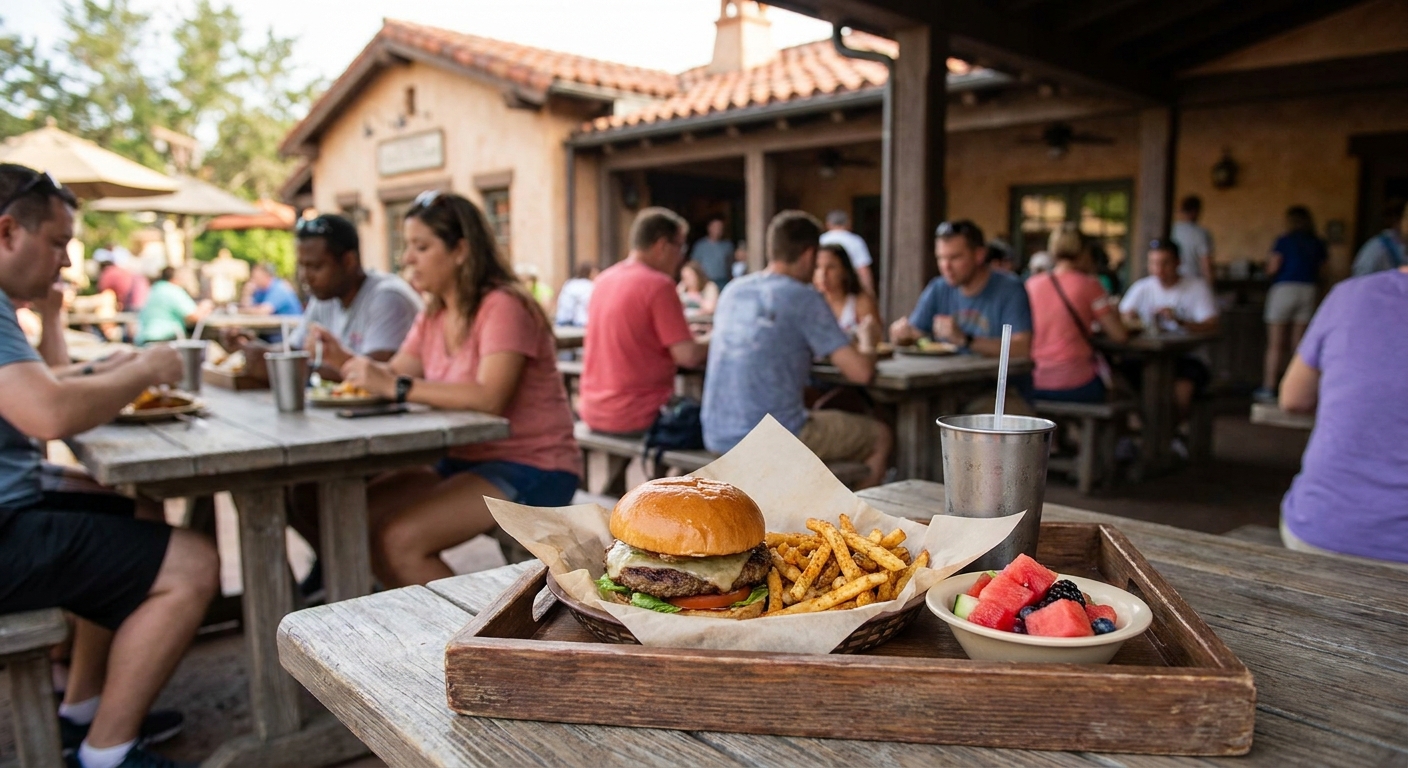
Magic Kingdom: The Snacks Worth Walking For
The real Magic Kingdom snack play isn’t a snack at all — it’s using Gaston’s Tavern cinnamon roll as a $10-ish shareable lunch for three people and skipping a full quick-service meal entirely. That one swap saves you 45 minutes of line and the better part of a counter-service bill. Everything else below is ranked by whether it’s actually worth the walk.
Adventureland: Aloha Isle
- What it is: The Dole Whip — soft-serve pineapple, served as a cup, a cone, or floated in pineapple juice.
- Portion: The float is the better value and genuinely shareable for two light eaters. The plain cup goes fast.
- Best for: Hot afternoons, dairy-sensitive guests (it’s non-dairy), and anyone who needs a sit-down-free cooldown.
- Shortest line: Before 10:30 a.m. or after the evening fireworks start. The 1–4 p.m. window is the worst line in Adventureland, regularly 20+ minutes when the rest of the park is quiet.
- Verdict: Worth It — but only off-peak. Waiting 25 minutes for soft-serve is how you lose a park day.
Fantasyland: Gaston’s Tavern and the Cinnamon-Sugar Crowd
- Gaston’s warm cinnamon roll: Absurdly large, served warm, easily split three ways. This is the single best calorie-per-dollar item in the park and the one veterans actually plan around.
- LeFou’s Brew: Frozen apple-and-mango slush with a passion-fruit foam top. Sweet, non-alcoholic, about the size of a large soda. Fun once; most adults don’t finish it.
- Shortest line: Gaston’s is quietest right at park open and again after 7 p.m. Midday it backs out the door.
- Verdict: Cinnamon roll = Worth It. LeFou’s Brew = Photo-Only unless you have a kid who loves apple slush. Order it in the souvenir stein only if you’ll genuinely reuse it.
Liberty Square: Sleepy Hollow
- What it is: Waffle-based items — typically a fresh-fruit-and-Nutella sweet waffle and a savory chicken-and-waffle option, plus funnel cake. Menu rotates.
- Portion: Sweet waffle is a real shared dessert; the savory version is a light meal for one adult.
- Best for: Breakfast-skippers and anyone wanting one warm, made-to-order thing instead of three cold ones.
- Shortest line: Opening hour. It becomes a 20-minute bottleneck during parade and fireworks staging because of where it sits on the castle sightline.
- Verdict: Worth It at breakfast. Fine at 3 p.m.
Frontierland: Westward Ho
- Corn dog nuggets, hand pies, and other walk-up window items. Nuggets are a solid shared kid snack — fried, portable, no utensils required.
- Shortest line: Almost always short. This is the quietest snack window in the park and the smart bail-out when Pecos Bill is slammed.
- Verdict: Fine — not a destination, but excellent when you’re already there and hungry.
Tiana’s Bayou Adventure Area
- Beignet-style treats turn up in and around the Frontierland/Tiana’s area, in rotating flavors. Usually sold in small multi-packs — shareable, powdered-sugar-everywhere, better warm.
- Verdict: Worth It if the current flavor sounds good to you; Fine if it’s a flavor you’d never order off a normal menu. Flavors rotate often — check day-of.
Main Street: The Confectionery
- Hand-dipped apples, cake pops, giant crisped-rice treats, seasonal shaped items.
- Best for: Souvenir-grade gifting and photos. Portions are big, flavor is ordinary.
- Verdict: Photo-Only for most. The exception: grab something here on your way out so a tired kid has a win, not on the way in when you’ll carry it for nine hours.
The Quick Ranking
| Snack | Where | Shareable? | Best time | Call |
|---|---|---|---|---|
| Gaston’s cinnamon roll | Fantasyland | Yes, 2–3 people | Park open / after 7 p.m. | Worth It |
| Dole Whip float | Aloha Isle | Yes, 2 people | Before 10:30 a.m. | Worth It |
| Sleepy Hollow waffle | Liberty Square | Yes | Opening hour | Worth It |
| Beignet-style treats | Tiana’s area | Yes | Anytime | Worth It / Fine |
| Corn dog nuggets | Westward Ho | Kid-share | Anytime | Fine |
| LeFou’s Brew | Fantasyland | Barely | Off-peak | Photo-Only |
| Confectionery apples | Main Street | Yes | On your way out | Photo-Only |
Pro tip: Mobile order from Gaston’s or Sleepy Hollow while you’re still in the ride queue, then pick up on your way past. The pickup window moves separately from the order line, so a 15-minute wait becomes a walk-up — and the snack is ready right when you step off the attraction.
Snack-Run Checklist
- [ ] Mobile order Gaston’s before 10 a.m. for a shared lunch replacement
- [ ] Dole Whip float before 10:30 a.m. or post-fireworks, never 1–4 p.m.
- [ ] Sleepy Hollow waffle instead of a sit-down breakfast
- [ ] Confirm today’s rotating flavors in the app before you walk anywhere
- [ ] Save Main Street sweets for the exit
The one thing to remember: menu items at these windows rotate constantly, and a closed window ruins a plan built around one treat. SupaPark’s crowd heat map shows you which corner of Magic Kingdom is clogging up before you commit to a 10-minute walk for a cinnamon roll — and on paid tiers, a wait-drop alert can pull you to a walk-on ride while you’re still holding it. Check current offerings at supapark.com before you plan your route.
EPCOT: World Showcase as a Snack Crawl
Skip the sit-down lunch entirely and eat your way around the lagoon instead — World Showcase is the best snacking venue at Walt Disney World, and it’s not close. Eleven pavilions, each with a bakery or counter window, means you can assemble a better meal from four small plates than most table-service restaurants will hand you — for less money and with zero reservation stress.
The trap is wandering. Most people drift, double back, and end up eating whatever’s in front of them when the hunger hits. Do it with a route instead.
The one-loop route (no backtracking)
Enter World Showcase and go clockwise — Mexico first, Canada last. That order puts your pastry stop early (when the France lines are shortest), your heavy savory stops mid-loop, and your shareable sit-and-rest stop at the end near the exit.
- [ ] Mexico — churro from the outdoor stand; margarita-and-chips pairing inside the Cantina if you want a cold drink in the dark
- [ ] Norway — Kringla Bakeri og Kafe for school bread (the coconut-and-custard one) and a soft pretzel
- [ ] China — light stop; skip unless something seasonal is running
- [ ] Germany — bakery case and the caramel/confection shop; buy caramel to take home, not to eat warm in the sun
- [ ] Italy — gelato or a pastry; good espresso stop if the loop is dragging
- [ ] American Adventure — funnel cake and the Fife & Drum stand; your kid-pleaser safety net
- [ ] Japan — kakigori (shaved ice) in the heat, small plates at Katsura Grill, and the snack aisles in the Mitsukoshi shop for packaged candy and drinks
- [ ] Morocco — pastry sampler territory; the quietest pavilion, which makes it the best place to actually sit
- [ ] France — Les Halles Boulangerie for pastries, L’Artisan des Glaces for ice cream and macarons, and a crepe (savory galettes are the sleeper order)
- [ ] UK — walk-up fish and chips window; one good pint, not three
- [ ] Canada — cheddar cheese soup with the bread service, split across the group
France: the pavilion that rewards strategy
France is the densest snacking stop on the loop and the one most people fumble. Three things change the experience:
Order pastries to-go in the morning. Les Halles is calmest early; by mid-afternoon the line snakes and the case is picked over. Buy your pastries when you arrive, carry them in the box, and eat them two pavilions later. They hold fine.
Use the quieter counter. Les Halles has more than one ordering point, and guests pile onto the main bakery line by default. Scan for the side register handling drinks and lighter items — it often moves faster for the same case.
Share one large pastry instead of buying four small ones. The big-format items are genuinely shareable and almost always cheaper per person than four individual pastries. Four people, one large item plus an espresso each, and you’ve spent less than two combo meals.
| Your situation | The move in France | Why |
|---|---|---|
| Family of four, mid-afternoon | One large pastry + ice cream from L’Artisan | Shares cleanly, no line math, around $10–15 total for the pastry |
| Want something savory | A galette (savory crepe) | Reads as a real meal, not a dessert detour |
| Just need caffeine and 10 minutes | Side counter at Les Halles | Shortest wait for the same case |
| Want the sit-down French experience | Book it, don’t walk up | Walk-up availability is thin; the window gets you 80% of the food |
Pro tip: Buy discounted Disney gift cards before your trip — warehouse clubs periodically run deals like a $200 card for roughly $180 (often member-only, limited quantities, sometimes delivered digitally). Load those and every snack on this crawl runs about 10% off without you ordering a single thing differently. It’s the one food-budget hack that doesn’t involve eating less.
What’s worth it, what to skip
- Worth it: Norway’s school bread, Japan’s kakigori on a hot day, Canada’s cheddar soup as a group share, a France galette, the UK walk-up fish and chips split between two light eaters.
- Skip: The table-service upcharge in the UK if you only want the British-food box checked — the window food isn’t dramatically worse. Also skip the second and third pint per adult; drinks are the quiet budget killer around the lagoon, and two or three pours each can double a bill.
- Order-of-operations tip: Do savory before sweet, and don’t stack two dessert stops back to back. Alternating keeps the crawl going three pavilions longer.
The one thing to remember: a World Showcase snack crawl works when you commit to the loop direction and front-load France. Everything else is improvisation you can afford. If you’d rather not track which counters are slammed and which festival booths are drawing crowds, SupaPark’s crowd heat maps and dining tools flag the busy zones in real time — and if you do want a World Showcase table on a crowded day, SupaPark’s Drop Watch pings you the moment a cancellation frees one up so you can grab it in My Disney Experience. Free on the web at supapark.com, plus iPhone and Android.
Hollywood Studios: Best Bites Between the Big Rides
Hollywood Studios is the one park where your snack plan has to bend around your ride plan — not the other way around. This park front-loads everything: Rise of the Resistance, Slinky Dog Dash, Tower of Terror, Rock ‘n’ Roller Coaster Starring The Muppets. You are not strolling. You are moving between windows. So the right question isn’t “what’s the best snack here” — it’s “what can I get in hand fast, eat standing, and not regret while my Lightning Lane return window is ticking.”
Know what’s actually a snack and what’s a meal in disguise
The single most common mistake here: ordering a Ronto wrap as a “snack” at 11 a.m. and then having no appetite — or budget — for the rest of the day.
| Item | Where | Snack or meal? | Mobile order? |
|---|---|---|---|
| Ronto wrap | Ronto Roasters, Galaxy’s Edge | Meal. Filling, savory, handheld | Yes |
| Blue/green milk | Milk Stand, Galaxy’s Edge | True snack — frozen, sweet, shareable | Yes |
| Docking Bay 7 shareables | Galaxy’s Edge | Meal-sized; split between two | Yes |
| Woody’s Lunch Box items | Toy Story Land | Meal (sandwiches) or snack (the sweet items) | Yes |
| Carrot cake cookie | Trolley Car Café | Snack, but a big one — split it | Yes |
| Hollywood Scoops ice cream | Sunset Boulevard | True snack | Window only |
| Popcorn / pretzel carts | Near Rise, Slinky Dog | True snack, fastest in park | Window only |
The handheld sandwiches at Woody’s Lunch Box are lunch, full stop. The sweet side of that menu is where the actual snacking lives — that’s the order if you’ve already eaten.
Mobile order is the whole game at this park
Galaxy’s Edge and Toy Story Land both run on mobile order, and both get genuinely clogged between roughly 11:30 a.m. and 2 p.m. Blue milk at the Milk Stand can show a 30+ minute pickup window at peak even though the actual handoff takes seconds.
- [ ] Place your Galaxy’s Edge order while you’re still in the Rise queue — the window will be ready when you walk out
- [ ] Order Woody’s Lunch Box before you board Slinky Dog Dash, not after
- [ ] Pick an off-peak pickup window (before 11 a.m. or after 2:30 p.m.) if the app offers one
- [ ] Only tap “I’m Here” when you’re genuinely 2 minutes out
Pro tip: The popcorn and pretzel carts near Rise of the Resistance and Slinky Dog Dash are the fastest food in the park precisely because they’re not on mobile order — everyone defaults to the app, so the physical lines stay short. When you have 15 minutes to kill before a return window, that’s your move, not the counter-service place with a 40-minute pickup.
Where to actually eat it (shade is the scarce resource)
Hollywood Studios is concrete, pavement, and very little tree cover. Seating strategy matters more here than at any other park.
- Trolley Car Café — the carrot cake cookie’s home turf, and the indoor air conditioning right at the park entrance. Best early-morning or late-afternoon reset.
- Docking Bay 7 / Galaxy’s Edge — the covered marketplace areas and the shaded alcoves around Black Spire give you real shade and lean-on space, even when tables are gone.
- Toy Story Land — the honest truth: shade is limited and the ground radiates heat. Grab-and-go, don’t picnic.
- Sunset Boulevard — Hollywood Scoops has limited seating nearby and almost no shade at midday. Eat it walking toward Tower of Terror, or sit at the shaded spots further up the street.
The honest value calls
- Worth it: Blue or green milk, shared. It’s a genuinely distinct flavor you can’t get elsewhere, and splitting one between two people makes the price land fine. Order one, pass it around, move on.
- Worth it: Carrot cake cookie at Trolley Car Café. Big enough for two, and it travels well in a bag for later.
- Split it: Docking Bay 7 shareables and the Ronto wrap. Two light eaters can make either work as a combined lunch.
- Skip the upsell: Don’t buy a full counter-service meal at 11 a.m. just because you’re near a window. You’ll lose 30 minutes you could have spent on a short wait.
- Drinks quietly double your spend. Specialty drinks and souvenir cups add up faster than food here. One good one beats three mediocre ones.
Time your snacks to the wait times, not the clock
The move at Hollywood Studios is to snack during the park’s high-wait window — roughly late morning through mid-afternoon — and ride during the lulls. SupaPark’s best-time forecaster shows you when each ride tends to bottom out, so you can eat at 12:30 while everyone else is standing in a 75-minute line, then walk on at 4:00 when the wait craters. Paid tiers push you an alert the moment a ride drops toward walk-on, which is exactly when you want to be holding a pretzel and nothing else. Free on the web at supapark.com, plus iPhone and Android.
The one thing to remember: at this park, a snack’s real cost is the time it takes to get it. Order from a cart or pre-order from a queue, split the big items, and keep your hands free for the rides.
Animal Kingdom: The Most Underrated Snack Park
If you only snack sweet, you’re eating Animal Kingdom wrong — this is the savory park, and it’s the only one where “snack” can mean duck wings, lumpia, or a lamb skewer. Every other park funnels you toward churros and cupcakes. Animal Kingdom’s quick-service kitchens are genuinely ambitious, portions skew generous, and a lot of the best stuff lives on small-plate and bar menus most guests walk right past.
Pandora: the two-stop combo nobody splits correctly
Satu’li Canteen is the park’s best snack-sized value play precisely because it isn’t snack-sized. The build-your-own bowls (protein + base + sauce) are big enough that two adults sharing one bowl plus one other item eat comfortably for less than two full orders. The boba-topped desserts in the little cheesecake pods are the dessert to get here — portable, cold, and not another frosting delivery device.
Then walk 30 seconds to Pongu Pongu, which is where Pandora actually earns the hype:
- Pineapple lumpia — crisp, hand-held, warm, and the rare fried item that doesn’t sit in your stomach for three hours. Share it.
- The frozen specialty drinks — the signature slushy with the boba “pearl” is bright, extremely sweet, and genuinely cooling. One per two people unless you love sugar.
- Why both stops: Pongu Pongu’s line moves far faster than Satu’li’s at peak. Order the bowl at Satu’li via mobile order, grab lumpia while it cooks.
The Yak & Yeti bar menu is the best-kept secret in the park
Here’s the move almost nobody makes: Yak & Yeti is a table-service restaurant, but the bar inside serves a short bar-only list to walk-ups with no reservation — availability permitting. Thai chili duck wings and a spicy garlic edamame have shown up on it. Items rotate and can be sold out or simply unavailable on a given day, so treat it as a happy bonus, not a plan.
- Walk in, tell the host you want the bar, and ask for the bar list specifically — it’s not the main menu.
- The wings run genuinely spicy. Order a drink with them; that’s not a sales pitch, it’s self-defense.
- This is the cheapest way to “eat at Yak & Yeti” without a reservation or a full entrée commitment.
Right next door, Yak & Yeti Local Food Cafes (the counter-service window) is the fallback: honey chicken, egg rolls, and fried rice-style plates in portions big enough to split, with seating in the shade of the Asia walkways.
Africa: skewers, samosas, and the shade you actually want
Harambe Market is the most underrated food court on property — grilled skewers, flatbreads, and spiced fries, with covered communal tables that stay usable in August. The Africa side also hits for samosas and similar hand-held savory bites.
Dawa Bar is the drink stop: open-air, live music nearby, and the place to park for 20 minutes when Kilimanjaro Safaris has chewed through your family’s patience. Nomad Lounge (at Tiffins) is the grown-up version — small plates and cocktails on a covered patio with fans, walk-up seating when available, and no commitment to a full signature meal. It’s sit-down-adjacent snacking at its best.
Pro tip: Nomad Lounge and the Yak & Yeti bar both exist specifically so you can get signature-kitchen food without the signature-kitchen reservation. Use them as your mid-afternoon reset instead of a table-service booking — you’ll save a time block and still eat better than the churro cart crowd.
Hot-day snack strategy
Animal Kingdom runs hotter than any other park — lots of asphalt, limited indoor space, long shade-free stretches between lands. Fried food at 2 PM is a mistake you’ll feel on the Everest queue.
| Time of day | Order this | Skip this |
|---|---|---|
| Morning (open–11) | Lumpia, samosas, skewers | Nothing — eat the heavy stuff now |
| Midday heat (11–4) | Frozen drinks, fruit-forward items, boba desserts | Fried baskets, heavy sauced plates |
| Late afternoon | Nomad Lounge or Yak & Yeti bar small plates, in the shade | Standing in open sun for a hot order |
Shade ranking for eating: Harambe Market covered tables → Nomad Lounge patio → Asia walkway seating near Yak & Yeti → Pandora’s bioluminescent nooks after dark.
- [ ] Mobile order Satu’li before you reach Pandora
- [ ] Split one bowl, add lumpia from Pongu Pongu
- [ ] Ask at the Yak & Yeti host stand for bar seating + the bar list
- [ ] Bank a Nomad Lounge or Dawa Bar break into the 1–4 PM window
- [ ] Refill water bottles at every station you pass
The one thing to remember: in Animal Kingdom, the best snacks are savory and the best seats are shaded — plan your food around the heat curve, not your hunger. SupaPark’s crowd forecasts and day builder slot those shade breaks into the hours your park is most miserable, so the reset happens on purpose instead of by collapse. Free at supapark.com.
Savory vs. Sweet: Which Snacks Actually Work as a Meal
The real dividing line at Disney World isn’t price — it’s protein. A snack with 15+ grams of it buys you three hours of touring. A snack that’s mostly sugar and butter buys you about 45 minutes and then quietly charges you interest.
Once you sort snacks that way, the family food budget stops being a mystery. Two shared savory snacks plus a drink routinely lands under what one quick-service family order costs, and everyone walks away actually full.
The Two Categories
| Snack type | Rough portion | Protein | Approx. price | What it really is |
|---|---|---|---|---|
| Walk-up fish & chips, UK Pavilion (EPCOT) | Hefty — a combo splits between two light eaters | High | Mid-teens | Meal replacement |
| Savory crepe/galette, France Pavilion (EPCOT) | Large, hot, filling | Moderate–high | Low-to-mid teens | Meal replacement |
| Spring rolls / Asia-side savory bites (Animal Kingdom) | Shareable, warm | Low–moderate | Under $10 | Tide-you-over |
| Loaded fries or nachos (Magic Kingdom, Hollywood Studios) | Big volume, low substance | Low | Low teens | Tide-you-over (filling, not fueling) |
| Turkey leg (Magic Kingdom) | Enormous | Very high | Low-to-mid teens | Meal replacement — for 2+ people |
| Dole Whip, churros, cupcakes, specialty popcorn | Small-to-medium | Near zero | $6–$10 | 45 minutes, max |
| Pretzel with cheese | Medium | Low | Under $12 | Tide-you-over |
The pattern: anything fried-and-protein-forward or meat-based is a legitimate lunch for two. Anything sugar-forward is a mood, not a meal. Both have a place — just don’t confuse them.
The Math That Changes Your Day
A family quick-service order with four entrées, fries, and drinks clears $45 fast and often tops it. Compare that to the two-savory-snacks play:
- UK Pavilion walk-up fish & chips + a savory crepe from France, split four ways, plus one shared drink each — materially cheaper, hotter, and you eat it outdoors in 10 minutes instead of queuing in a packed pavilion at 12:30.
- At Magic Kingdom: one turkey leg split two ways plus a pretzel covers two adults and a small kid for well under a full quick-service tab.
- At Hollywood Studios: a shared savory order plus drinks beats four separate entrées — the portions there are generous enough that nobody actually needs their own.
- At Animal Kingdom: pair a warm savory bite with a real protein item rather than stacking two snack-sized nibbles, or you’ll be hungry again at the Kilimanjaro Safaris queue.
Where the budget actually leaks is drinks. Two or three pints per adult in World Showcase quietly doubles a bill — one good pour beats three mediocre ones if you’re pacing around the lagoon.
Pro tip: Buy discounted Disney gift cards before you leave home. Warehouse clubs periodically run deals in the neighborhood of a $200 card for around $180 — often member-only, limited quantities, sometimes delivered digitally. Load those and every snack, meal, and drink in the parks runs roughly 10% off without changing a single thing you order. It’s the rare food savings that doesn’t mean eating less.
The 11 AM Sugar Trap
Here’s the mistake that costs families the most money, and nobody sees it coming.
You get into the park at rope drop, skip breakfast, ride hard until mid-morning, then grab the fun stuff — a Dole Whip, a churro, a cupcake — around 11 AM because it’s the thing you came for. Ninety minutes later the whole group is hangry, tired, and standing in the sun. Now you’re negotiating with a six-year-old in a line, and the “solution” becomes whatever table service you can get a last-minute table at. That’s a $100+ decision caused by a $9 snack.
The fix is sequencing, not restraint:
- [ ] Eat something with protein before 11:00 AM — even a breakfast sandwich in the resort room
- [ ] Make your first park purchase savory; bank the sweet one for 2:00–4:00 PM
- [ ] Share one savory item mid-morning rather than four sugar items
- [ ] Carry refillable water bottles — free ice water is available at most quick-service counters
- [ ] Treat the sweet snack as the afternoon reward it actually is
If you do want the sit-down break, go in with eyes open. The UK Pavilion’s table service is worth it for air conditioning, the full bar, and a genuine mid-day reset — not because the food is dramatically better than the window’s. Pay for the break, not the upgrade. Same logic applies at resort signature spots: lounges often let you sample the kitchen without the multi-course commitment, and kids are generally welcome.
One more piece of fine print worth knowing: at Disney table service, kids’ pricing applies to ages 3–9 only. A 10-year-old pays — and eats — adult. That alone can push a family of five past the point where snacking smart stops being a preference and starts being a strategy.
The one thing to remember: savory before noon, sweet after. Get that order right and you’ll spend less, wait less, and skip the 2 PM meltdown entirely. SupaPark’s dining tools can flag when the table-service spot you actually want frees up — but the better move is not needing one.
Park-by-Park Snack Showdown: The Comparison Table
If you only snack seriously in one park, make it EPCOT — but Animal Kingdom quietly has the best savory game per dollar, and Magic Kingdom is the most overrated snack park on property.
Here’s the whole thing on one screen. “Wait at peak” means what you’ll typically face between about 11 a.m. and 2 p.m., or right after a parade or show lets out.
| Magic Kingdom | EPCOT | Hollywood Studios | Animal Kingdom | |
|---|---|---|---|---|
| Best overall | Dole Whip (Adventureland) | A warm savory crepe/galette in the France Pavilion | A specialty cupcake or warm bakery item on Sunset Blvd. | Bakery-case pastry + coffee at Creature Comforts |
| Best shareable | A full Dole Whip float, two straws | Fish & chips from the UK walk-up window — the portion genuinely splits | An oversized cupcake, cut in half | Yak & Yeti Local Food Cafes order, split three ways |
| Best savory | A warm pretzel-style snack | UK fish & chips or a France savory crepe | Quick-service flatbread/handheld near Grand Ave | Asia-side quick service — the best savory-per-dollar on property |
| Best frozen / hot weather | Dole Whip, no debate | Gelato or sorbet in Italy; artisan ice cream in France | Frozen lemonade or a soft-serve stand | Dole Whip-style frozen treat near Discovery Island |
| Best for toddlers | Mickey-shaped ice cream bar | Gelato scoop in a cup (no cone chaos) | Mickey pretzel — survives a stroller | Fruit + yogurt from Harambe Market area |
| Best allergy-friendly | Dole Whip (dairy-free by nature) | Gelato shops label clearly; ask for the allergy binder | Ask at any bakery register for the allergy menu | Dairy-free frozen treats; strong allergy-friendly quick service |
| Price band | ~$7–9 typical snack | ~$8–14 (festival booths push higher) | ~$7–10 | ~$7–10 |
| Wait at peak | 20–35 min at Dole Whip | 10–20 min; 25+ during festivals | 15–25 min on Sunset Blvd | 5–15 min — the shortest lines on property |
| SKIP | Mickey-shaped anything bought mid-day | $80-range afternoon tea service nearby | Anything from the first stand you pass | Overpriced sit-down apps when the counter does it better |
The skip column, explained
- Magic Kingdom: the shape is the product. You’re paying a premium and standing 25 minutes for a snack that’s genuinely better at 9 a.m. when the stand is empty.
- EPCOT-adjacent: a roughly $80 tea service is atmosphere, not food. It’s grand and it’s lovely — but if you want a meal, it’s not one, and there’s a comparable service nearby in the $95 range that’s also not a meal.
- Hollywood Studios: the stands nearest the entry corridor exist to catch impatient people. Walk two more minutes toward Sunset Blvd.
- Animal Kingdom: the table-service appetizers overlap heavily with what the counters do for a fraction of the cost. Order at the bar instead — Yak & Yeti’s bar has off-menu items (spicy duck wings among them) you won’t see on the printed menu.
Ranking the four parks for snacking
- EPCOT — not close. World Showcase is eleven distinct snack cultures in walking distance, and festival season multiplies it. The trade-off: it’s the most expensive and the easiest place to spend $60 on “a few bites.”
- Animal Kingdom — the value champion. Best savory per dollar, shortest lines, best shade. Loses only on variety, and DinoLand’s closure (now being rebuilt as Tropical Americas) removed one snack cluster from the map.
- Hollywood Studios — strong individual items, weak density. You’ll walk past a lot of nothing between good things.
- Magic Kingdom — iconic, not excellent. The most-photographed snacks in Florida and the longest waits for them.
How to actually run the table
- [ ] Pick one “destination snack” per park — not five
- [ ] Buy frozen items before 10:30 a.m. or after 7 p.m.
- [ ] Split one shareable instead of buying two singles
- [ ] Load discounted gift cards before the trip (warehouse clubs periodically run deals — roughly 10% off everything you eat)
- [ ] Ask for the allergy menu at the register, not at the pickup window
Pro tip: Snack lines move inversely to ride lines. When waits spike mid-afternoon, that’s exactly when the Dole Whip window clears out — people are in queues, not at counters. SupaPark’s wait data shows you those park-wide crowd shifts in real time, so you can read the lull and spend it on food instead of a 50-minute standby. Free at supapark.com.
Snack Costs, Credits, and the Real Daily Budget
The honest number: snacks at Walt Disney World run roughly $7–$12 a pop for the good stuff, which means a family of four grazing casually lands somewhere around $60–$100 a day — and almost none of that was in your original budget. Here’s how to plan it on purpose instead of discovering it on your credit card statement.
Three realistic daily snack budgets
These are planning ranges, not quotes. Prices shift by date, season, and festival (EPCOT festival booths in particular run higher per item than everyday carts).
| Style | Solo adult | Couple | Family of four |
|---|---|---|---|
| Minimalist — one real treat a day, water from counters | ~$10 | ~$20 | ~$35–$45 |
| Moderate — two snacks plus one specialty drink | ~$25–$30 | ~$50–$60 | ~$90–$110 |
| Snack crawl as dinner — 4–6 shared items instead of a meal | ~$40–$50 | ~$70–$85 | ~$120–$150 |
The snack-crawl line looks expensive until you compare it to a table-service dinner for four with drinks and tip. Done well — a couple of savory items, one shared dessert, one drink per adult — a crawl often comes in meaningfully cheaper than a sit-down and takes half the time. Done badly (everyone orders their own everything), it costs the same and you’re still hungry.
Snack credits: the value math nobody does
A snack credit on a dining plan is worth exactly the same no matter where you spend it. That’s the whole game. Redeem it on a banana or a bottle of water and you’ve converted a credit worth several dollars into about two. Redeem it on the priciest eligible item you’d actually enjoy — a loaded specialty dessert, a large festival-style item, a gourmet popcorn or premium bakery piece — and the same credit works three or four times as hard.
How to play it:
- [ ] Scan menus for the snack-credit eligibility marking before ordering, not after
- [ ] Bank credits for high-price-band items; pay cash for cheap fillers
- [ ] Never burn a credit on bottled water or plain fruit
- [ ] Spend remaining credits before your last park morning — they don’t carry over
Pro tip: Kids’ credits (ages 3–9) follow the identical rule — equal value everywhere — so route them to the highest-priced kid-friendly menu you can find, not to the nearest nugget stand. And skip fixed tasting-menu restaurants on family nights entirely: if a place has no children’s menu, a kids’ credit covers nothing, and you’ll pay full price while managing a restless nine-year-old through a long, quiet meal.
Stacking discounts: the boring move that actually works
Budget by who’s eating, not by resort prestige. Then layer the flat discounts:
| Lever | How it works | Realistic effect |
|---|---|---|
| Discounted gift cards | Warehouse clubs periodically sell Disney cards below face value — a $200 card for around $180 is a typical deal (member-only, limited quantities, sometimes delivered digitally) | ~10% off everything you buy, no behavior change |
| Annual Passholder discount | Applies at many merchandise and dining locations; terms vary by location | Varies — ask before ordering |
| Disney Visa cardholder discount | Similar footprint, select locations | Varies |
| Resort lounges | Access signature kitchens à la carte instead of committing to a multi-course prix fixe | Often a fraction of the full dinner |
Two notes that save arguments at the register: discounts don’t apply everywhere, and you generally can’t stack a passholder discount on top of a snack credit — the credit already paid. Buy the gift cards ahead, because that one stacks with everything.
The single highest-ROI money move
Bring refillable water bottles and fill them with free ice water at any quick-service counter. That’s it. Ask at the register or a drink window for a cup of ice water — it’s complimentary — and refill rather than buying bottled water at roughly $5 a go. For a family of four drinking three bottles each on a hot day, you’ve just erased $50–$60 from a single park day without skipping a single snack.
The small purchases are where park budgets quietly leak. Bottled drinks, impulse sodas, a $6 coffee you didn’t want — none of it is memorable, and all of it comes out of the same pot as the thing you’ll still be talking about in six months. Spend the money on the item worth photographing; drink the free water.
The one thing to remember
Set a per-person daily snack number before you walk in, route every dining-plan credit to the most expensive eligible item you’d genuinely order, and pre-buy discounted gift cards. Do those three things and your snack budget stops being a surprise — it becomes the part of the trip you planned on purpose.
Mobile Order, Lines, and the Timing That Saves an Hour
The hour you lose at Disney World isn’t in ride queues — it’s in the 20-minute snack lines you joined at the exact moment everyone else did. Mobile Order in My Disney Experience fixes most of that, but only if you treat it like a reservation system instead of a checkout button.
How Mobile Order actually works at snack windows
You browse the menu in My Disney Experience, pay in the app, then tap “I’m Here, Prepare My Order” when you’re close. The kitchen starts cooking at that tap — not when you paid. That distinction is the whole game.
Two things people get wrong:
- Tapping “I’m Here” while standing at the window. You’ve just joined the same queue you were trying to skip. Tap it one stop earlier — as you leave the ride, or while you’re still watching a show.
- Assuming every stand takes it. Coverage skews heavily toward full quick-service restaurants and the bigger kiosks. Small carts — popcorn, churro, pretzel, ice cream wagons, most World Showcase outdoor windows — are typically walk-up only, cash-register style. Check the location in the app before you build your plan around it.
| Order type | Where it usually works | Best timing |
|---|---|---|
| Mobile Order | Quick-service restaurants, larger snack kiosks, festival-style booths at some locations | Place 15–30 min ahead; tap “I’m Here” one stop before arrival |
| Walk-up only | Popcorn/churro/pretzel/ice-cream carts, small outdoor windows | Hit during a parade or show, not after it |
| Walk-up window at a table-service spot | e.g. the UK Pavilion’s fish & chips window at EPCOT | Off-peak; order one combo for two light eaters |
The two rush windows that cost you an hour
Counter-service demand is extremely predictable, and it’s not a mystery why:
- 11:30 AM–1:30 PM. The lunch wall. Every quick-service location in every park spikes together. Mobile Order slots for popular spots can be gone or pushed an hour out.
- The 45 minutes before a nighttime show. Everyone stakes out a viewing spot and then realizes they’re hungry. Lines balloon, then empty the second the first firework goes up.
The counter-move: eat your real meal at 11:00 AM or 2:00 PM, and make your snack stops at the moments crowds are looking at something else — mid-parade, during a show, or the first 20 minutes after a nighttime spectacular lets out.
Which stands are just slow, always
Some locations are structurally slow and no app fixes them: single-window operations in high-traffic choke points, anything with a made-to-order item (hand-dipped, griddled, assembled to order), and famous “one iconic item” stands where the line is partly the attraction. If you see one register and a 10-deep line, that’s a 15-minute stop minimum — decide if the snack is worth it before you commit.
Pro tip: Buy discounted Disney gift cards before your trip and load them as your in-app payment method. Warehouse clubs periodically run deals in the neighborhood of a $200 card for around $180 (often member-only, limited quantities, sometimes delivered digitally). That’s roughly 10% off every snack, meal, and Mobile Order of the trip without changing a single thing you order — and it stacks with the timing strategy above.
The snack-stop sequence that works
- [ ] Night before: scan the crowd forecast for tomorrow’s park and note the predicted peak hours
- [ ] Morning: pick one sit-down-ish meal window at 11:00 AM or 2:00 PM — never 12:15
- [ ] In the app: confirm your target stands take Mobile Order (pin the walk-up-only ones to parade/show windows)
- [ ] Place the order while you’re still in the previous queue
- [ ] Tap “I’m Here” one stop before arrival, not at the window
- [ ] Skip any single-register stand with a 10-deep line unless the item is a genuine must
Where SupaPark does this for you
Before you commit to a snack stop, check the heat map — if the land you’re walking toward is already bunching, the counter inside it is bunching too, and a five-minute walk to the next land is usually faster than waiting. The crowd forecast tells you whether your park day’s lunch wall hits at 11:30 or stretches to 2:00, which changes your whole eating window.
Then let the park-day builder slot the snack stops between rides, so you’re eating while the park eats somewhere else. Live wait times make the trade visible in real time: when a nearby headliner craters to a walk-on, that’s a terrible moment for a snack line and a great moment to ride. SupaPark is free on the web at supapark.com and as an app on iPhone (App Store) and Android (Google Play), where push alerts can catch those wait drops while you’re mid-churro.
The one thing to remember: the snack itself takes two minutes to eat. Everything else is timing — order one stop early, never queue between 11:30 and 1:30, and let the crowds look at the fireworks while you look at the menu.
Snacks With a View: Pairing Treats With Shows, Fireworks, and Shade
The best snack of your day isn’t the one you eat standing up — it’s the one you eat sitting down, in shade or in a good sightline, 25 minutes before you’d otherwise be stuck in a line. Treat snacks as scheduled breaks, not impulse buys, and the same $8 churro buys you a rest, a seat, and a view.
The pre-show timing rule that saves your night
Counter-service lines near a nighttime show follow a brutal curve: they’re calm until roughly 60 minutes before showtime, then they balloon as everyone has the same idea at once. Then they die again mid-show.
So the sequence is:
- [ ] Check park hours and the show time before dinner, not after
- [ ] Order your snack and drinks 60–75 minutes before showtime (mobile order wherever it’s offered)
- [ ] Claim your spot 30–40 minutes out on a normal night, 45–60 on a holiday or weekend
- [ ] Eat while you wait — don’t save the snack for the show, or you’ll be fumbling with a cup when the castle lights
- [ ] Hit the restroom before you claim the spot, not after
Pro tip: If you’re not married to a front-and-center view, order during the show instead. Lines at nearby counters crater while the fireworks run, and you walk out with dessert while the crowd funnels toward the exit — the same trick that turns the post-show crush into a non-event.
Where to sit, park by park
| Park | Snack-plus-sightline spot | Why it works | Trade-off |
|---|---|---|---|
| Magic Kingdom | Tomorrowland Terrace area / the hub lawns | Real seating, castle sightlines, close to Tomorrowland counters | Lawn sections fill early; some have reserved dessert-party seating |
| Magic Kingdom | Liberty Square and Frontierland walkways toward the hub | Lower foot traffic than Main Street, benches nearby | Partial sightlines; projections on the castle won’t read |
| EPCOT | World Showcase Lagoon rail, Canada through the UK side | Snacks are 90 seconds away in any direction | Rail spots go 45+ min out on busy nights |
| EPCOT | Japan pavilion’s upper terrace area | Shade, seating, and a wide lagoon view | Limited seats — arrive early or treat it as a daytime stop |
| Hollywood Studios | Hollywood Boulevard toward the hat-less end of the street | Straight shot at the theater, exits fast | Crowded and loud; rough for sensory-sensitive kids |
| Hollywood Studios | Grand Avenue and Echo Lake benches | Quieter, still catches the high effects | No projections, so you lose half the show |
| Animal Kingdom | Discovery Island waterfront walkways near the Tree of Life | Benches, breeze, genuinely low traffic | No nighttime spectacular to pair it with — this is a sunset snack |
The afternoon air-conditioning reset
Between about 1:00 and 4:00 PM is when Florida heat, crowd levels and kid patience all peak at once. Spend that window indoors with a snack instead of in a queue.
- EPCOT: the Land pavilion’s lower level is the gold standard — big indoor space, cool air, seating, and food right there. The Mexico pavilion’s indoor marketplace is dark, cool, and quiet.
- Magic Kingdom: Pinocchio Village Haus has upstairs seating overlooking “it’s a small world”; Columbia Harbour House’s second floor is the classic hidden-table move.
- Hollywood Studios: a Villains show seat in the Sunset Showcase theater is 20-odd minutes of air conditioning for the price of standing still.
- Animal Kingdom: the Zootopia show inside the Tree of Life theater is the best shaded sit-down in the park, and Pizzafari’s indoor rooms are cool and underused.
Quiet-zone logic for sensory-sensitive kids
The rule is simple: pick your snack spot by what it sounds like, not what it looks like. Nighttime shows mean loud, sustained concussive booms with no warning and no easy exit once you’re boxed in.
- Sit at the edge of a viewing area with a clear path out, never in the middle of a packed walkway
- Choose perimeter spots — Frontierland or Liberty Square at Magic Kingdom, the back half of World Showcase at EPCOT — where sound is softer
- Bring ear protection and hand it over before the first shell, not after
- Have a stated bail plan: one adult, one kid, one exit, meet at a named landmark
- A snack in a quiet indoor space while the show runs is a completely legitimate choice — nobody has to watch fireworks
SupaPark’s heat maps and crowd forecasts show you where the park is actually packed right now, so you can pick the low-traffic bench instead of guessing — and the live wait times tell you whether that afternoon indoor show is a five-minute walk-on or a twenty-minute wait. Free at supapark.com.
The one thing to remember: order early, sit down, and let the snack do double duty as your break. The guests eating standing up in a 45-minute line at showtime are the ones who’ll be exhausted by 9:00 PM.
Resort and Disney Springs Snacks Worth a Detour
The honest rule: a resort snack is worth the trip only when the transit is already happening. Riding a bus round-trip from Magic Kingdom to grab a cookie costs you 60–90 minutes of park time, and no baked good on property is worth a Lightning Lane window. But stack that snack onto an arrival morning, a rest day, a late-flight afternoon, or a dinner reservation you already hold, and suddenly you’re eating the best stuff on property for the price of a monorail ride you were taking anyway.
The Monorail Loop: Your Highest-Value Snack Run
The Magic Kingdom resorts are the only “detour” that isn’t really a detour, because the monorail and the Grand Floridian walking path make it nearly free in time cost.
- Gasparilla Island Grill (Grand Floridian) is open extremely long hours and is the quiet MVP of arrival nights — grab-and-go pastries, flatbreads, and a case of desserts when every park quick-service is slammed or closed.
- Grand Floridian bakery case is where you go for a single, genuinely impressive pastry rather than a snack-sized nibble. Split one; portions are generous and the price reflects the lobby you’re sitting in.
- Polynesian Dole Whip variants beat the Magic Kingdom version on variety — rotating flavors, floats, and swirls you won’t find at the Adventureland window, with a fraction of the line. Captain Cook’s is the move when the park stand is 25 deep.
Pro tip: Build your resort snack run around a dining reservation you already have, not the snack itself. Arrive 45 minutes early, hit the bakery or Dole Whip window first, and you’ve turned a dessert detour into zero added transit. The same logic saves rest days — one resort, one snack, one pool, done.
Wilderness Lodge, BoardWalk, and Beach Club
| Stop | Order this | Best day for it | Watch out for |
|---|---|---|---|
| Roaring Fork (Wilderness Lodge) | Bakery case + a hot drink by the lobby fireplace | Rest day, cool morning, holiday season | Boat/bus from Magic Kingdom only — no monorail |
| BoardWalk bakery + walk-up stands | Pastries, oversized cookies, carnival-style stand snacks | Evening stroll from EPCOT or Hollywood Studios | Stands are weather- and crowd-dependent |
| Beach Club ice cream shop | Classic sundaes and scoops without the full sit-down commitment | After an EPCOT World Showcase evening | Lines build sharply right after EPCOT’s nighttime show |
Wilderness Lodge earns its detour hardest in the holiday stretch, when the lobby decorations and seasonal lodge treats make the snack secondary to the atmosphere. If you’re staying elsewhere, pair it with a Fort Wilderness or boat-based evening rather than a mid-park bus run — multi-leg transfers eat your day faster than anyone expects, and a Lodge trip from a non-Magic Kingdom park can easily run an hour each way.
The BoardWalk is the single easiest resort snack add-on at Walt Disney World, because you can walk there from EPCOT’s International Gateway or Hollywood Studios. Same with Beach Club — this is a “walk out of EPCOT, keep walking” snack, not a transit project.
Disney Springs: Great Snacks, Terrible Timing
Disney Springs has the heaviest hitters on property — the famous oversized cookie shops (expect a posted wait and sometimes a virtual queue), gourmet doughnut and popcorn counters, and Ghirardelli for a sundae that feeds two. All of it is good. None of it belongs in the middle of a park day.
Here’s why: Disney Springs has no monorail or Skyliner connection. From most parks you’re looking at a bus to a resort, then a transfer, or a rideshare. You will spend more time in transit than eating.
When Disney Springs snacking actually works:
- [ ] Arrival day — you’ve landed, you can’t check in yet, and you need a low-commitment few hours
- [ ] Departure day with a late flight — bags with Bell Services, one last cookie, then out
- [ ] Rest day — pair snacks with the free-to-browse shopping and no park ticket burned
- [ ] Evening after an early park close — you were leaving anyway; this is the dessert stop
- [ ] Rain day — a lot of it is covered, which is more than the parks can say
Skip it on any day you’re using Lightning Lane Multi Pass. You bought those selections in advance and you refill them one at a time through the day — being off-property mid-afternoon wastes the windows you paid for.
The Cost-Per-Minute Gut Check
Before any snack detour, do this math: round-trip transit time plus line time, divided by how badly you want the item. Thirty minutes for a Poly Dole Whip variant on a rest day? Easy yes. Ninety minutes round-trip from Animal Kingdom for a cookie at 2:00 PM? That’s a headliner you just gave up.
Pro tip: Expect a 10% time tax on every leg of Disney transportation versus what the app suggests — waiting for the bus is the part people never budget for. One resort snack stop per trip, attached to something you were already doing, is the veteran move. Three is how you end your vacation having spent more time on buses than on rides.
The one thing to remember: resort and Disney Springs snacks are schedule fillers, not schedule disruptors. Slot them into the dead hours — arrival, rest, departure — and they’re some of the best eating on property. Force them into a park day and you’re paying for them twice.
Seasonal Festivals and Limited-Time Snack Booths
The festival math is simple: small plates cost more per bite than almost anything else in the parks — so the winning move is to split everything and treat the booths as a tasting flight, not a meal.
Festival snacking runs on a different logic than the permanent stands. Booth food is portioned for sampling, priced like a snack but sized like a few forkfuls, and designed to make you order four or five things. That’s great if you plan for it and rough on your wallet if you don’t.
How EPCOT’s festival rotation actually works
EPCOT cycles through a series of festivals across the year — an arts-focused event, a flower-and-garden-style spring event, a food-and-wine-style fall event, and a holiday-season event. Each one rolls out temporary outdoor kitchens around World Showcase and sometimes into World Celebration and World Discovery, with menus of small plates, specialty drinks and desserts that exist only while the festival runs. Holiday-season treats aren’t EPCOT-only either: seasonal items show up across Magic Kingdom, Hollywood Studios and Animal Kingdom too, usually at existing quick-service locations rather than purpose-built booths.
What doesn’t change season to season is the strategy. What does change is which event — if any — overlaps your dates, how long it runs, and what’s on the menus. Confirm that on Disney’s own calendar before you build a day around it. Festival dates shift annually, and showing up expecting booths that closed two weekends ago is a genuinely deflating way to start a park day.
The value play: split, don’t stack
| Approach | What you spend | What you get | Verdict |
|---|---|---|---|
| Everyone orders their own plate | Highest per person | Full portions, fastest fullness, most waste | Skip unless the item is a known favorite |
| One plate per 2–3 people, shared | Roughly a third to half as much per person | Most variety, nobody gets full on item #2 | The move |
| Festival passport / sampler card | Fixed cost up front | Set number of items; breaks even only if you’d have bought that many anyway | Worth it for committed grazers, not casual snackers |
| Treat booths as lunch | Mid-to-high | A patchwork “meal” at snack-food prices | Works for adults, poorly for kids |
Small plates commonly land in the roughly $7–$10 range each, which sounds reasonable until a family of four has ordered eleven of them. Split three ways and the same crawl costs what one quick-service lunch would.
Pro tip: Buy discounted Disney gift cards before your trip — warehouse clubs periodically run deals like a $200 card for around $180 (member-only, often limited quantities, sometimes delivered digitally). Load those and every festival plate, drink and sampler effectively runs about 10% off without you ordering a single thing differently. It’s the one food “hack” that doesn’t mean eating less.
Timing: when booth lines are worst
Booth queues are the most predictable thing about festivals:
- Weekends are the worst, especially the fall food-and-wine-style event, when locals and annual passholders show up specifically to drink and graze.
- Late afternoon through evening is the second peak — the pre-fireworks window stacks festival crowds on top of regular park crowds.
- Mornings are weirdly quiet. Many booths open later than the park, but the first hour after they do is the shortest you’ll see all day.
- Weekday lunch hours are the sweet spot if your dates allow it.
If a festival overlaps your trip, build one dedicated EPCOT day around it rather than grazing a little every day — you’ll hit more booths with less walking and less repeat waiting.
A festival day that actually works
- [ ] Check Disney’s calendar for which event (if any) overlaps your dates, and note the booth hours
- [ ] Pick a weekday over a weekend if you have the flexibility
- [ ] Ride your must-dos first — festival booths don’t get better later, but ride waits do get worse
- [ ] Decide your top 5–6 items as a group before you start, so you’re not deciding in line
- [ ] Order one plate per two or three people and pass forks
- [ ] Do the passport/sampler math against your actual list, not the brochure’s
- [ ] Pace drinks — two specialty cocktails per adult quietly doubles the bill
- [ ] Keep one real meal in the plan; booths alone rarely satisfy kids
Where the data helps
Festival days are crowd-sensitive, which makes them worth planning rather than winging. SupaPark’s crowd forecasts and park heat maps help you pick the quieter festival day in your window, and the best-time-to-ride forecaster tells you when to peel off from World Showcase for Guardians of the Galaxy: Cosmic Rewind or Remy’s Ratatouille Adventure instead of fighting peak waits. Free on the web at supapark.com, and free on iPhone and Android too.
The one thing to remember: festivals are about variety, not volume. Share every plate, go on a weekday morning, and verify the event is actually running during your dates before it anchors your itinerary.
Allergy, Dietary, and Picky-Eater Snack Options
The move: stop hunting for “allergy-friendly” signage and start talking to a leader at the register — that one 30-second conversation gets you further than any app filter. Walt Disney World handles the common allergens (peanut, tree nut, egg, milk, wheat, soy, fish, shellfish) at virtually every counter-service and snack location, but the quality of your snack day depends entirely on whether you ask the right way in the right place.
How to flag an allergy so it actually sticks
At a physical register, say the allergy out loud and ask for the coordinator or a manager. Cast members are trained to pull the allergen binder and, at most quick-service spots, to grab a leader who can check a prepped item or cook something fresh on clean equipment. “Does this have dairy?” gets you a guess; “My daughter has a dairy allergy — can I speak to a coordinator?” gets you a documented answer.
On Mobile Order in My Disney Experience, tap the allergy filter before you build the order — it rewrites the menu to show only items that can be made without your selected allergens. Two things people get wrong:
- Mobile Order allergen filtering is excellent for packaged and fryer items, thinner on made-to-order substitutions. If the swap you need is unusual, order in person.
- Cross-contact questions are not answerable through the app. Severe allergies should always be a face-to-face conversation.
Pro tip: The best allergy intel in any park isn’t at the snack carts — it’s at the full quick-service kitchens. Satu’li Canteen in Pandora, Docking Bay 7 in Star Wars: Galaxy’s Edge, and the bakery counters in EPCOT’s World Showcase have deeper prep capacity and staff who field these requests constantly, so when a cart can’t help, walk to the nearest big kitchen instead of giving up on the land.
Where the reliable options cluster, park by park
| Park | Plant-based / dairy-free wins | Gluten-friendly go-to |
|---|---|---|
| Magic Kingdom | Dole Whip at Aloha Isle (classic flavors are dairy-free), fresh fruit at Liberty Square and Tomorrowland carts | Packaged gluten-friendly baked goods at Main Street Bakery; allergy-friendly menus at Pecos Bill |
| EPCOT | Sorbet and fruit ices in World Showcase; plant-based options at Sunshine Seasons | Grilled and rice-based items in the Asia and Mexico pavilions; naturally GF frozen treats |
| Hollywood Studios | Plant-based bowls and sides at Docking Bay 7; Dole Whip-style frozen treats near Sunset Boulevard | Allergy-friendly buns and packaged items at Woody’s Lunch Box and ABC Commissary |
| Animal Kingdom | Strongest plant-based lineup on property — Satu’li Canteen bowls, Pongu Pongu frozen drinks, Harambe Market sides | Rice bowls, grilled proteins, and fruit stands throughout Africa and Asia |
Animal Kingdom is genuinely the easiest park for plant-based and dairy-free snacking; Magic Kingdom is the hardest for savory plant-based (you’ll live on fruit, pretzels, and Dole Whip). Plan accordingly.
Frozen treats that are naturally dairy-free
- Classic Dole Whip (pineapple and most fruit flavors) — ask before assuming a swirl or specialty flavor qualifies, since some mix in dairy soft-serve.
- Fruit sorbets and Italian-style ices in World Showcase.
- Frozen fruit bars and sorbet pops from outdoor carts.
- Frozen lemonade and slushes — usually dairy-free, but confirm the specific recipe.
The picky-eater safety net
Your kid will eat something at Disney World. These are available within a five-minute walk almost anywhere:
- Popcorn — carts in every land, no allergens beyond corn and oil, and it’s one of the cheaper snacks on property.
- Pretzels — warm, plain, filling, and a hard no on the cheese sauce solves most dairy issues.
- Fresh fruit cups and whole fruit — produce stands near major quick-service locations.
- Plain rice, plain pasta, plain buns — most quick-service kitchens will plate these on request even when they’re not on the menu.
- Applesauce and packaged snacks — kids’ meal sides are often sold separately.
Bringing your own: allowed, encouraged, and smart
Disney lets you bring your own food and non-alcoholic drinks into the parks within standard bag rules (no glass containers except small baby-food jars, no loose ice — reusable ice packs are fine). Refill your bottle free at any water fountain or quick-service soda station instead of buying bottled water all day; that single habit saves real money across a week.
What actually survives Florida heat:
- [ ] Shelf-stable protein: nut-free bars, jerky, roasted chickpeas
- [ ] Crackers, pretzels, dry cereal in a hard-sided container (soft bags turn to crumbs by noon)
- [ ] Apples, oranges, grapes — skip bananas and anything that bruises
- [ ] Two frozen reusable ice packs, which double as a cooling towel at 2 PM
- [ ] Insulated bottle per person, filled before you leave the resort
- [ ] Electrolyte powder packets — cheaper and lighter than sports drinks
- [ ] Anything chocolate stays home; it will not survive the walk to the gate
The one thing to remember: pack the picky-eater defaults and the heat-proof basics, then treat in-park snacking as the fun part rather than the survival strategy — and always ask for a coordinator rather than reading a menu and hoping.
Snack Strategy for Families With Young Kids
The single biggest upgrade to a family park day isn’t a better snack — it’s a better snack clock. Feed the kids before they ask, not after they melt down. Two pre-emptive stops — one around 10:30 AM, one around 3:00 PM — head off roughly 80% of the “why is everyone crying in Fantasyland” problem, because those are the exact windows when breakfast has worn off and the afternoon heat is peaking.
Build the day around two scheduled snack stops
Reactive snacking is expensive and slow. You’re in a 20-minute line at the busiest counter-service window during the lunch rush, paying full price, with a kid who’s already past the point of being reasoned with.
- 10:30 AM stop: something with protein or substance (a warm pretzel, a bakery item, fruit). Kids ate at 7 AM; they’re running on fumes by 10:30 even if they haven’t said so.
- 3:00 PM stop: something cold and sweet. This is the heat-and-fatigue trough, and it’s also when you most need an excuse to sit down.
- Skip the 12:30 PM scramble. If you snack at 10:30, you can push a real meal to 1:30–2:00 PM when counter-service lines have thinned considerably.
One big shareable beats four small ones
This is the rule that quietly saves the most money all trip: at Disney World, the little purchases are where your budget leaks out the side door wearing a Mickey hat. Four individual snacks for a family of four runs well past $30 before anyone’s had a drink. One large shareable plus a cup of ice water lands closer to $10–12 and — this is the part parents underestimate — young kids genuinely do not finish a full portion.
| Move | Why it works | Watch out for |
|---|---|---|
| One large shareable, four spoons | Cheaper, less waste, built-in portion control | Pick something that divides cleanly — not a single-serve cone |
| Free cups of ice water at any counter-service window | Costs nothing; stops a $5 bottled soda habit cold | Taste varies by location; bring a flavor packet if your kids are picky |
| Split a big savory item (pretzel, flatbread, loaded fries) | Works as a mini-meal, not just sugar | Melty/saucy items don’t travel |
| Buy discounted Disney gift cards before the trip | Warehouse clubs periodically run deals like a $200 card for around $180 — everything you buy in the parks effectively runs ~10% off | Often member-only and limited quantity |
Portable vs. melts-in-ten-minutes
In Florida heat, your snack choice is a logistics decision.
- Portable (safe to buy and walk): pretzels, popcorn, bakery pastries, churros, spring rolls, cookies, anything in a sealed bag.
- Eat-it-where-you-stand (10-minute clock): soft-serve, Dole Whip, ice cream bars, anything chocolate-coated. Buy these only when you’ve already got a shaded bench or a seated show coming up.
Stroller-friendly snack routes
Nothing ruins a snack stop faster than realizing you have to park the stroller 200 feet away and carry everything back.
- Favor walk-up windows and carts in open-plaza areas over indoor food courts — the queues are short and you can keep the stroller in sight.
- Look for stands adjacent to designated stroller parking plus shaded seating; that combo is what makes the stop a genuine reset rather than a standing-up-sweating transaction.
- Use mobile order where it’s offered: one adult taps the order while the group keeps walking, then one person peels off for pickup. The stroller never has to move.
The snack stop as tactical cover
Here’s the pro-level use of a snack: it’s a cover story for something else you need to do anyway.
- [ ] Kid too short for the headliner? Start the snack as the Rider Switch hand-off — one adult rides while the other does ice cream duty, then swap. Nobody feels like they’re waiting.
- [ ] Overstimulated? Route the snack to a quiet zone — a shaded walkway, a low-traffic seating area, an air-conditioned indoor attraction with a long pre-show. Fifteen quiet minutes resets a kid better than any ride.
- [ ] Need a nap window? Snack, then walk straight to a long, dark, seated attraction. Sugar, air conditioning, and a dark theater is the oldest trick in the book.
Pro tip: Pair the 3:00 PM snack stop with your Lightning Lane refill. Once you’ve redeemed a Multi Pass selection, you can add the next one — doing that while sitting down with a cold drink beats doing it one-handed in a queue, and SupaPark can ping you the moment a better return window opens so you’re not refreshing your phone through your churro.
Hydration beats everything in summer
Dehydration looks exactly like a tantrum. In July and August, a kid who’s “being difficult” at 2 PM is usually just down a liter of water.
- Carry refillable bottles and top them off with free ice water at counter-service windows all day.
- Toss a few electrolyte powder packets in the bag — they fix both hydration and the “this water tastes weird” complaint in one move.
- Aim for a few sips every 20–30 minutes rather than one big chug per hour.
Let your profile do the filtering
If you’ve told SupaPark your kids’ heights and food preferences, the recommendations stop being generic. Height tracking means you already know which rides trigger a Rider Switch snack hand-off before you walk up, and food preferences keep nut-allergy or picky-eater landmines out of your suggestions. Merlin, the in-app AI on Silver and Gold, can answer “what’s a shareable snack near us that my 4-year-old will actually eat” using live data and the profile you’ve shared — free on the web and in the iPhone and Android apps at supapark.com.
The one thing to remember: schedule the snack, share the portion, and use the stop to accomplish something else. Snacks aren’t just treats on a family park day — they’re your pacing mechanism.
Overrated, Underrated, and the Honest Verdicts
The hard truth: most “famous” Disney World snacks are famous because they photograph well, not because they’re the best thing within 200 feet of you. Reputation lags reality by years, and the line length tells you about social proof, not flavor. Here’s how to sort it.
The value math behind every verdict
Before anyone yells, here’s the logic each call below runs on — not vibes:
- Portion per dollar. Can two people split it? A sharable item at a high price is often better value than a cheap single-serving one.
- Is there a better version within a 5-minute walk? This is the one most guests never check. Lots of “skips” are only skips because something nearby does it better for similar money.
- Does it cost you time? A snack with a 30-minute line during peak hours is costing you a ride, not just cash.
- Does it hold up in Florida heat? Anything whipped, frozen, or chocolate-dipped has a shelf life measured in minutes outdoors.
Coasting on reputation
| The famous one | Why it underdelivers | Order this instead |
|---|---|---|
| Any heavily-marketed novelty dessert with a long posted line | Guests routinely report the wait is the main event; the item is small and melts fast | The same category from a bakery window 2 minutes away, no line |
| Table-service fish & chips at the UK Pavilion in EPCOT | The walk-up window serves the same British-food box-check without the sit-down upcharge | Walk-up fish & chips — the portion is big enough that two light eaters can split one combo |
| Premium afternoon tea service at a Deluxe resort | Around $80 and up per person; commonly described as light for the money if you arrive hungry | Go for the room and the atmosphere, or go to a lounge instead and order à la carte |
| Signature-restaurant prix fixe with a kid in tow | Fixed menus and no kids’ menu means a child’s dining credit covers essentially nothing | The same kitchen’s lounge — first-come, first-served, no multi-course commitment, kids usually welcome |
| Bottled soda from a cart | The single most reliable budget leak in the parks | Free ice water from any quick-service counter, then one real drink you actually wanted |
Genuinely worth the hype
- EPCOT’s World Showcase savory snacks. The pavilions where a real kitchen makes one thing well — the crepe windows in France, the UK walk-up — consistently outperform the dessert-cart circuit on both flavor and portion.
- Animal Kingdom’s bar menus. Yak & Yeti keeps items at its indoor restaurant bar that aren’t on the main menu, including spicy wing-style plates. Bar seating, no reservation, same kitchen. This is the most underused dining hack in that park.
- Resort lounges generally. You get signature-kitchen cooking in snack-size portions, usually walk-up, usually air-conditioned, and you don’t burn a dining reservation slot.
The sleepers most guests walk right past
- Anything with a window instead of a door. Quick-service windows at the resorts and in World Showcase have the best price-to-quality ratio on property and almost never appear on “must-eat” lists.
- Savory over sweet, mid-afternoon. The 2:00–4:00 PM sugar snack is why people feel wrecked by dinner. A savory split-able item at that hour does more for your park day than any cupcake.
- The second-closest option. At nearly every snack landmark, the stand one building over sells something comparable with a fraction of the line.
Pro tip: Buy discounted Disney gift cards before you leave home — warehouse clubs periodically run offers like a $200 card for roughly $180 (often member-only, limited quantities, sometimes delivered digitally). Load those and every snack, meal, and drink on property effectively runs about 10% off without changing a single thing you order. It’s the rare food-budget move that doesn’t mean eating less.
Your five-minute verdict checklist
Run this before any snack purchase over about $10:
- [ ] Can two of us split this? If yes, buy one, not two.
- [ ] Is the line longer than 10 minutes? If yes, check what’s within a 5-minute walk first.
- [ ] Is there a window version of this sit-down meal? Order from the window unless you specifically want air conditioning and a bar.
- [ ] Am I buying a drink I actually want, or just a drink? Two or three pints per adult quietly doubles a bill — one good pour beats three mediocre ones.
- [ ] Am I paying full price, or paying with a discounted gift card?
The one thing to remember: a snack’s fame is a measure of how long it’s been photographed, not how good it is today. Ask “what’s the better version within five minutes?” before every purchase, and you’ll eat better and spend less on the same park day. If you’d rather not track which stands are slammed at any given moment, SupaPark’s live park heat maps and crowd forecasts at supapark.com show you where the crush is before you walk into it.
Build Your Own Snack Day: Sample Routes for Each Park
The best snack days aren’t a list — they’re a route. Eat savory early, frozen at the hottest point, shareable late afternoon when everyone’s crashing, and something handheld before fireworks so you’re not in a queue when the music starts. Here’s that rhythm applied to all four parks.
The four-beat structure (steal this for any park)
- [ ] Morning savory — before 11 a.m., while lines are short and you actually want real food
- [ ] Midday frozen + shaded — 1–3 p.m., the window where heat, crowds, and waits all peak together
- [ ] Late-afternoon shareable — one item, three straws or forks, right around the 4 p.m. energy dip
- [ ] Pre-fireworks handheld — grab it 45–60 minutes before showtime, eat it while you walk to your spot
| Park | Morning savory | Midday frozen/shaded | Late-afternoon share | Pre-fireworks |
|---|---|---|---|---|
| Magic Kingdom | Breakfast pastry on Main Street before rope drop crowds thicken | Dole Whip near Adventureland — shade and seating nearby | Fresh popcorn or a warm pretzel in Liberty Square | Handheld dessert eaten en route to your Hub spot |
| EPCOT | Savory crepe or galette in France | Frozen treat in Mexico’s air-conditioned pavilion after Gran Fiesta Tour | Shared plate split three ways in Japan or Germany | Dessert near Showcase Plaza, 45 min out |
| Hollywood Studios | Savory bite on Sunset Boulevard before the Rock ‘n’ Roller Coaster Starring The Muppets crowd builds | Indoor-seating frozen stop near Grand Avenue | Shareable from Docking Bay 7 side of Galaxy’s Edge | Something handheld before you stake out Hollywood Blvd |
| Animal Kingdom | Savory bao or breakfast item in Asia before the Pandora rush eases | Frozen stop with shade near Discovery Island | Shared appetizer at the Yak & Yeti bar — bar seating is first-come | Early-dinner snack; AK closes earlier, so plan around dusk |
The EPCOT World Showcase crawl (the one worth planning)
Walk it clockwise from Mexico, not counter-clockwise. Mexico’s pavilion is indoors and air-conditioned, which is a gift at the start of a hot lap, and Gran Fiesta Tour is a sit-down rest disguised as a ride. Then: Norway → Germany (split something) → Japan → America (bathroom + seating reset) → Morocco → France (the savory crepe hits harder as a mid-lap anchor than as a finisher) → UK → Canada.
Order of operations that actually works:
- [ ] Mexico — frozen or savory, indoors, 11 a.m.-ish
- [ ] Germany — one shareable, split four ways
- [ ] Japan — second savory, light
- [ ] France — savory crepe/galette, your real “meal” of the lap
- [ ] UK — walk-up fish & chips, split one combo between two light eaters; the portion genuinely handles it
- [ ] Canada — finish strong, then walk to your fireworks spot
Per-person range: plan on roughly $45–$70 for 5–6 shared stops plus one drink. Two or three pints per adult is what quietly doubles that number — one good pour beats three mediocre ones when you’ve got nine pavilions to go.
On the UK sit-down: book it if you want air conditioning, a full bar, and a real mid-day break. Don’t book it expecting the food to be dramatically better than the walk-up window — it isn’t.
Pro tip: Buy discounted Disney gift cards before your trip. Warehouse clubs periodically run deals in the neighborhood of a $200 card for about $180 — usually member-only, often limited quantities, sometimes delivered digitally. Load those and every snack, meal, and drink in the parks effectively runs around 10% off without changing a single thing you order. It’s the one food-budget hack that doesn’t mean eating less.
Make the route fit your actual day
A snack route only works if it doesn’t collide with your ride plan. That’s the whole point of SupaPark’s park-day builder — slot these stops around the attractions you’ve already prioritized, so your frozen break lands during the 1–3 p.m. stretch instead of during the one window Space Mountain is posting a 20-minute wait.
The best-time forecaster is the other half of it: it tells you when each ride is usually shortest, which by definition tells you when to not be in line. Snack during the predicted peak, ride during the predicted dip. Free tier covers live waits, the forecaster, and the crowd calendar; paid tiers add the day builder and the alerts that ping you when a wait craters or a hard-to-get table frees up from a cancellation — you still book it yourself in My Disney Experience. Start at supapark.com.
The one thing to remember: build the route around the heat and the crowd curve, not around a wish list. Four well-timed stops beat nine rushed ones.
Key Takeaways
If you remember one thing: snacks aren’t an impulse buy at Walt Disney World — they’re a routing problem. Decide what you’re eating and where before you walk through the tapstiles, and you’ll spend less, wait less, and actually taste the stuff worth tasting instead of whatever cart you happen to stumble past at 1:15 PM when you’re starving and irritable.
The one-line verdict per park
| Park | Your anchor snack | The move |
|---|---|---|
| Magic Kingdom | Dole Whip | Order it in the app and walk up to the window instead of standing in the Adventureland line |
| EPCOT | A savory World Showcase small plate | Treat two or three of them as lunch and skip a sit-down entirely |
| Hollywood Studios | Something from Galaxy’s Edge or Toy Story Land you can’t buy anywhere else | Go early — these stands get hammered after the first wave of headliner rides |
| Animal Kingdom | A shareable savory snack near Asia/Africa | Pair it with a cold drink; this park’s heat does more damage than its crowds |
Where the real money is
The savings aren’t in skipping snacks. They’re in five habits:
- Shareables over singles. Most Disney snack portions are built for two light eaters. Splitting a fish-and-chips box or a big crepe between two people is the difference between a $20 snack stop and a $40 one.
- Savory-as-meal. Two substantial savory snacks almost always beat one counter-service combo on both price and interest. This is the single biggest budget lever in EPCOT.
- Free ice water. Any quick-service window will hand you a cup of ice water for nothing. Guests disagree loudly about how it tastes — but at four cups a day across a family, the bottled-water line item disappears.
- Discounted gift cards. Warehouse clubs periodically sell Disney gift cards at a discount — deals in the neighborhood of $200 for about $180 show up, usually member-only and in limited quantities. Load those and everything you buy in the parks effectively runs around 10% off without changing a single order.
- Route your credits by value, not vibe. If you’re on a plan, a snack credit buys the same thing whether you spend it on a bottled soda or a premium specialty item — so never burn one on something you could grab for pocket change. Same logic on kids’ credits (ages 3–9): they hold identical value everywhere, so spend them at menus that actually cater to kids rather than at a tasting-menu restaurant where a child’s credit covers essentially nothing.
Timing rules that do the heavy lifting
- Eat before 11:30 AM or after 2:00 PM. The midday block is when every snack window in the park has a line, and it’s the same food you could have had in four minutes at 11:15.
- Mobile order one stop ahead. Place the order while you’re still in line for the previous ride, not when you arrive. You walk up, grab, and go.
- Don’t plan a snack stop into your rope-drop hour. Those first 60–75 minutes are the cheapest ride capacity of the day. Snack at 11:15, not 9:30.
Pro tip: The fixed-tasting-menu and lounge logic applies to snacks too — resort lounges let you eat a signature kitchen’s food without committing to the full multi-course bill. A late-afternoon lounge stop on the monorail or boat loop is one of the most underrated “snack breaks” on property, and it comes with air conditioning.
The most overrated item on property
Any high-priced, low-volume sit-down “experience” snack — the $80-ish afternoon tea format being the clearest example. You’re largely paying for atmosphere and grandeur. If you want the room, fine — go in knowing that. If you want food, you will be hungry an hour later and out real money. Skip it and put that budget toward three or four genuinely great park snacks instead.
Do this tonight
- [ ] Pick one anchor snack per park day and write it next to the park on your itinerary
- [ ] Mark the two time windows you’ll actually eat: before 11:30 AM, after 2:00 PM
- [ ] Check whether your warehouse club has a Disney gift card deal running before you travel
- [ ] Decide which snacks are shareable so you’re not ordering four of everything
- [ ] If you’re on a plan, list the specific high-value items your snack credits are going toward
- [ ] Note which quick-service windows are closest to your morning rides for free ice water
One last thing
Snack planning falls apart when the day goes sideways — a ride goes down, a crowd surges, your 1:00 PM window turns into a 40-minute line. That’s exactly the gap SupaPark fills: it’s free at supapark.com and on iPhone and Android, with live wait times, crowd forecasts, 240+ planning guides, and dining Drop Watch alerts that ping you the moment a hard-to-get table frees up from a cancellation — you grab it in My Disney Experience. Build the snack stops in, and let the alerts handle the plot twists.