Is STK Orlando Worth It at Disney Springs? Yes — If You Book Late Night or Brunch, Not Peak Dinner
Published June 11, 2026 · Updated October 15, 2026
Live now: STK Orlando availability
At a Glance
- Best for: Adults, couples, and grown-up groups who want a real steakhouse night with a DJ soundtrack — not families with young kids looking for a quiet dinner
- Worth it? Yes, but only in the right window. Weekend brunch (Saturdays and Sundays, 11 AM–3 PM) and the late-night tail end are where the value is; peak dinner is where the bill and the noise both peak
- Where: The Landing, Disney Springs — table service, Signature Dining, roughly 14,000 square feet with indoor lounges and rooftop seating. No theme park ticket needed
- Time needed: Plan a solid two hours door to door at dinner, including the walk from the bus or rideshare drop and the inevitable table wait
- Typical cost: Steakhouse math — entrées, sides, apps, cocktails, dessert, tax and tip all stack separately, so a “steak dinner” total climbs fast. Budget for a splurge, not a casual meal. Not on the Disney Dining Plan
- Best time to go: Weekend brunch for the best price-to-atmosphere ratio, or late night when the dining room thins and you can graze on a couple of appetizers, a side and a cocktail for a fraction of the full dinner spend
- Book it on: An arrival night, a departure night, or a no-park rest day — Disney Springs has no rope drop and no early entry, so a long dinner there costs you nothing
- Skip: A peak-dinner reservation stacked on top of an open-to-close Magic Kingdom or Animal Kingdom day. After 25,000 steps and a heat-wrecked afternoon, the splurge turns into a slog
- Watch for: Prime weekend tables and brunch slots that fill early — cancellations are where most people actually get in
This guide is for anyone who’s been eyeing STK as their one big non-park meal and wants to know whether it earns the money. The single biggest win: treat the window as the decision, not the restaurant. Shift the same reservation from a 7 PM park-day dinner to weekend brunch or the late-night lounge stretch and you get the same room, the same energy, and a meaningfully smaller bill with none of the schedule damage. If the slot you want is gone, SupaPark’s Drop Watch pings you the moment a table frees up from a cancellation — you grab it in My Disney Experience.
The Short Answer: Who STK Is Worth It For (and Who Should Walk Past)
STK is worth the money when the room matches your group — and it’s a waste when it doesn’t. The single biggest variable isn’t the steak, it’s when you book and what day you attach it to.
This is a DJ-driven, high-energy steakhouse in The Landing at Disney Springs, roughly 14,000 square feet with lounge seating and rooftop tables. It is loud on purpose. That’s the product. Go in wanting that and you’ll have a great night; go in hoping for a hushed anniversary whisper-fest and you’ll spend the meal annoyed at a room that’s working exactly as designed.
Worth it for
- Adult groups and friend trips. The scene is the draw. Music, cocktails, a room that feels like a city restaurant instead of a theme park.
- Celebration dinners and milestone nights. Birthdays and “we finally did it” dinners land well here, because the energy does half the work.
- Date nights and anniversaries — if your version of romance is lively. Plenty of couples love it. Just know you’re choosing buzz over candlelight.
- The “get me out of Disney for one night” crowd. No character greeting, no castle sightline, no mouse ears on the menu. Sometimes that reset is exactly what a long trip needs.
- Anyone who actually wants a well-executed steak with a side of spectacle and has priced out what that costs before sitting down.
Who should walk past
- Families with young kids on a tight budget. Steakhouse math moves fast: entrées, sides ordered separately, apps, drinks, dessert, tax, tip. A table of five ordering like it’s a once-per-trip dinner can clear a few hundred dollars without anyone doing anything unusual. There’s a kids’ menu, but you’re paying signature-dining prices for a room your five-year-old won’t register.
- Anyone who wants to talk. Conversation at a normal volume is genuinely hard at peak hours. If your group’s idea of a good dinner is hearing each other, book somewhere else at Disney Springs.
- Guests treating it as “a Disney Springs dinner.” It is not interchangeable with the Italian or the steak-adjacent place next door. If you don’t specifically want this, the value proposition collapses.
- Anyone slotting it onto a full park day. More on that below, because this is where most regret comes from.
Match the window to your group
| Your group | Best window | Why it works |
|---|---|---|
| Adults, want the scene | Late night | Dining room has thinned, bar is still alive, graze instead of committing to a full steak |
| Celebration dinner | Early dinner, non-park day | You get the room at full energy with time to linger |
| Mixed-age or budget-aware | Weekend brunch (Sat/Sun, 11 AM–3 PM) | Calmer room, different menu, far gentler total |
| Families with small kids on a budget | None — skip it | You’ll pay peak prices for an experience the kids won’t value |
The late-night loophole
If your party skews adult, the last stretch of the night is the best-value version of STK. The dinner rush has cleared, the bar is still going, and you can order a couple of appetizers, a side, and a cocktail and walk out having had the atmosphere you came for — for a fraction of a full entrée-plus-sides dinner. Park close to Disney Springs is an easy hop by bus or rideshare, and at that hour nothing else on your schedule is competing for the time.
Pro tip: Never put a peak-dinner STK reservation on a park day. Disney Springs has no early entry, no rope drop, and nothing to rush for — it’s the one part of your trip where a two-hour dinner costs you literally nothing. Put it on an arrival night, a departure night, or a no-park rest day, and that same two hours stops competing with your park evening.
What happens if you book without matching the room
The failure mode is predictable. A late steakhouse reservation sounds fantastic from your couch in February. It feels very different after rope drop, 25,000 steps, Florida heat, a bus that didn’t come, and a kid who’s been running on popcorn since 10 AM. If your day was Magic Kingdom or Animal Kingdom open-to-close, that splurge dinner turns into “why did we do this to ourselves” by the time the bread hits the table — and you’ve also either rushed the meal or given up the park evening you paid for.
Before you lock it in:
- [ ] Confirm the date is an arrival, departure, or rest day — not an open-to-close park day
- [ ] Pick your window on purpose: late night for adults, weekend brunch for lower spend
- [ ] Price the real total, including sides ordered à la carte, drinks, tax, and tip
- [ ] Decide if your group wants energy or quiet — and book accordingly
- [ ] If it’s the splurge meal, build a resort break into that afternoon
The takeaway: STK earns its price when you bring an adult-leaning group, pick late night or weekend brunch, and give the evening nothing to compete with. Book it as a casual add-on to a maxed-out park day and you’ve bought an expensive dinner you were too tired to enjoy.
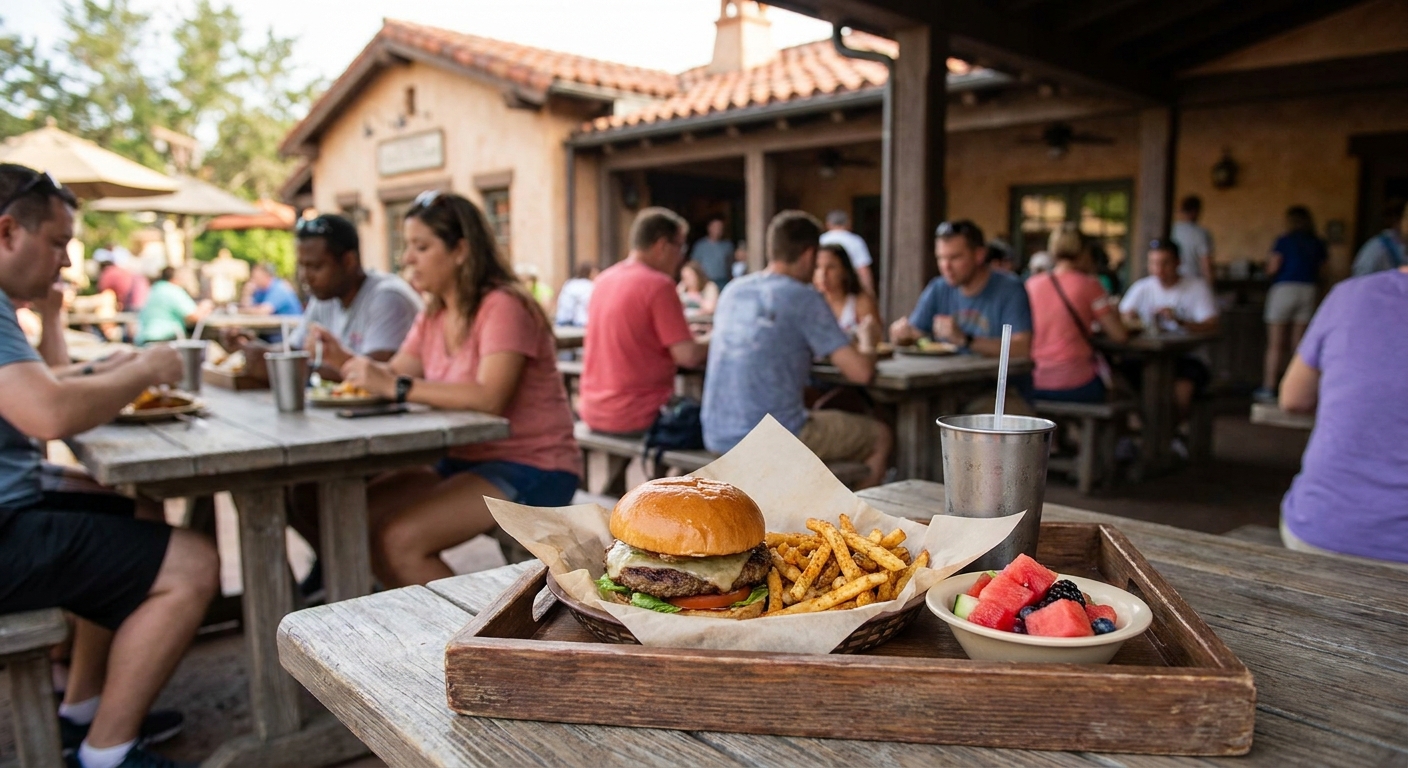
What STK Orlando Actually Is: Steakhouse, Lounge, and Nightclub Energy in One Building
The honest frame: this is a city steakhouse that happens to sit at Disney Springs, not a Disney restaurant that happens to serve steak. STK is a national upscale brand with locations in cities like New York, Los Angeles, Miami and Washington D.C., and the Orlando outpost — in The Landing at Disney Springs, at roughly 14,000 square feet, one of the largest in the chain — behaves like its siblings: DJ in the room, dim lighting, music with real volume, and a social scene designed in on purpose. Nobody Imagineered a story here. If you walk in expecting Disney theming or a hushed special-occasion room, you’ll feel lied to by minute five, and that’s a planning failure, not a restaurant failure.
Three restaurants, one reservation
The biggest thing people don’t know: your table assignment changes the experience more than your order does. Same booking, three genuinely different nights.
| Where you sit | What it feels like | Best for | The catch |
|---|---|---|---|
| Main dining room | Full steakhouse service, DJ audible throughout, darkest and busiest at peak | Adult groups who want the whole scene | Loudest at peak dinner; conversation across a six-top is work |
| Bar / lounge | Smaller plates, cocktails, graze-and-go pacing, no commitment to a full steak dinner | Two adults, late night, anyone testing the waters | Can be standing-room busy on weekend nights |
| Rooftop terrace | Open-air, Disney Springs views, music present but diluted by the outdoors | Families, mixed-age groups, anyone noise-sensitive | Florida weather and humidity decide for you; not guaranteed by request |
Signature Dining, table service, American menu, and — worth knowing before you plan around it — the Disney Dining Plan does not apply here. Lunch and dinner run daily; brunch is Saturdays and Sundays, roughly 11 a.m. to 3 p.m., which is the quietest version of the room that still gets you the full menu treatment.
Pro tip: Request the rooftop terrace or a lounge table at booking and mention it again at check-in — the host stand, not your reservation, decides where you land, and the people who ask politely in person are the ones who get moved. If the terrace is full and your group includes kids or anyone who hates shouting, ask whether the next terrace turn is close enough to wait for. Fifteen minutes in the lobby beats two hours of yelling.
The volume problem, said plainly
Noise is the single most common complaint about STK Orlando and the single biggest reason a reservation misses. This is not a quirk to be managed around the edges — it’s the design. Peak dinner on a weekend, the DJ and the crowd stack, and the room gets loud enough that:
- Grandparents and anyone with hearing aids struggle to follow the table.
- Kids under about eight read it as overwhelming rather than exciting.
- Business-y or milestone conversations don’t happen — you get volume, not intimacy.
- Servers repeat themselves, which drags an already long meal longer.
If any of that describes your party, you have three real options and one bad one. The real ones: brunch on a weekend morning, the rooftop terrace, or late night after the dining room thins. The bad one: booking 7 p.m. on a Saturday and hoping it’s calmer than people say.
Quick self-check before you book
- [ ] Is anyone in your party noise-sensitive, hard of hearing, or under eight?
- [ ] Are you okay with a two-hour meal that is a destination, not a quick refuel?
- [ ] Does your group actually want atmosphere, or do they want to taste the steak and talk?
- [ ] Have you priced steakhouse math — entrées, sides à la carte, drinks, tax, tip — not just “a steak dinner”? Expect a real signature-dining total, often north of $100 a head once drinks are in.
- [ ] Is this landing on a non-park night, or are you stacking it on top of 25,000 steps?
If you check most of those boxes, STK delivers exactly what it advertises and does it well. If you checked the first one, you’re not ruling STK out — you’re ruling out peak dinner in the main dining room, which is a very different and much more fixable problem.
The read
STK is a mood restaurant. Book it when the mood is the point: adults, no 7:00 a.m. Lightning Lane alarm the next morning, cocktails in play, nobody fading. Book brunch or the terrace when half your group just wants a good meal they can hear. The restaurant isn’t the variable — your seating and your timing are.
The Room Matters More Than the Menu: Rooftop vs. Dining Room vs. Bar
At STK, where you sit changes the experience more than what you order — and the rooftop is the one people picture when they book, not the one most people actually get.
This is a roughly 14,000-square-foot restaurant in The Landing, one of the larger STK locations anywhere, with a DJ, lounge space, and a true rooftop deck. Three very different rooms share one menu. Pick the wrong one for your group and you’ve paid signature-dining money for a seat you didn’t want.
The three rooms, head to head
| Rooftop | Main dining room | Bar / lounge | |
|---|---|---|---|
| Noise | Moderate — music plus open-air chatter | Loudest; DJ-driven, club-adjacent energy | Loud but conversational if you’re side by side |
| View | Best — open-air, Disney Springs waterfront side | None to speak of; the room is the view | People-watching and the bar itself |
| Best time | Late afternoon through sunset | Any dinner slot; shines after dark | Last stretch of the night |
| Best for | Couples, two to four adults | Parties of five or more, kids in tow | Two adults, no prix-fixe-scale bill |
| Odds of getting it | Lowest — request only, never guaranteed | Highest | High, especially late; often walk-up |
| How to ask | Note it at booking, then again at check-in | Default; no ask needed | Skip the reservation, walk up to the bar |
| Weather risk | Real — rain or a hot, humid afternoon kills it | None | None |
Asking for the rooftop (twice)
The rooftop is a request, not a reservation type. Put it in the special-requests field when you book, then say it out loud to the host when you arrive — the booking note and the seating chart are not the same system, and the host is the one holding the pen.
- [ ] Add “rooftop seating if available” to the reservation notes
- [ ] Ask the host again at check-in, politely and specifically
- [ ] Offer flexibility: “we’ll wait 15 minutes for rooftop” moves you up the list
- [ ] Have a plan B you’re actually fine with
- [ ] Check the forecast the morning of and drop the ask if storms are likely
Pro tip: Book the rooftop before sunset, not after. An earlier slot gets you golden-hour light and the view you came for, and you’re still outside when it’s pleasant — then the room cools as the sun drops. Reverse that order and you’re sitting in the dark, in Florida humidity, looking at nothing you couldn’t see from the walkway.
Season matters as much as time of day. November through March, the rooftop is the best seat in the building. June through September, an afternoon out there is a sweaty, thunderstorm-adjacent gamble — that’s when the dining room’s air conditioning stops being a consolation prize.
Big party? Take the dining room and stop negotiating
Larger groups are genuinely easy here — the space handles them — but easy means inside. The dining room seats parties of five-plus without the puzzle-solving a rooftop table requires, it’s climate-controlled, and nobody’s dinner gets relocated because the sky opened up.
The trade-off is volume. The DJ and the hard surfaces make this a room where you lean in to talk. If your group includes a grandparent who’ll struggle to hear, request a table along the perimeter or away from the DJ rather than fighting for the rooftop you won’t get anyway.
The bar is the sleeper pick
Two adults who want the atmosphere without steakhouse math should skip the dining reservation entirely and sit at the bar.
Why it works:
- No reservation pressure. Walk-up seating means you’re not building your evening around a 7:45 slot.
- You can graze. A couple of appetizers, a side, and a cocktail gets you the room, the music, and the energy for a fraction of a full entrée-plus-sides dinner.
- Late night is when it peaks. The dining room thins out while the bar stays alive — that’s the adults-only loophole, and the atmosphere is identical.
- Zero weather risk, unlike the rooftop you were originally scheming for.
The one thing this room isn’t: a celebration. If it’s an anniversary or a milestone dinner, a bar stool won’t carry it. Take the rooftop at sunset, or a dining-room table, and accept that you’re paying for the occasion as much as the steak.
The takeaway: request the rooftop before sunset in cooler months, default to the dining room with five or more people, and if it’s just two of you chasing the vibe, the late-night bar delivers most of the experience for a fraction of the bill.
What to Order: Steaks, Cuts, and the Dishes That Carry the Meal
The move: order a smaller premium cut, then spend the difference on starters and sides — that’s where STK actually earns its reputation. Menus at Signature Dining spots rotate, so treat this as a framework rather than a shopping list, and confirm what’s on offer when you sit down.
Cut selection: small and good beats big and fine
At this price point, the bill tracks ounces, but the enjoyment tracks quality. A petite filet or a well-marbled smaller cut usually delivers a better meal than the biggest mid-tier slab on the menu — and after a park day, almost nobody finishes the giant one anyway.
| If you want… | Order this way | Why |
|---|---|---|
| The best bite per dollar | Smaller premium cut | Quality scales better than size here |
| Beefy, chewy, steak-forward flavor | Bone-in cut | Bone-in tends to cost more and cook slower, but it eats bigger |
| A once-a-trip flex | Wagyu-tier upsell, shared | Rich enough that two people splitting it is the smarter play |
| To not think about it | Medium-rare filet + one shared side | Hardest version of the meal to get wrong |
- Bone-in is worth it when steak is the whole point of the evening and you have the time — these cuts often run longer in the kitchen, which matters on a late-night table.
- Wagyu-tier is worth it only as a shared indulgence or a genuine celebration. Ordering one per person is how a dinner becomes a four-figure story.
- Ask for the temperature one notch under what you normally order. Steakhouse broilers run hot, and a rested cut keeps cooking on the plate.
The starters and sides are the real headline
Ask people what they remember about STK and they rarely lead with the steak — they lead with the warm sweet baked bread that lands at the start of the meal. It’s the signature opener guests consistently bring up, it’s meant to be shared, and it sets the tone. Don’t fill up on it, but don’t skip it either.
Shareable starters are where the kitchen shows personality, and they’re also the smartest ordering lever you have:
- Order two starters for the table instead of one each. You get more variety and less waste.
- Sides are built to share — one side per two people is usually plenty alongside an entrée.
- If you’re doing the late-night graze version of STK, a couple of starters plus one side and a cocktail is the meal, and it’s the best-value version of this restaurant.
À la carte is where the bill quietly doubles
Steakhouse math: the entrée price on the menu is the floor, not the ceiling. Sides and sauces are typically ordered separately, and so are the add-ons the server will offer with the steak.
- [ ] Count your actual order: entrée + sides + sauce + starter + drink, per person
- [ ] Decide before you sit down whether this is a graze or a full steak dinner
- [ ] Share sides by default — order a second one only if the first disappears
- [ ] Skip the per-steak sauce upcharge unless you know you want it; most cuts arrive seasoned well enough
- [ ] Add tax and tip to your mental number before you commit
Pro tip: Order one shared starter, one shared side, and one fewer entrée than you have people — a smaller premium cut plus the shared plates feeds most groups fully, and it’s the single biggest swing on the final total.
Mixed groups: seafood and the non-steak table
Not everyone at the table wants beef, and a steakhouse is a rough room for a picky eater. Before you lock this reservation in for a mixed group:
- Seafood entrées and a lighter-plate option are generally available alongside the steaks — good news for the one person in your party who doesn’t do red meat.
- Brunch (weekends, roughly late morning through mid-afternoon) is the friendliest service for mixed appetites and the least intimidating version of the room.
- Kids with narrow tastes do better at brunch than at a loud, dim dinner service — the pacing is gentler and the menu is broader in style.
Dessert, if you’re celebrating
STK does a celebration-scale sweet finish, and that’s the one to point at if you’re marking a birthday or anniversary. Note the occasion when you book and again when you’re seated — Signature Dining restaurants are generally good about acknowledging it.
If you’re not celebrating, dessert is the easiest line item to cut. Disney Springs has strong dessert options a short walk away, and splitting one at the table keeps the finish without the full third course.
The takeaway for this section: pick the smaller, better cut, share the starters and sides, and decide your total before the server starts offering add-ons.
Lunch vs. Weekend Brunch vs. Dinner vs. Late-Night Bar: The Four Versions of STK
The version of STK most people book — 7 PM on a Friday — is the worst value of the four. Weekend brunch and the late-night bar graze are the two that actually justify the bill.
STK Orlando sits in The Landing at Disney Springs and runs around 14,000 square feet across sleek lounges, a DJ, and rooftop dining — it’s one of the largest STK locations anywhere. That scale matters, because the room changes character completely depending on when you walk in. Lunch and dinner are served daily; brunch runs Saturdays and Sundays, 11 AM to 3 PM.
The four versions, side by side
| Lunch (weekdays) | Weekend brunch (Sat/Sun, 11 AM–3 PM) | Peak dinner (~6:30–8:30 PM) | Late-night bar/lounge | |
|---|---|---|---|---|
| Crowd | Thin — locals, couples, a few conference refugees | Moderate, mixed, cheerful | Packed, every table turning | Thinning dining room, lively bar |
| Noise | Lowest; you can actually talk | Medium — music up, not shouting | Loudest; DJ at full tilt | Loud but social, bar-energy loud |
| Relative cost | Mid | Mid, with the best food-for-dollar | Highest by a wide margin | Lowest if you graze |
| Atmosphere | Calm, slightly empty-feeling | Daylight, waterfront, relaxed polish | Full nightclub-steakhouse theater | The vibe you came for, minus the entrée math |
| Reservation difficulty | Easy | Moderate — weekend-only, so it moves | Hardest window of the week | Easiest; walk-ups happen |
| Kid tolerance | High | Highest — brunch dishes, daylight, shorter wait | Low to medium; long, loud, late | Not the move with kids |
| What you give up | The energy — it’s a steakhouse with the lights on | Peak-dinner spectacle and the full dinner menu | Money, quiet, and an evening you can’t get back | A proper steak and a real table |
Why brunch wins on value
Weekend brunch gets you the waterfront Landing setting and a room with actual energy, without steakhouse dinner math. You’re ordering off a different, generally gentler menu in daylight, in a shorter sitting, with a group that isn’t fried from 25,000 steps. It’s also the single most kid-survivable version: shorter, brighter, and earlier than anything your family will tolerate at 8 PM.
The trade: it’s a two-day-a-week window, so the tables genuinely go. Treat a weekend brunch slot like a reservation you have to hunt for, not one you grab on a whim.
Why late night is the adults-only loophole
If your group skews adult, the last stretch of the night is the best-value version of STK, full stop. The dining room has thinned, the bar is still alive, and you can graze — a couple of appetizers, a side, a cocktail — for a fraction of a full steak dinner while still getting the atmosphere you paid to be around. Park close to Disney Springs is an easy transition by bus or rideshare, and nothing else on your schedule is competing for the time.
Lunch is the conversation version
Book lunch when the point is talking — a milestone, a split-off from the rest of the group, a meal you want to remember a sentence from. It’s the quietest room STK offers. The honest downside: you’re seeing a high-energy restaurant with the house lights up, and some of what makes STK distinctive simply isn’t running yet.
Peak dinner: the default nobody should default to
6:30–8:30 PM is the most expensive, loudest, hardest-to-book version — and it’s the one most people book first, because that’s what “steakhouse reservation” sounds like in your head. Entrées, sides, apps, drinks, dessert, tax and tip stack fast when everyone orders like it’s a once-in-a-trip meal. You’re paying a premium for the hardest table at the noisiest hour.
Pro tip: Never put a peak-dinner STK reservation on a park day. Disney Springs has no early entry, no rope drop, nothing to rush back for — it’s the only part of your trip where a two-hour dinner costs you nothing. Schedule it on an arrival night, a departure night, or a no-park rest day. On a park night, you’re choosing between a rushed meal and a sacrificed evening in the park.
Build the buffer before you book
The mistake usually isn’t the window — it’s stacking a big reservation on top of a maxed-out day. Before you lock a time:
- [ ] Check what park day sits under that reservation — open-to-close at Magic Kingdom or Animal Kingdom plus a late Disney Springs dinner is how “splurge meal” becomes “why did we do this to ourselves?”
- [ ] Give yourself a resort break between park and table, or plan Disney Springs as the whole evening instead of a bonus round
- [ ] Price the meal honestly with your group’s actual ordering habits, not the entrée column alone
- [ ] If you want weekend brunch, set a watch early — SupaPark’s Drop Watch pings you the second a cancelled table frees up, and you confirm it in My Disney Experience
Cost Breakdown: What a Real STK Night Actually Costs
The same restaurant can run you roughly $60 a head or north of $150 a head depending entirely on which version of STK you order — and the menu structure, not the steak, is what moves the number. Prices change regularly, so confirm current menus before you budget. What doesn’t change is the math shape: at a modern steakhouse, the entrée is the starting line, not the finish.
Three versions of the same night
| Scenario | What’s on the table | Where the money goes | Rough per-person feel |
|---|---|---|---|
| Bar graze (2 adults, late night) | 2 appetizers, 1 shared side, 2 cocktails | Cocktails are the biggest line item, not food | Lowest — often a third to half of a full dinner |
| Standard dinner (2 adults) | 1 starter, 2 steaks, 2 sides, 1 dessert, 2 drinks | Steaks anchor it; sides and dessert add a meaningful chunk | Mid — the “expected” number most people picture |
| Celebration dinner (4 adults) | Premium cuts, 3–4 shared sides, a bottle of wine, dessert | Premium cuts + wine + automatic gratuity | Highest — can be double the standard-dinner rate |
Brunch (Saturdays and Sundays, 11 AM–3 PM) tends to land closer to the graze end than the dinner end, which is why it’s the other smart window.
How the add-ons stack
This is the part people miss. A steakhouse menu is deliberately modular:
- Sides are à la carte. Nothing comes with your steak. Four adults each ordering “their” side is effectively a second appetizer course in disguise — order two or three to share instead.
- Sauces and toppers are extras. Small individually, real money across four people.
- Cocktails at a DJ-driven steakhouse are priced like a cocktail bar, not like a resort lounge. Two rounds each can rival an entrée.
- Wine by the glass vs. bottle: for a table of four, two glasses apiece almost always costs more than one bottle. If three or more people are drinking the same thing, the bottle is the better buy.
- Dessert is the easiest line to cut without feeling cheated — Disney Springs has excellent dessert within walking distance.
- Tax applies to the whole check, including drinks.
- Automatic gratuity typically kicks in on larger parties at Disney Springs signature restaurants. On a four-to-six-adult celebration check, assume it’s there and budget for it rather than being surprised at the end.
Pro tip: The single biggest cost lever isn’t which steak you order — it’s whether you order courses or plates. Two appetizers plus one shared side at the bar delivers the same room, the same DJ, and the same view for a fraction of the four-course version. The atmosphere is what you’re actually paying a premium for, and the atmosphere is free with any order.
What won’t save you money
- [ ] Disney Dining Plan — no. STK Orlando does not participate. If you bought a dining plan, this meal is fully out of pocket on top of it.
- [ ] Annual Passholder discounts — don’t count on them. Third-party operated Disney Springs restaurants set their own discount policy, and it can change without notice. Ask when you’re seated; never build your budget around it.
- [ ] Tables in Wonderland-style dining discount programs — don’t assume coverage. Participation at independently run locations is inconsistent. Treat any discount you get as a bonus, not a plan.
- [ ] Lunch as a loophole — partly. A weekday lunch is genuinely cheaper than dinner, but it burns daylight you’d otherwise spend in a park.
Build the budget around the day, not just the check
The hidden cost of STK isn’t on the receipt — it’s the park evening you gave up. Disney Springs has no early entry, no rope drop, and nothing to rush for, which makes it the one place on your trip where a two-hour dinner costs you nothing. Put STK on an arrival night, a departure night, or a no-park rest day. Book it on a Magic Kingdom open-to-close day and you’ll either rush the meal or sacrifice the evening — and a $150-a-head dinner eaten by people who’ve done 25,000 steps in Florida heat is the worst value version of this restaurant that exists.
The takeaway: decide which of the three scenarios you’re buying before you book, tell your group the plan, and the per-person swing works in your favor instead of ambushing you at the end.
Is It Worth It Compared to Disney’s Own Signature Steakhouses?
STK wins on energy, rooftop views, and not needing a park ticket — Disney’s own signatures win on quiet service, theming, and Disney Dining Plan value. Pick based on which of those you actually want that night.
Here’s the honest framing: STK isn’t competing with Yachtsman Steakhouse for “best steak.” It’s competing for your one big dinner slot, and the real question is what kind of evening you want. A DJ-and-cocktails rooftop night out, or a hushed room where the server knows the cut of beef by name.
The head-to-head
| Restaurant | Price tier | Vibe / noise | Kids | Dining Plan | Dress | View / theming | Hard to book? | Does best |
|---|---|---|---|---|---|---|---|---|
| STK Orlando (Disney Springs) | Signature, high | Loud — DJ, lounge energy | Tolerant, not designed for it | No | Smart casual, people dress up | Rooftop + Disney Springs waterfront | Moderate; late slots open up | Nightlife atmosphere, no park ticket needed |
| Yachtsman Steakhouse (Yacht Club) | Signature, high | Quiet, grown-up, lodge-calm | Fine but subdued | Yes (2 credits) | Resort-nice | Boardwalk/lagoon views, clubby room | Moderate–hard | Classic steakhouse execution and pacing |
| Shula’s Steak House (Dolphin) | Signature, high | Dim, business-dinner hush | Least kid-oriented | Varies — not a Disney-owned restaurant | Jacket-optional nice | Dark wood, zero Disney theme | Easiest of the bunch | Walk-in-able steak when everything else is booked |
| Le Cellier (EPCOT, Canada) | Signature, mid-high | Cozy, cellar-quiet, cramped | Good — short meal, pretzel bread | Yes (2 credits) | Theme-park casual | Vaulted stone cellar | Hardest | Dining Plan value + you’re already in the park |
| The Boathouse (Disney Springs) | Upper-mid | Lively but conversational | Best for families | No | Casual | Waterfront, vintage boats, Amphicars | Moderate | Mixed group where not everyone wants steak |
| Capa (Four Seasons) | Highest | Polished, calm, adult | Poor fit | No | The dressiest | Rooftop with Magic Kingdom fireworks sightline | Hard at fireworks times | Spanish steakhouse + fireworks from a quiet terrace |
| California Grill (Contemporary) | Signature, highest | Buzzy but refined | OK for well-behaved kids | Yes (2 credits) | Nicest of the Disney signatures | Rooftop over Magic Kingdom, fireworks audio piped in | Very hard | The single best view-plus-food combo on property |
What the table actually tells you
- If Dining Plan value matters, STK is out. It does not accept the Disney Dining Plan. Le Cellier, Yachtsman, and California Grill do, at two credits each — and Le Cellier is the best credit-to-dollar steak on property, which is exactly why it’s the hardest table in this group.
- If you want fireworks, STK is also out. Its rooftop looks at Disney Springs, not Magic Kingdom. California Grill and Capa are the fireworks plays.
- If you want a party, STK is the only real answer here. Nothing Disney operates does DJ-and-rooftop. That’s the whole product.
- If you have a 7-year-old who’s done with ambiance, The Boathouse beats every steakhouse on this list. Broader menu, lower noise anxiety, boats to look at.
The no-park-ticket advantage is bigger than people credit
Yachtsman and Le Cellier and California Grill all sit behind something — a park ticket, a monorail ride, a resort-hopping trek after a full day. STK sits in Disney Springs, which has no rope drop, no early entry, and nothing to rush back for. That makes it the one dinner on your trip that costs you zero park time.
Pro tip: Put STK on an arrival night, a departure night, or a no-park rest day — and put Le Cellier or Yachtsman on your park days instead. The Disney signatures are inside the day you’re already having; STK works best as the day itself. Booking it as a bonus round after 25,000 steps is how a splurge turns into “why did we do this to ourselves.”
Where each one genuinely beats STK
- Yachtsman: quieter room, steadier service pacing, and you can talk at a normal volume.
- Le Cellier: you’re already in EPCOT, it’s two credits, and the meal is short enough to get back to World Showcase.
- Shula’s: the backup plan nobody thinks of — often available when every Disney signature is gone.
- California Grill: the view. There’s no argument.
Where STK genuinely beats them
- Weekend brunch, 11 AM–3 PM Saturday and Sunday, which none of the Disney signatures offer in this format.
- Late-night grazing — a couple of appetizers, a side, a cocktail at the bar after the dining room thins. You get the atmosphere for well under a full steak dinner.
- Groups that want a night out, not a reverent meal.
The takeaway: choose by evening type, not by steak quality. And if Le Cellier or California Grill is the one you actually want, set a SupaPark dining Drop Watch — those two cancel and refill constantly, and you’ll get pinged the second a table frees up so you can grab it in My Disney Experience. More at supapark.com.
How to Actually Get the Reservation (Including the Windows Nobody Books)
The booking move most people miss: STK takes reservations through two separate systems, and they don’t always show the same tables. Walt Disney World Advance Dining Reservations put it in My Disney Experience, but STK Orlando also books direct — by phone at (407) 917-7440 and on its own website. Same restaurant, different inventory feeds. Check both before you decide a night is “full.”
The sequence that actually works
- [ ] Count back 60 days from your arrival date — not from the night you want to eat. ADRs open 60 days before arrival for your whole stay.
- [ ] Be in My Disney Experience at 6:00 AM Eastern on that day, already signed in, party set, payment card saved. (Do not confuse this with the 7:00 AM Lightning Lane Multi Pass window — different system, different hour.)
- [ ] Book the window you want most first. You can always layer a backup later.
- [ ] Immediately re-check the direct channel — phone or the restaurant’s own site. If Disney shows nothing at 7:15 PM, direct sometimes does.
- [ ] If both come up empty, set a dining Drop Watch and stop refreshing. Cancellations, not availability, are how most people get in.
Which dates are genuinely hard
| Date type | Difficulty | What to do |
|---|---|---|
| Random Tuesday–Thursday, off-season | Easy | Book at 60 days or even walk in |
| Weekends (Fri–Sun dinner) | Hard | 60-day morning or Drop Watch |
| Marathon and race weekends | Hard | Book the window, assume you need a watch |
| EPCOT festival weekends | Hard | Shift to a weekday or late night |
| Valentine’s Day, New Year’s Eve | Brutal | Treat prime time as unavailable; aim late |
| Christmas week, spring break | Brutal | 60 days, 6:00 AM, no hesitation |
The windows nobody competes for
Prime time at a Disney Springs steakhouse means roughly 6:30–8:30 PM. That’s where every reservation request lands. Step outside it and the same restaurant suddenly has room:
- Early lunch — the first hour of lunch service is consistently the softest table at STK. Quietest dining room, same kitchen.
- Late dinner — the back end of the night tends to open up, and it’s also the best-value version of the meal: appetizers, a side, a cocktail at the bar instead of a full steak flight, with the room still buzzing.
- Weekend brunch’s first hour — brunch runs Saturdays and Sundays from 11 AM to 3 PM, and that 11 AM slot is the least-requested seating of the weekend.
Pro tip: Never put a peak-dinner STK reservation on a park day. Disney Springs has no rope drop, no Early Theme Park Entry, nothing to rush back for — which makes it the one place in your trip where a two-hour dinner costs you zero ride time. Put it on an arrival night, a departure night, or a no-park rest day, and your “impossible” prime-time slot problem often disappears because you’ve just widened the dates you can accept.
Cancellations are the real door
Here’s the part that changes the odds. Hard-to-get tables at Disney Springs don’t stay booked — plans shift, flights slip, groups shrink, and tables get dropped days and even hours ahead. The table you want probably will free up. You just won’t be looking at your phone the second it happens.
That’s what SupaPark’s dining Drop Watch is for: it watches the inventory and pings you the moment a table opens, so you can grab it in My Disney Experience. Free members get those alerts by email (10 a day), and paid plans get instant push — which matters, because a dropped weekend table at a Disney Springs signature restaurant can be gone in minutes. To be clear: SupaPark never books anything. It catches the opening and tells you; you confirm it yourself in Disney’s own app.
Set the watch as soon as you know your dates. Watching for three weeks costs you nothing and beats refreshing for three weeks.
Fallback: walk in and sit at the bar
If you arrive without a reservation, the bar and lounge are your best shot — walk-up seating at the lounge is far more realistic than a dining-room table, and the lounge menu gets you the same room and the same energy. Odds are decent on weekday afternoons and late evenings, poor on weekend nights and festival weekends. Go as a party of two if you can; small parties slot into bar seats that a group of six never will.
The one thing to remember: book the window nobody wants, check both booking channels, and let a Drop Watch handle the waiting. That combination gets more people into STK than refreshing ever has.
When to Schedule It in Your Trip: The Park-Day Mistake
If you book only one thing right in this whole guide, make it this: never put a peak-dinner STK reservation on a park day. Put it on your arrival night, your departure night, or a true no-park rest day. That single scheduling choice does more for your experience than anything you order off the menu.
Why Disney Springs is the one place a two-hour dinner is free
Disney Springs has no early entry, no rope drop, no Lightning Lane return windows ticking down, and no fireworks you’re racing back for. There is nothing to be late to. That makes it the only pocket of your trip where a long, slow, loud, DJ-soundtracked dinner costs you exactly zero ride time.
Flip that around and the problem is obvious: every minute you spend at a Disney Springs table on a park day is a minute of park you paid for and didn’t use. A two-hour steak dinner on a Magic Kingdom day isn’t a two-hour dinner — it’s a two-hour dinner plus bus or rideshare out, plus the trip back (or the decision not to come back), which realistically removes the entire evening.
What actually goes wrong when you stack it
A late steakhouse reservation sounds fantastic when you’re planning from your couch in March. It lands very differently after rope drop, 20,000-plus steps, Florida humidity, a transportation delay, and a seven-year-old who has been running on popcorn and Lightning Lane adrenaline since 8 a.m. The predictable outcomes:
- The rushed meal. You arrive hot, you’re watching the clock, and you speed through a signature dinner you’re paying signature prices for.
- The sacrificed evening. You skip the nighttime show, or you eat at 5:30 and lose prime low-wait touring hours instead.
- The cut-and-run. Dessert gets skipped so you can make the bus back — and you’ve now paid full price for two-thirds of the experience.
- The hangry table. STK is a high-energy room with a DJ. That’s a feature when everyone’s fresh and a liability when a tired kid is already melting down.
Open-to-close at Magic Kingdom or Animal Kingdom plus a late Disney Springs dinner is the specific combination that turns “splurge meal” into “why did we do this to ourselves.”
Which day to pick
| Day type | Verdict | Why |
|---|---|---|
| Arrival night | Best | You’re fresh, luggage is dropped, no park ticket burned, and nothing starts early tomorrow — unless you’re rope-dropping day one |
| Departure night | Great | Nothing left to protect on the schedule; works well if your flight is late the next day |
| Rest / no-park day | Great | Pair it with a resort pool morning and a Disney Springs afternoon of browsing |
| Low-intensity park half-day | Workable | Only if you leave the park by mid-afternoon and don’t plan to return |
| Full open-to-close park day | Skip it | You will either rush the meal or lose the evening |
| Weekend brunch day (Sat/Sun, 11 a.m.–3 p.m.) | Sneaky-best | Brunch is the value window, and the day is still yours afterward |
Build the buffer
If you’re pairing it with any park time at all, plan backward from the reservation, not forward from your morning:
- [ ] Leave the park at least 90 minutes before your reservation time — 60 is cutting it, and bus transfers at Disney Springs are not fast at dinner hour
- [ ] Budget two hours at the table for a full dinner; brunch and a late-night graze run closer to 60–90 minutes
- [ ] Take a real resort break that afternoon — shower, change, air conditioning
- [ ] Decide in advance whether you’re going back to the park afterward, and if yes, accept you’ll get roughly one hour, not three
- [ ] If the group skews adult, consider the late window instead: appetizers, a side, and a cocktail at the bar for a fraction of a full steak dinner, with park close to Disney Springs as an easy hop
Pro tip: Don’t pick your STK day from your itinerary — pick it from the crowd forecast. Your lowest-crowd days are the ones worth spending in a park, so the smart move is to make your highest-crowd projected day the low-intensity Disney Springs day. You skip the worst park conditions of the trip and get a great dinner out of it. SupaPark’s crowd calendar (free) shows which of your dates are projected heaviest, and the day builder on Gold lets you slot the reservation in and see what the day actually looks like around it — including whether leaving by 4 p.m. really does cost you the rides you care about.
The one thing to remember: STK is an evening, not a side quest. Give it a day where nothing else is competing, and it goes from an expensive interruption to one of the better nights of your trip.
The Late-Night Adults-Only Loophole
If your group skews adult, the smartest STK reservation isn’t dinner at all — it’s the last stretch of the night, when you can graze at the bar for a fraction of the steakhouse total and still get every bit of the room you came for.
Here’s the thing most planners miss: what people actually love about STK isn’t the ribeye. It’s the room — the DJ, the lighting, the energy of a place that feels like a night out instead of a theme park meal. You can buy that atmosphere for a lot less money than the full three-course version charges you.
Why late night is the best-value version
By the back half of the evening, the dining room has thinned out but the bar and lounge are still running. Two adults can order a couple of appetizers, a side to share, and a cocktail each and walk out having spent a meaningful amount less than a full steak dinner for two — without the entrée-plus-sides-plus-dessert math that makes signature steakhouses sting.
| Approach | What you order | Realistic feel | Best for |
|---|---|---|---|
| Peak dinner (7–8 PM) | Entrées, sides, apps, drinks, dessert | Full signature-dining spend, longest wait, loudest crowd | A genuine once-a-trip steak occasion |
| Weekend brunch (Sat/Sun, 11 AM–3 PM) | Brunch menu, daylight room | Mid-range, calmest service | Couples, small groups, no-park days |
| Late-night graze | 2 apps, a shared side, cocktails | Lowest spend of the three, best atmosphere-per-dollar | Adults, no kids, post-park wind-down |
The schedule math that makes it work
The reason late night wins isn’t just the check — it’s that nothing else is competing for the hour. Disney Springs has no early entry, no rope drop, and no reason to arrive at a specific minute. It’s the one part of your trip where lingering costs you literally nothing.
Compare that to a peak-dinner booking on a park day, which forces an ugly choice: leave the park early and sacrifice the evening, or rush the meal you paid a premium for. After park close, that tension disappears. You’ve already gotten your full day. Dinner isn’t competing with Happily Ever After.
- Park close → Disney Springs is a short hop by Disney bus from most resorts, or a quick rideshare straight from the park’s rideshare pickup.
- Rideshare usually beats the bus here, because post-close bus queues are at their worst and you’d be transferring through a resort.
- Budget extra time regardless — leaving a park at close is the single most congested transportation moment of the day.
Bar seating is the actual loophole
Lounge and bar seating at STK is typically walk-up — meaning the late-night version often doesn’t require a reservation at all. That’s the whole trick: you skip the hardest-to-get part of the restaurant and sit in the part that’s actually more fun. Arriving as a party of two makes this dramatically easier than four or more.
Pro tip: Put STK on an arrival night, a departure night, or a no-park rest day — never on top of an open-to-close park day. A late steakhouse booking sounds wonderful from your couch at home and considerably less wonderful after 25,000 steps, Florida heat, and a transportation delay. The mistake is rarely the restaurant; it’s stacking a big reservation onto a maxed-out day.
Before you count on it
Closing hours at Disney Springs restaurants shift with season, day of week, and demand, and kitchens frequently stop serving the full menu before the bar closes. “Open until late” and “still serving food” are not the same thing — verify both.
- [ ] Check STK’s current hours in My Disney Experience or on the restaurant’s own page within a day or two of going — not weeks ahead.
- [ ] Confirm whether the kitchen’s last call for food is earlier than the bar’s closing time.
- [ ] Note the lounge menu is separate from lunch, brunch, and dinner — it’s the menu you’ll likely be ordering from.
- [ ] Have a backup in mind; The Landing has several late-serving bars within a short walk if STK’s kitchen has closed.
- [ ] Decide on rideshare vs. bus before you leave the park, and build in 20–30 minutes of slack.
A quick note on the fallback plan: if you’d rather have the real dinner and the only thing standing between you and it is availability, a cancellation watch does the waiting for you. SupaPark’s dining Drop Watch pings you the moment a table frees up, and you confirm it in My Disney Experience — Free members get those alerts by email, no card required (supapark.com).
The takeaway: the late-night graze is the version of STK that veterans actually book — same room, same energy, dramatically less money, and zero cost to the rest of your day.
Bringing Kids: Honest Guidance, Not a Blanket No
STK isn’t anti-kid — it’s anti-toddler. The room is loud, the lighting is low, the pacing is slow, and a two-hour steak dinner asks more patience than most under-5s have after a park day. But if your kids are older, like feeling fancy, and can handle a dim room with a DJ in it, this is one of the few Disney Springs meals they’ll actually remember as a “grown-up night.”
Who it works for — and who it doesn’t
| Your group | Verdict | Why |
|---|---|---|
| Teens and tweens | Strong yes | The music, the room, the vibe — this reads as a real night out, not a kids’ meal with a character |
| Kids roughly 8–12 | Usually fine | Can handle the pacing if you order appetizers early and keep a device or a plan for the lull between courses |
| Noise-sensitive kids of any age | Skip it | Volume is the dealbreaker, not the menu; a quieter Disney Springs table serves you better |
| Toddlers and preschoolers | Skip at dinner, consider brunch | Dim + loud + slow is the worst combination for this age; weekend brunch is a different restaurant entirely |
Timing is the whole game
Two windows make STK genuinely workable with kids:
- The earliest seatings of the night. The dining room is still filling, the volume hasn’t peaked, and service tends to move faster before the room is full.
- Weekend brunch, served Saturdays and Sundays 11 AM to 3 PM. Daylight, a calmer room, brunch-shaped portions, and no late bedtime math. If you’re bringing anyone under about 8, this is the booking to chase — not dinner.
Peak dinner is the version you should treat as adults-only. That’s when the volume, the wait for a table, and the pacing all land at once.
Pro tip: Never put an STK reservation on a park day when kids are involved. Disney Springs has no early entry and nothing to rope-drop, so it’s the only part of your trip where a two-hour dinner costs you nothing — put it on an arrival night, a departure night, or a no-park rest day. A late steakhouse reservation sounds great from your couch and much worse after 25,000 steps, heat, a bus delay, and a kid who’s been running on popcorn since breakfast.
Kids’ menu and ordering expectations
There is a children’s menu, so you’re not forced into steakhouse entrées for a 6-year-old. Set expectations anyway:
- It’s a short, straightforward kids’ menu — don’t plan the trip around it being a highlight.
- Order kids’ food and an appetizer in the same breath. The gap between sitting down and food arriving is where dinners fall apart.
- Steakhouse math applies to everyone at the table. Entrées, sides ordered separately, drinks, dessert, tax and tip climb fast when the whole party orders like it’s a once-a-trip meal. Sharing a side or two keeps the total sane.
Strollers, high chairs, and a crowded room
- Strollers are awkward here. The dining room is busy and the walkway from the Disney Springs bus stops and parking garages is a hike — park the stroller outside and carry in what you need.
- High chairs are available, but a high chair in a packed room means your kid is at elbow height with servers moving past. Request a table away from the main traffic path when you check in.
- The Landing is central, but the walk from the Lime or Orange garage with a tired kid is longer than it looks on the map. Build 15 minutes of buffer in both directions.
If you decide against it
Disney Springs has better kid answers, and choosing one isn’t a downgrade:
- A quieter table-service Italian spot for strollers and shareable plates.
- Counter service plus the waterfront — the Amphicar ride around the lake is a genuine kid win when they’re running.
- Dessert-only as the splurge: skip the steakhouse entirely, do a casual dinner, then let the kids pick the treat.
Plan the dining day around their actual limits
- [ ] Pick brunch or the earliest seating, not peak dinner
- [ ] Put it on a non-park day or an arrival/departure night
- [ ] Build in a resort break if any park time happens that day
- [ ] Decide the stroller plan before you’re standing at the host desk
- [ ] Order kids’ food with the first appetizer order
SupaPark’s Gold family tools track each kid’s height and which rides they’re actually eligible for, so you can see where the park side of the day runs out of steam — and schedule the big dinner on the day that has room for it. Start at supapark.com.
Getting There, Parking, and Timing the Disney Springs Trip
Leave the resort 75 minutes before your reservation if you’re taking a Disney bus, 40 if you’re driving, and 25 if you’re walking from a Disney Springs Resort Area hotel. STK sits in The Landing, roughly in the middle of Disney Springs — which means wherever you park or get dropped, you’re walking several minutes through crowds to reach the door. That walk is the part people forget to budget.
Parking: free, plentiful, and still stressful on Saturday
Disney Springs parking is free in all three garages — Orange, Lime, and Grapefruit — with no validation needed and no time limit. The catch isn’t cost, it’s the hunt. On Friday and Saturday evenings from roughly 5:00 to 8:00 PM, the lower levels fill, traffic backs up at the garage entrances, and you can lose 15 minutes circling before you’re parked.
| Garage | Closest to | Best for an STK reservation |
|---|---|---|
| Orange | Town Center / The Landing side | Best overall — shortest walk to STK |
| Lime | Town Center, World of Disney end | Good backup; slightly longer walk |
| Grapefruit | West Side, House of Blues end | Longest walk; usually the emptiest |
Pro tip: Skip the ground floors entirely and drive straight to an upper level of Orange. Everyone fights for level 1–2, the top levels stay open on all but the busiest nights, and the elevator/escalator banks put you out on the pedestrian bridge headed toward The Landing anyway. Grapefruit is the overflow play — if Orange and Lime are showing full, go there without hesitating rather than idling in a queue.
Buses, boats, and the walking path
Disney bus service to Disney Springs runs from Disney resort hotels, and it’s free — but it is the slowest option by a wide margin. Realistically, plan on 20–40 minutes of travel once you’re actually moving, plus however long you wait at the stop. Buses to Disney Springs tend to run less frequently than park buses, and some routes share stops with other resorts.
- From Disney Springs Resort Area hotels (the cluster along Hotel Plaza Boulevard): you can walk. It’s a flat, sidewalked 5–15 minutes depending on which hotel, and it beats any shuttle. Boat service also connects some nearby resorts to Disney Springs — pleasant, scenic, and not fast. Treat it as the experience, not the commute.
- From Deluxe and Value resorts farther out: bus or rideshare. Rideshare typically runs 10–20 minutes door to door and costs roughly $10–20 each way depending on distance and surge.
- Rideshare pickup: the designated zone is on the Orange Garage level 1 side. Know that before you order, because trying to get picked up curbside elsewhere turns into a wandering-around situation.
The arrive-by plan
- [ ] Check in at the STK host stand 15 minutes before your reservation time
- [ ] Add 15 minutes of walking from whichever garage you land in
- [ ] Add 15–20 minutes of parking hunt on a Friday or Saturday evening
- [ ] Add 30 minutes of cushion if you’re on a Disney bus
- [ ] Driving on a weeknight? 40 minutes door to door is plenty
Signature dining at Disney Springs will generally hold your table briefly, but showing up 20 minutes late on a packed Saturday risks a long wait or a lost reservation — and there’s no “we’ll squeeze you in” at 7:30 PM in The Landing.
Don’t put this on a park day
The single biggest timing mistake isn’t the hour you book — it’s stacking a two-hour steakhouse dinner on top of an open-to-close park day. A late STK reservation sounds terrific when you’re planning from your couch. It feels very different after rope drop, 25,000 steps, Florida humidity, a transportation delay, and a kid running on popcorn since 10:00 AM.
Disney Springs has no early entry and no rope drop, which makes it the one part of your trip where a long dinner costs you nothing. So put STK on an arrival night, a departure night, or a true rest day. If you must pair it with a park, make it a half day with a real afternoon resort break — or just let Disney Springs be the evening.
30 minutes to kill? Here’s where to spend it
If you arrive early (and you should plan to), The Landing has you covered within a two-minute walk:
- Jock Lindsey’s Hangar Bar — Indiana Jones–themed, strong cocktails, hidden details worth hunting. The outdoor patio has the best water view in The Landing.
- The Boathouse dock area — walk out and look at the Amphicars. Free, kids love it, and it kills exactly 10 minutes.
- Lakefront walk toward Town Center — the bridges and waterfront are genuinely the nicest part of Disney Springs after dark, and almost nobody budgets time for them.
The takeaway: park in upper Orange, check in 15 minutes early, and never let a Disney bus be your only plan on a night you’re paying steakhouse prices.
What Guests Consistently Praise and Complain About
The pattern is remarkably consistent: people love STK when the room isn’t slammed and resent it when it is. Almost every complaint traces back to timing, not the kitchen.
Sort the recurring feedback into two buckets and the booking strategy writes itself.
What holds up
- The steaks. This is the part nobody argues about. Order a cut, cooked the way you asked, and the core product generally delivers at the level the bill implies.
- Shareable starters. The appetizer-and-side format is the most flexible thing on the menu, and it’s the lever that makes the late-night version of STK work for a group that doesn’t all want an entrée.
- The rooftop and the room. DJ-driven, high-energy, modern — this is not Victoria & Albert’s and isn’t trying to be. If you want a steakhouse that feels like a night out, that’s the draw.
- Celebration energy. Birthdays, anniversaries, engagements — the staff leans into it, and the room’s volume works for you here instead of against you.
- Service, conditionally. Attentive and sharp when the dining room has breathing space. That conditional is the whole story.
What goes wrong — and the counter-move
| Complaint | Why it happens | The move that avoids it |
|---|---|---|
| Too loud to talk | DJ + hard surfaces + a packed room | Weekend brunch (Sat/Sun, 11 AM–3 PM) or the last stretch of the night |
| Upselling pressure | À la carte menu, high check targets | Decide your order before you sit; say “we’re sharing” early and it mostly stops |
| Inconsistent food/service | Peak-dinner volume, not the kitchen’s ceiling | Avoid the 6:30–8:30 crush entirely |
| Bill shock | Entrées, sides, apps, drinks all priced separately | Price the meal on the posted menu before booking; sides are shared, not per person |
| Seated well past your time | Turn times slip on busy nights | Early or late seating; build a buffer, not a hard stop |
| No Disney Dining Plan | STK doesn’t participate | Budget it as cash from the start — don’t count on credits |
The noise and inconsistency complaints are the same complaint
Read enough guest feedback and the “the server disappeared” and “my steak came out wrong” stories cluster hard in the peak dinner window. That’s not a defense of the restaurant — it’s a planning instruction. The version of STK people rave about and the version people warn you off are frequently the same restaurant on either side of a two-hour window.
Pro tip: If your reservation is the only one you can get and it lands mid-peak, check in and then wait at the bar rather than hovering by the host stand. You’ll get a drink, you’ll feel less jerked around by a 25-minute delay, and you can start the shareable starters before the table is even ready — which quietly fixes the “we were starving and annoyed before the food came” spiral that colors so many bad reviews.
Bill-shock defense, in order
- [ ] Pull up the posted lunch, brunch, and dinner menus before you book — they’re priced differently
- [ ] Pick your cut and one or two shared sides per table, not per person
- [ ] Decide on cocktails vs. wine by the glass in advance; drinks are where checks quietly double
- [ ] Assume tax and tip on top — a steakhouse entrée that reads as around $60 is not a $60 line on the final bill
- [ ] Confirm nobody in your group is expecting to use dining plan credits here
If you can’t get the window you want
The good reservations at STK move. Cancellations are constant at Disney Springs, especially 24–48 hours out, and brunch and late-night tables are exactly the ones that free up as people rework their park days. Book whatever you can get, then watch for the slot you actually want — SupaPark’s dining Drop Watch pings you the moment a table frees up from a cancellation, and you grab it in My Disney Experience. Free accounts get those alerts by email, which is plenty for a 48-hour-out table. Details at supapark.com.
The takeaway on reviews: stop reading them as a verdict on the restaurant and read them as a map of when not to go. Praise clusters at brunch and late night; complaints cluster at peak dinner. Book accordingly and you’ll be writing the first kind of review.
Celebrations, Dress Code, and Practical Details Worth Knowing
Note the occasion in the reservation, then say it again out loud at check-in — the second mention is the one that actually travels to your server. Reservation notes get read, but they don’t always get read in time on a busy Saturday. Thirty seconds at the host stand does more for your anniversary than anything you typed a month ago.
How celebrations actually go here
STK is a Signature Dining restaurant with a lounge-and-DJ energy, not a character meal. That shapes what a celebration looks like:
- What usually happens: a written greeting on the dessert plate, a candle, and a server who makes a point of it. The dining room is dim and loud enough that it feels special without the whole restaurant turning around.
- What you shouldn’t assume: a free dessert is a courtesy, not a policy. Some tables get one, some get the acknowledgment only. If the dessert matters to the moment, order it — treat anything comped as a bonus.
- Proposals: call the restaurant directly rather than leaving it in a note. Ask what they can do about table placement (a quieter corner versus the middle of the room) and timing. A booth on the edge of the room beats a center two-top for a question you want her to actually hear.
Pro tip: Book the celebration meal at weekend brunch instead of peak dinner. Service is unhurried, the room is bright enough for photos that don’t look like a nightclub, and a celebration lands better when your server has four tables instead of nine.
Dress code: casual passes, but you’ll be the underdressed one
Disney Springs runs on theme-park clothes, and STK will seat you in them. But this is one of the few rooms on property where a real share of guests genuinely dress up — date nights, anniversaries, locals out for the night.
| Occasion | What works | What to skip |
|---|---|---|
| Lunch / brunch | Resort casual — sundress, polo, nice shorts | Nothing, really |
| Standard dinner | Collared shirt, dress or jumpsuit, jeans fine | Swimwear, tank tops, wet park clothes |
| Anniversary / proposal | Dress up — you’ll match the room | Ponchos, lanyards, backpack-and-sneakers look |
If you’re coming straight from a park day, build in a resort stop to change. Showing up in a sweat-soaked shirt at a place with a DJ and rooftop seating is the single most common reason people feel out of place here.
Big parties, private events, and the gratuity math
- Large parties: the restaurant handles groups and buyouts, but a table of eight or more is a phone call, not an app booking. Call ahead rather than stacking two separate reservations and hoping they get pushed together.
- Automatic gratuity: expect it on larger parties — standard practice at Signature restaurants, and typically around 18%. Check the bill before you add another tip on top; double-tipping on a steakhouse total is an expensive mistake.
- Private events: rooftop and lounge space gets used for buyouts and group functions, which occasionally affects the layout of a normal night. Worth asking when you confirm if you’re booking for something that matters.
Allergies and dietary needs
Steakhouses are generally easier than they look for allergy navigation — proteins and sides are mostly cooked to order.
- [ ] Flag the allergy in the reservation notes when you book
- [ ] Repeat it to your server before anyone orders, not after
- [ ] Ask specifically about shared fryers and butter/compound-butter finishes on steaks and sides
- [ ] For a serious allergy, ask for the chef — Signature kitchens expect that request
- [ ] Vegetarians: check the current menu before booking, because the non-steak options are limited and change
Cancellation reality
Disney Springs table service typically carries a per-person no-show fee, and STK’s terms are set by the restaurant rather than Disney — so confirm the exact window and amount in My Disney Experience when you book. Practical read: treat the cancellation deadline as the day before, and kill the reservation the moment your plans change rather than the morning of.
That also means tables genuinely free up — hard-to-get windows open when someone else bails. SupaPark’s dining Drop Watch catches those cancellations and pings you the second one appears, then you book it yourself in My Disney Experience. Free accounts get those alerts by email; paid plans get instant push. It’s the only reliable way to land a prime Saturday brunch slot that looked fully booked in September.
The one thing to remember: mention the occasion twice, dress a notch above your park day, and read the bill for auto-gratuity before you tip.
Alternatives at Disney Springs If You Decide Against It
If STK doesn’t fit your night, The Boathouse is the closest swap — same price tier, same waterfront, wider menu, and far easier on a mixed-age group. Disney Springs has more than a dozen real sit-down options within a 10-minute walk of each other, so backing out of a steakhouse reservation doesn’t mean backing out of a good dinner. It mostly means picking the version of “nice meal” that matches your group’s energy level.
Here’s how the realistic off-ramps stack up.
| Instead of STK | Why you’d pick it | Dining Plan | Short-notice odds |
|---|---|---|---|
| The Boathouse | Waterfront tables, steaks and seafood, menu wide enough for picky eaters | Yes (Signature, 2 credits) | Moderate — big restaurant, lots of turns |
| Morimoto Asia | Shared plates, special-occasion room, two floors and a lounge | Yes (1 credit) | Good — large capacity, frequent openings |
| Wine Bar George | Graze-and-drink version at a lower bill; small plates over entrées | Yes (1 credit) | Good, especially at the bar |
| Maria & Enzo’s / Enzo’s Hideaway | Quieter celebration; Hideaway is a tucked-away “rum runner tunnel” room | Yes (1 credit) | Moderate to good |
| Chef Art Smith’s Homecomin’ | Comfort food, family-friendlier noise level, fried chicken that kids eat | Yes (1 credit) | Tougher — stays popular |
| Quick service + lounges | Eat and move on, no reservation, no two-hour commitment | Varies (QS credits) | Walk-up |
The single biggest practical difference: STK is Signature Dining but does not accept the Disney Dining Plan. Nearly every alternative above does. If you bought the Dining Plan and then booked STK, you’re paying twice — once in credits you aren’t burning and once out of pocket.
Pick by what your group actually wants
- Waterfront and a real steak: The Boathouse. Ask for a dockside table, and do it on a clear evening — it’s the best value-for-view trade in Disney Springs.
- Celebration without a decibel problem: Enzo’s Hideaway. It’s underground, it’s dim, it’s the one place in Disney Springs where you can actually hear the person across the table. Maria & Enzo’s upstairs is louder but still calmer than a DJ-driven dining room.
- Special occasion for a group that can’t agree: Morimoto Asia. Order family-style and let everyone build a plate — that solves more group arguments than any single-entrée restaurant can.
- You want the vibe, not the bill: Wine Bar George. A few small plates, a flight, and you’re out for a fraction of a full steakhouse check. It’s the honest answer for most people who think they want STK.
- Kids are fading: Homecomin’. Fast-ish, familiar, and nobody will look sideways at a six-year-old who’s done with dinner.
Pro tip: If you’re backing out of STK but still want a steak, keep the reservation window and change the restaurant rather than the time slot — your evening logistics (bus, rideshare, who’s watching the stroller) are already solved around that hour, and re-solving them at 5 PM on park day is how groups end up eating Earl of Sandwich by accident.
The no-reservation play
Sometimes the right answer is: don’t book anything. If your group has already done 25,000 steps and is running on popcorn and Lightning Lane adrenaline, a two-hour table is a punishment, not a treat. Disney Springs rewards the eat-and-move-on approach better than any park does.
- [ ] Split up — one person grabs quick service, another grabs lounge seats
- [ ] Use bar seating at the sit-down spots; most take walk-ups and you get the same kitchen
- [ ] Eat early (before 6 PM) or late (after 9 PM) to dodge the Springs dinner crush
- [ ] Save the big meal for an arrival night, a departure night, or a no-park rest day
Short notice? Let the cancellations come to you
Disney Springs tables churn constantly — people overbook from home, then reshuffle once they’re in the parks. That means the “fully booked” Boathouse or Homecomin’ slot you want often frees up the day before or the morning of.
Rather than refreshing My Disney Experience between rides, set a Drop Watch in SupaPark on the restaurant and party size you want. The moment a cancellation hits, you get pinged and book it yourself in My Disney Experience — SupaPark just catches the opening. Free accounts get those alerts by email; paid tiers get instant push. It’s free at supapark.com.
The takeaway: STK’s alternatives aren’t consolation prizes. The Boathouse matches it on price and beats it on menu range, Wine Bar George delivers the same evening for less, and Enzo’s Hideaway wins any celebration where you’d like to hold a conversation.
Frequently Asked Questions
Is STK Orlando worth it at Disney Springs?
Yes — but only in the right window. At peak dinner on a park day, you’re paying signature-steakhouse prices for a loud room and a two-hour commitment you can’t afford; at weekend brunch or late night with the bar still going, the same restaurant becomes one of the better-value splurges at Disney Springs. The restaurant doesn’t change — your energy level and your schedule do.
What’s the best time to book STK Orlando?
Weekend brunch (Saturdays and Sundays, 11 AM to 3 PM) or the last stretch of the night. Brunch gets you the sleek Landing room and rooftop setting without the full dinner-entrée math, and late night gets you a thinned dining room, a live bar, and the freedom to graze on a couple of appetizers, a side, and a cocktail instead of ordering a full steak service.
| Window | Who it’s for | Why it works |
|---|---|---|
| Weekend brunch, 11 AM–3 PM | Families, mixed-age groups | Daylight, calmer room, lighter bill, no park day burned |
| Lunch, weekdays | Couples, solo diners | Easiest table to get, same kitchen |
| Peak dinner, 6–8 PM | Almost nobody on a park day | Loudest, priciest, longest wait, worst value after 25,000 steps |
| Late night | Adults-only groups | Graze-and-cocktail version; atmosphere without the full entrée commitment |
Do I need a reservation, and when do they open?
Yes, book it — Advance Dining Reservations open 60 days before your arrival date at 6:00 AM Eastern in the My Disney Experience app. Don’t confuse that with the 7:00 AM Lightning Lane Multi Pass window; they’re different systems on different clocks, and missing the 6:00 AM dining drop is how people end up with a 9:15 PM table they don’t want.
Pro tip: The table you actually want usually appears after the 60-day rush, not during it. Signature restaurants bleed cancellations in the 48 hours before the date as plans shift — so if brunch is full, set a SupaPark Drop Watch on it and let the alert find you the moment a cancellation frees up, then grab it in My Disney Experience. SupaPark only watches and pings; the booking always happens on Disney’s side.
Can I fit STK into a full park day?
You can, but you probably shouldn’t. A late steakhouse reservation sounds great from the couch and feels very different after rope drop, heat, transportation delays, and a kid who’s been running on popcorn since breakfast — if your day is Magic Kingdom or Animal Kingdom open-to-close, that splurge dinner turns into an endurance event.
If STK is the splurge, build the day around it:
- [ ] Put it on an arrival night, a departure night, or a no-park rest day
- [ ] If it must land on a park day, make it a lighter park day with an afternoon resort break
- [ ] Budget 90 minutes to two hours at the table, plus transit each way
- [ ] Plan the Disney Springs bus or a rideshare in advance — don’t improvise transport at 9 PM
- [ ] Decide in advance whether this is a full entrée night or a graze night, and tell the table
Disney Springs has no early entry and no rope drop, which is exactly the point: it’s the one part of your trip where a long dinner costs you nothing in ride time.
How expensive is STK Orlando, really?
Assume steakhouse math, not theme-park-restaurant math. Entrées, sides ordered separately, appetizers, cocktails, dessert, tax, and tip stack fast when everyone orders like it’s a once-in-a-trip meal — a table of four doing the full treatment can land well north of a few hundred dollars. The mistake isn’t picking an expensive restaurant; it’s walking in without agreeing on how you’re ordering. Note that STK is Signature Dining and does not participate in the Disney Dining Plan, so it’s an out-of-pocket meal on top of whatever else you’ve prepaid.
Is STK Orlando good for kids?
It’s workable at brunch, rough at peak dinner. The room is designed around a DJ and a high-energy lounge vibe, which is fun if your group skews adult and punishing if you’re trying to get a tired six-year-old through a three-course meal — weekend brunch is the version of STK that actually suits a family. If your kids are old enough to enjoy a loud, grown-up room, late dinner can work; if they’re not, spend the money somewhere else at Disney Springs and save STK for a trip without them.
The one thing to remember: STK’s value isn’t in the steak — it’s in the slot you book. Pick brunch or late night, protect the day around it, and let a Drop Watch do the waiting for you.
Key Takeaways
The verdict: STK Orlando is worth it if you pick the right window, and a bad deal if you default to a 7:00 PM Saturday reservation after a full park day. Nothing about the food changes between windows — what changes is the price-to-experience math, the noise level, and how much energy you have left to enjoy it.
Who it’s actually for
| Group | Worth it? | Best window |
|---|---|---|
| Adults-only, want the scene | Yes | Late night at the bar — graze instead of ordering a full steak dinner |
| Couple wanting a real steak dinner | Yes, with planning | Weekend brunch (Saturday/Sunday, 11:00 AM–3:00 PM) or an early non-park-day dinner |
| Family with young kids | Usually no | Brunch if you must; peak dinner is loud, long, and expensive |
| Group celebrating something | Yes | Late night, if the celebration is about atmosphere more than conversation |
| Anyone on a park day | No | Move it to arrival, departure, or a rest day |
The window ranking
- Weekend brunch (served Saturdays and Sundays, 11:00 AM–3:00 PM) — calmer room, a different menu structure, and the most forgiving version of steakhouse pricing.
- Late night at the bar/lounge — the dining room has thinned, the energy is still there, and a couple of appetizers plus a side and a cocktail gets you most of the experience for a fraction of a full dinner.
- Weekday early dinner — fine, but you’re paying dinner prices for a dinner room.
- Peak weekend dinner — the loudest, the most expensive, the longest wait for a table even with a reservation. This is where “worth it?” usually turns into “no.”
The park-day rule
Never put a peak STK dinner on a park day. Disney Springs has no rope drop, no early entry, and no reason to rush — which makes it the one part of your trip where a two-hour meal costs you literally nothing. Put STK on an arrival night, a departure night, or a no-park rest day. Book it after 25,000 steps, Florida heat, and transportation delays and you’ll either rush the meal or sacrifice your evening in the park.
The four moves that save the most
- [ ] Shift to weekend brunch or late-night bar instead of peak dinner
- [ ] Order shareable — split a larger cut, share sides, skip the “everybody gets their own entrée” instinct that makes steakhouse math explode
- [ ] Decide on drinks before you sit down; cocktails are where the total quietly doubles
- [ ] Put it on a non-park night so you’re arriving with energy instead of spending it
Pro tip: Price the meal by the add-ons, not the entrée. Sides, appetizers, drinks, dessert, tax and tip can easily match or exceed the cost of the steaks themselves — a group of four ordering like it’s a once-in-a-trip dinner can land near double what they mentally budgeted. Do the math at the top of the table, out loud, before anyone opens a menu.
Set one expectation: it is loud
This is the thing people are most surprised by, so hear it now. STK is a high-energy modern steakhouse with lounges, a DJ, and rooftop seating across roughly 14,000 square feet — one of the largest locations in the chain. That is a feature if you’re an adult group out for a night. It is a problem if you wanted a quiet anniversary dinner or you’re trying to keep a tired five-year-old calm through a two-hour meal. Expect to raise your voice. If that sounds exhausting, you already have your answer.
When to just book something else
If you want a conversation, a slower pace, or a meal where a sensitive kid isn’t the whole story of the evening, book a different Disney Springs table instead and spend your splurge somewhere the room works in your favor. “Someone wants a steak dinner” is not a good enough reason to commit to steakhouse math in a DJ-driven room — and there’s no Disney Dining Plan here to soften the hit. Choosing the right restaurant beats choosing the right entrée, every time.
If your window is booked solid, keep the hunt passive instead of refreshing My Disney Experience all week. SupaPark’s free dining Drop Watch pings you the moment a table frees up from a cancellation, then you grab it in My Disney Experience — supapark.com, also free on iPhone and Android.
Check it live: dining drop odds and hardest reservations.