Best Spanish Food at Disney World: Where to Actually Eat Tapas, Paella, Sangria, and Churros
Published June 11, 2026 · Updated October 13, 2026
At a Glance
- Best for: Families who want to try tapas, paella, and churros without betting a whole evening on it — plus adults who want a real Spanish-leaning drink-and-share night without kids in tow
- Where to start: Disney Springs for the low-pressure win (churros, small bites, a shared plate or two); resort lounges when you want the grown-up version
- Time needed: 20–30 minutes for a snack-and-share stop; 90 minutes-plus for a sit-down signature dinner
- Best time to go: Early evening or mid-afternoon, not after a full park day — tired kids and a long polished dinner don’t mix
- Order first: Crispy potatoes, bread, sandwiches, mild pork, and churros — the familiar-shaped stuff that gets picky eaters to actually taste something new
- Don’t miss: Churros as the gateway snack; they turn “I don’t like that” into “what else is there?”
- Skip: A 7 p.m. reservation at a premium, polished restaurant on a park day — save those for a resort-rest day or an adults-only night
- Book ahead: Advance Dining Reservations open 60 days before arrival at 6:00 AM Eastern in My Disney Experience; hard-to-get tables often reopen later from cancellations
This guide is for anyone who wants Spanish flavors on a Disney World trip but doesn’t want to blow a night of their vacation finding out their kids won’t touch it. The single biggest win: treat Spanish food as a snack-and-share adventure rather than a high-stakes dinner — small plates, shareable bites, and churros at a casual Disney Springs stop deliver most of the flavor with none of the risk. Then save the rooftop and signature experiences for a rest day or an adults-only evening, when you can actually enjoy a slow meal. If the table you want is already gone, SupaPark’s Drop Watch pings you the moment a cancellation frees it up so you can grab it in My Disney Experience.
How Spanish Is Spanish Food at Disney World, Really?
Short answer: there is no Spain pavilion, no dedicated Spanish restaurant, and no authentic paella-and-vermouth institution on property — but there is genuinely good Spanish-influenced food if you know which of three buckets you’re actually shopping in.
That distinction is the whole reason this guide exists. “Spanish food” gets used three different ways by three different guests, and if you book the wrong bucket you’ll be annoyed before the bread hits the table.
The three things people mean by “Spanish”
Sort yourself into one of these first:
| What you mean | What that looks like at Disney World | Where to look | Reality check |
|---|---|---|---|
| Spanish / Iberian — tapas, paella, jamón, Spanish wine and sherry, plancha cooking | Spanish technique and small plates inside broader fine-dining and steakhouse menus | Disney Springs; a few resort signature spots | Closest you’ll get; it’s influence, not a Spain pavilion |
| Mexican — tacos, mole, margaritas, queso | A full pavilion and multiple table-service and quick-service options | EPCOT World Showcase (Mexico) | Not Spanish, but it’s where most searches land |
| Broader Latin American — Caribbean, South American, Cuban-leaning sandwiches and pork | Scattered across Disney Springs and resort menus | Disney Springs, resort lounges | Overlaps with Spanish flavors; different cuisine |
If you wanted paella and sangria and you booked a Mexican table service, that’s not a bad meal — it’s just not the meal you were picturing. Decide now.
Bucket 1: Disney Springs fine dining with Spanish technique
This is where the real Iberian DNA lives on property — Spanish-trained cooking, small plates meant for sharing, plancha and wood-fire work, and wine lists with actual Spanish depth. It’s also the most expensive and the most adult.
- Best for: couples, foodies, a designated “nice dinner” night, adults-only evenings.
- Worst for: a 7 p.m. reservation at the end of a 14-hour park day with a 5-year-old.
- The trade-off: you’re paying signature-dining money (think roughly $60–$100+ per adult once you add shared plates and wine) for a meal that rewards time and attention. If your table needs to be out in 50 minutes, skip it.
Bucket 2: EPCOT World Showcase small plates and sangria
EPCOT is where “Spanish-ish” becomes easy. The Mexico pavilion delivers the margarita-and-small-plates energy most people are really after, and festival booths rotate in Spanish and Latin-leaning bites and wines when a festival is running. It’s walk-up friendly, air-conditioned in places, and doesn’t require a 60-day reservation plan.
- Best for: grazing, drinks with a view, flexible timing, groups that can’t agree.
- The move: eat EPCOT small plates between about 11 a.m. and 1 p.m. or after 7 p.m. and skip the 1–3 p.m. crush entirely.
Bucket 3: Resort lounges, churros, and charcuterie
The most underrated bucket. Resort lounges and quick-service windows cover the snackable end — churros with dipping sauces, cured-meat-and-cheese boards, crispy potatoes, bread, mild pork, Cuban-style sandwiches. Low commitment, low cost, no reservation drama.
Pro tip: treat Spanish food here as a snack-and-share adventure, not a high-stakes dinner. The setting matters more than the cuisine — a plate of churros at Disney Springs is an easy family win; a polished signature dinner at 7 p.m. only works if your kids genuinely enjoy long meals. Introduce the flavors in low-pressure order (crispy potatoes → bread → churros → mild pork → a shared board), and save the premium stuff for a resort-rest day or an adults-only night.
Pick your bucket in 30 seconds
- [ ] I want real Spanish technique and a wine list → Disney Springs fine dining, book it early, go adults-only if you can
- [ ] I want tapas-style small plates and sangria without committing → EPCOT World Showcase, off-peak windows
- [ ] I want churros and a shareable board with zero planning → resort lounges and quick service
- [ ] I actually wanted Mexican food → EPCOT’s Mexico pavilion, and the rest of this guide is optional reading
- [ ] Kids under 8 in the party → start in bucket 3, not bucket 1
The one honest caveat
Menus at Disney World change — dishes rotate, lounges reconcept, festival booths swap lineups season to season. Treat any specific dish you’ve read about as “usually available” rather than guaranteed, and check the current menu in the My Disney Experience app before you build a day around one plate. If the table-service spot you want is booked solid, SupaPark’s dining Drop Watch pings you the moment a cancellation frees it up — you confirm it in My Disney Experience. Free accounts get those alerts by email at supapark.com.
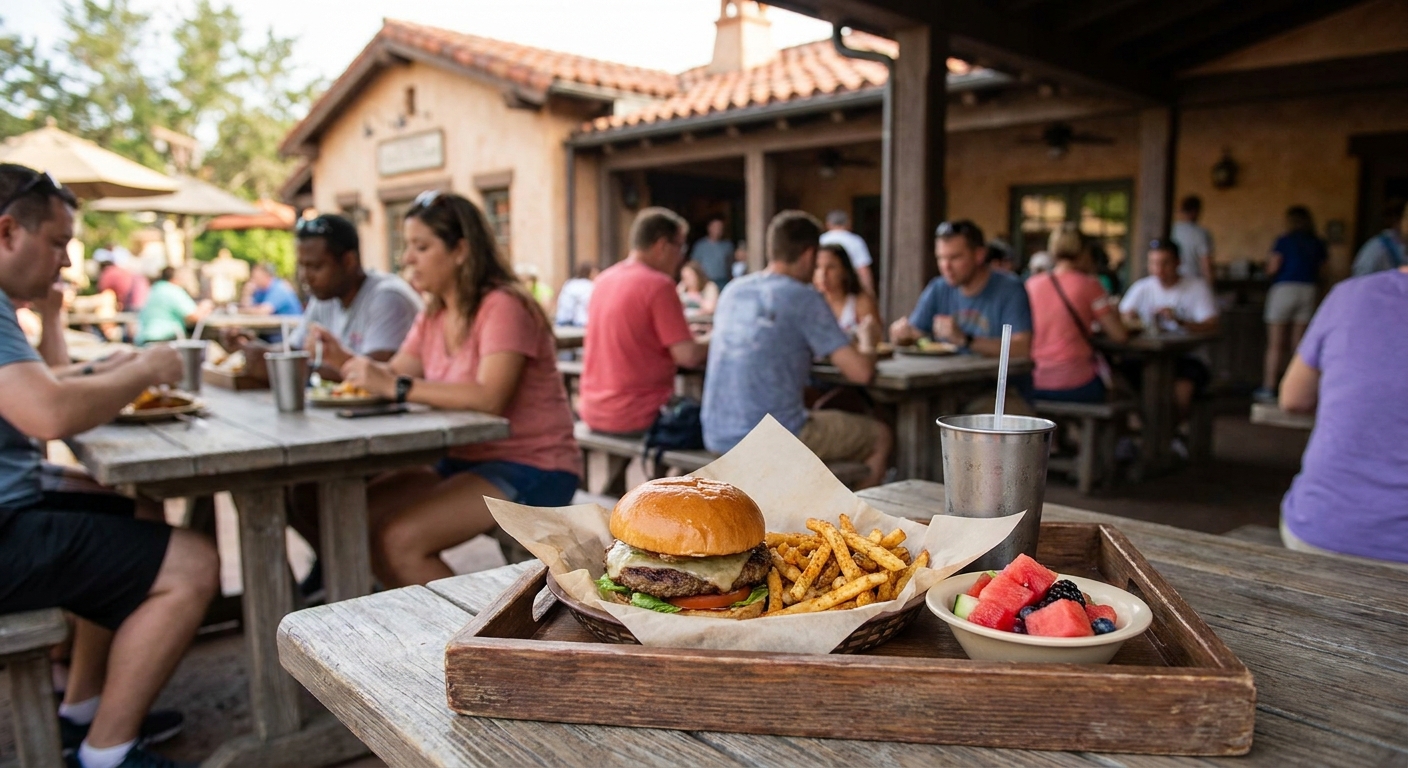
The Best Overall Spanish-Leaning Meal at Disney World
If you want one real, grown-up Spanish-leaning dinner at Walt Disney World, book the Spanish-influenced, open-fire steakhouse at Disney Springs — and order off the Iberian side of the menu, not the steak side. That last part is where most guests get it wrong.
Disney World doesn’t have a classic Spanish restaurant in the parks. No paella pavilion, no tapas bar in World Showcase. What it does have is a Disney Springs signature kitchen built around live-fire cooking, Iberian-style cuts, Spanish-heavy wine, and a starter list that eats exactly like tapas. That’s as close to a true Spanish dinner as the resort gets, and when you order it right, it’s genuinely excellent rather than just “nice for Disney.”
What the meal actually feels like
Expect a slow, polished, adult-paced dinner — closer to two hours than one. Dim lighting, open hearth, a sommelier who will talk to you about Rioja and Ribera del Duero if you give them an opening, and portions designed for sharing. The pacing is the point: courses arrive in waves, and the table is meant to pick at things together.
Budget-wise, treat this as a signature splurge. A two-person dinner with shared starters, one large-format cut or a seafood main, a couple of glasses of Spanish wine, and dessert lands in the range you’d expect from any Disney Springs signature — roughly $150–$250 for two, and higher fast if you go deep on the wine list or a dry-aged cut.
Order the Spanish side, not the steak side
Here’s the move: if you order a plain ribeye and a wedge salad, you’ve paid signature prices for a meal you could get at home. Steer the table toward the Iberian and small-plate end of the menu instead.
- Lean into the tapas-style starters. Two or three shared, plus bread, is a better opening than one big appetizer each.
- Ask what’s cooked over the open fire. Live-fire vegetables and seafood are usually the most distinctive things in the kitchen and get overlooked next to the beef.
- Ask for the Iberian-style cut rather than the standard American steak, if one is offered that night.
- Let the wine do work. A glass-by-glass Spanish flight, or asking the sommelier for a Tempranillo in your price band, is where the “Spanish dinner” feeling actually lands.
- Finish Spanish-adjacent, not with a generic chocolate cake.
Pro tip: Ask your server which starters the kitchen considers shareable before you order a single thing. Signature steakhouses plate some “appetizers” as full single portions, and a table that orders three of those has accidentally bought two dinners each. The small-plate strategy only works if you know which plates are actually small.
Book it early — and know what “late” costs you
Advance Dining Reservations open 60 days before your arrival date, at 6:00 AM Eastern, in My Disney Experience. (Don’t confuse that with the 7:00 AM Lightning Lane Multi Pass window — different system, different time.) Disney Springs signature restaurants are among the hardest tables on property, and prime evening slots go first.
| When you book | What you typically get |
|---|---|
| 60 days out, 6:00 AM ET | Your choice of 6:30–7:45 PM |
| ~30 days out | Edges of prime — 5:30 PM or 8:30 PM |
| Inside 2 weeks | 4:30 PM or 9:15 PM, if anything |
| Day-of walk-up | Bar seating if you’re lucky, otherwise no |
That 4:30 PM / 9:15 PM squeeze is the real consequence of waiting. Neither works well with a park day: 4:30 means leaving a park mid-afternoon, 9:15 means dinner starting after the kids have hit the wall.
If you missed the window, don’t give up — cancellations at signature restaurants are constant, especially 24–48 hours out. This is exactly what SupaPark’s dining Drop Watch is for: set a watch on the restaurant and your target time, and you get pinged the second a table frees up, then you grab it in My Disney Experience. Free accounts get Drop Watch alerts by email; paid plans get instant push.
Who should skip this entirely
- [ ] Kids under ~8, or any kid who can’t sit through a two-hour dinner — the setting will beat you, not the food
- [ ] Anyone booking a 7:00 PM table on a full park day — you’ll be too fried to enjoy it
- [ ] Picky eaters (this is an organ-meat-and-unfamiliar-cuts kind of menu at its best)
- [ ] Anyone who mostly wants churros and sangria — you can get that for a fraction of the price elsewhere at Disney Springs
The takeaway: this is a resort-rest-day or adults-only-night reservation, not a park-day dinner. Book it 60 days out at 6:00 AM, order the small plates and the live-fire dishes instead of a default steak, and let someone else explain Spanish wine to you for an hour.
Tapas and Small Plates: Where to Share Instead of Committing to an Entrée
The smartest Spanish-food move at Disney World isn’t a reservation — it’s two lounge stops and 4–6 shared plates, which usually costs less than one table-service dinner and fails a lot more gracefully with kids.
Here’s the logic. A sit-down dinner for four at a signature restaurant is a two-hour commitment where everyone has to be hungry, patient, and agreeable at the same time. Small plates let you order in waves, bail early, and let a picky eater survive on bread and potatoes while the adults eat well. That’s not a compromise — at Disney Springs and around the resorts, it’s genuinely the better meal.
Build the night as two stops, not one meal
The pattern that works: a savory lounge stop first, a dessert stop second, with a walk in between.
- [ ] Stop 1, around 5:00–5:30 p.m.: a lounge or bar with charcuterie, cheese, croquette-style fried bites, and a flatbread or two. Early seating means you actually get a table.
- [ ] Order 4–6 plates for a party of four, not 3 — more on that below.
- [ ] Walk 10 minutes. Let the kids move. This is the step everyone skips and then regrets.
- [ ] Stop 2: churros, a shared dessert, or a drink for the adults while the kids finish the churros.
- [ ] Hard stop before the meltdown window. Spanish food is relaxed; tired six-year-olds are not.
Where share-style eating actually works
| Where | What it’s good for | Watch out for |
|---|---|---|
| Disney Springs lounges and bars | Charcuterie and cheese boards, fried croquette-style bites, flatbreads, late hours, walk-up seating at off-hours | Peak 6:30–8:30 p.m. waits; boards are snack-sized, not dinner-sized |
| EPCOT World Showcase kiosks and small-plate windows | Grazing with zero commitment — one plate per window, walk and eat, no reservation needed | Plates can run small for the price; standing-only at most windows |
| Resort lounges (Deluxe resorts especially) | Quiet, air-conditioned, Spanish-adjacent snack menus, great on a rest afternoon | Menus change; call it a bonus, not the plan |
| Disney Springs dessert counters | Churros and fried-dough style sweets as the second stop | Lines spike right after dinner rush |
The EPCOT angle is underrated. World Showcase is already a small-plates park by design — you can graze your way around with a plate here and a snack there and never sit down to a single entrée. On a festival day especially, that’s the play: order one thing per booth or window, share every bite, and keep moving.
Portion realism: the under-ordering trap
The classic mistake is treating a lounge menu like an entrée menu. It isn’t. A charcuterie board is a starter for two, not dinner for four. Croquette-style bites usually come three or four to an order. A flatbread feeds one hungry adult or two grazers.
Rough math that holds up:
- Two adults: 3–4 plates, plus one dessert.
- Two adults, two kids: 5–6 plates — load up on the safe carbs (crispy potatoes, bread, flatbread) and let the adults take the braised or seafood plates.
- Order in two rounds. Get three plates, see where you land, add two more. Ordering everything at once is how you end up with cold food and a $130 tab you didn’t intend.
Pro tip: Order one “anchor carb” per person before you order a single adventurous plate — crispy potatoes, bread, a flatbread. Lounge plates land staggered over 20–30 minutes, and the anchor carb is what keeps a hungry kid calm through the gap. Skip it and you’ll order a second round out of panic, which is exactly how a cheap grazing dinner turns into entrée money.
What to actually order
- Crispy or fried potatoes — the single most reliable order at any lounge. Kids eat them, adults eat them, they arrive fast.
- Croquette-style fried bites — small, hot, easy to split, and the most tapas-feeling thing on most Disney Springs menus.
- Cheese and charcuterie boards — great value per person if you treat them as one of several plates, poor value as “the meal.”
- A flatbread — the kid-insurance order, and genuinely good at several Springs spots.
- Mild pork or a simple sandwich if there’s one on the board — more approachable than seafood for a first-timer table.
- Churros last, somewhere else. Churros at Disney Springs are an easy win and the lowest-stakes way to end the night.
Skip the rooftop-at-9 p.m. fantasy
A late, polished Spanish dinner after a full park day is a trap with young kids — not because the food is wrong, but because the setting demands something your family has already spent at Magic Kingdom. Save the premium rooftop or long tasting dinner for a resort rest day or an adults-only night, and do the shared-plates version on park days.
The takeaway for this section: two stops, 4–6 plates, anchor carbs first, order in rounds — and keep the long, fancy Spanish dinner for a day when nobody’s already walked nine miles. If you want to lock in one of the harder-to-get Springs tables for that rest day, SupaPark’s Drop Watch pings you the second a cancellation frees one up, then you grab it in My Disney Experience.
Paella and Spanish Rice Dishes: Honest Expectations
Straight answer: there is no restaurant at Walt Disney World where you can reliably walk in and order traditional Spanish paella on any given day. If you’re searching for it, you’re searching for something that shows up intermittently — a signature restaurant special, a festival booth, a resort lounge menu that rotated in last month and may rotate out next month. Build a park day around it and you’re likely to be disappointed.
That’s not a knock on Disney dining. It’s just what happens with a labor-intensive, saffron-heavy, 40-minute-to-fire rice dish in an operation built on turning tables fast.
Why paella is a moving target here
Three structural reasons it never settles into a permanent menu slot:
- It doesn’t fit quick-service timing. Proper paella wants time and a wide pan. Counter-service kitchens are built for throughput.
- Menus change constantly. Disney restaurants swap items seasonally and without announcement. A dish you read about in someone’s trip report from last spring may already be gone.
- It lives in the “special” tier. When Spanish-style rice does appear, it’s usually as a chef’s feature, a festival item, or a prix-fixe component — exactly the categories most likely to disappear.
Check the menu before you commit the reservation
Do not book a table for paella. Book a table you’d be happy with anyway, then treat paella as a bonus if it’s there.
- [ ] Pull up the restaurant’s current menu in the My Disney Experience app — that’s the closest thing to a live source.
- [ ] Look for the exact dish name, not just “rice” or “seafood.”
- [ ] If the menu shows a rotating chef’s feature, assume today’s version is unknown until you’re seated.
- [ ] Have a specific backup order picked out at the same restaurant before you walk in.
- [ ] If a festival is running, check the booth lineup before you spend a sit-down reservation on it.
Pro tip: If paella genuinely matters to your trip, call the restaurant directly the week of your visit rather than relying on any menu listing — kitchen staff know what’s actually firing right now, and online menus lag real changes by weeks.
The closest things you can actually count on
Here’s where to aim instead, ranked by how reliably you’ll find something in the neighborhood of what you want:
| What you want | Realistic substitute | Where to look | How dependable |
|---|---|---|---|
| Saffron seafood paella | Seafood-and-rice entrées at signature restaurants | Resort signature dining, EPCOT World Showcase | Moderate — varies by season |
| Arroz-style rice and protein | Latin rice-and-protein plates | Disney Springs, resort table service | Fairly steady |
| The social, shareable part | Tapas-style small plates | Resort lounges, Disney Springs | Steady |
| Spanish flavor on a budget | Spanish-leaning snacks and sides | Festival booths, quick service | Seasonal |
The honest read: the experience you’re chasing — a big shared pan, bold rice, people reaching across the table — is easier to replicate with a spread of small plates than by hunting one dish. That’s the smart fallback, and frankly the better family move anyway.
Festival booths are your best seasonal shot
When EPCOT’s festivals are running, the booth lineups rotate and Spanish-style dishes turn up more often than they do on permanent menus. Festival kitchens are built for exactly this: one or two dishes, prepped in volume, no table turn to worry about.
Two caveats worth knowing:
- Booth menus change between festivals and sometimes within one. Check the current lineup rather than last year’s.
- Portions are tasting-size. Plan on two or three booths per person, not one.
The family angle
If you’ve got kids, this is actually good news. Chasing paella means a long sit-down dinner with an unfamiliar dish and a tired table. Treating Spanish food as a snack-and-share adventure — crispy potatoes, bread, mild pork, small bites, churros later — gets everyone fed and nobody melts down at 8 p.m. Save the polished signature dinner for a resort-rest day or an adults-only night.
What to remember
Paella at Disney World is an opportunistic order, not a plan. Verify the menu the week you go, pick a restaurant you’d enjoy regardless, and lean on tapas-style sharing or a festival booth for the flavors you came for.
If the restaurant you’re eyeing is a tough booking, SupaPark’s Drop Watch pings you the moment a table frees up from a cancellation — you grab it in My Disney Experience. Free accounts get those alerts by email at supapark.com.
Sangria at Disney World: Where It’s Good and Where It’s Just Sweet
Most sangria at Disney World is a fruit punch with wine in it — and if you know that going in, you’ll order much better. Spanish sangria is typically dry, wine-forward, and barely sweetened. Theme-park sangria is built to please a crowd of vacationers in 90-degree heat, which means more juice, more sugar, more ice. Neither is wrong. But if you’re expecting something that tastes like a Madrid bodega and you get a glass of liquid Jolly Rancher, that’s a disappointment you can avoid.
Know which style you’re actually ordering
The three main versions behave very differently, and the menu name rarely tells you which camp it falls into.
| Style | What to expect | Best for |
|---|---|---|
| Red (tinto) | Deepest flavor, most forgiving of ice melt; the sweet versions hide behind the fruit | Someone who wants it to taste like sangria |
| White (blanco) | Lighter, often the sweetest of the three — citrus and stone fruit can tip syrupy | Hot afternoons, lighter food |
| Sparkling | Fizz cuts sweetness better than anything else; flattens fast once the ice melts | Drinking it fast at a table, not walking it around |
The honest read: sparkling is the safest order in the parks because carbonation does the work the dry wine isn’t doing. If it’s a kiosk pour you’ll carry across a pavilion for ten minutes, go red.
EPCOT World Showcase: the sangria circuit
World Showcase is where most guests find sangria, and the quality gap between a lounge pour and a window pour is real.
- Pavilion lounges and table-service spots generally pour the more wine-forward versions. Someone built a drink list, there’s a bartender, and the recipe isn’t engineered for a walk-up line.
- Outdoor kiosks and quick-service windows are built for volume. Expect sweeter, more juice-forward, heavier on ice.
- Mexico pavilion is a special case: the margarita and tequila-driven menu is genuinely strong, and it’s the better order there. If you want Spanish-style sangria specifically, Mexico isn’t the stop — it’s a different (very good) drink tradition.
- Pour size at a kiosk is usually a modest 6–8 oz plastic cup. A lounge glass runs closer to a real 8–9 oz wine pour. That difference matters a lot when you do the math below.
Pro tip: Ask the bartender, “Is this one on the sweeter side?” before you order. They answer honestly, every time, and it takes three seconds — it’s the single highest-return question at any World Showcase bar, and it’s how you find out whether the house version leans dry or dessert.
Disney Springs and resort lounges
- Disney Springs bars tend toward the cocktail-program version — fresher fruit, better base wine, sometimes a brandy float. The trade-off is you’re paying bar prices with a bar wait.
- Resort lounges are the quiet winner. No park admission needed, actual seating, air conditioning, and a bartender with time. If sangria is a priority for your trip, a late-afternoon resort lounge beats a crowded pavilion window on almost every axis.
The value math nobody does
Here’s where a little arithmetic changes your whole evening. A single glass of sangria in the parks typically lands in the $16–18 range.
- Two glasses for two adults: roughly $35 before tip.
- A bottle of Spanish wine — Rioja, Albariño, cava — at a table-service restaurant is often in the range of two to three glasses of sangria, and it pours four to five glasses.
So: if two adults each want more than one drink, order the bottle. You get more liquid, more actual wine, and a drink that doesn’t get sweeter as the ice melts. If you’re each having exactly one, the sangria glass wins on convenience and you’re not overpaying.
A simple decision checklist:
- [ ] One drink each, walking the parks → single sangria, go sparkling or red
- [ ] Two-plus drinks each, seated → bottle of Spanish wine, every time
- [ ] You want it dry → skip the kiosks, find a lounge or table-service bar
- [ ] You want it sweet and cold → the kiosk version is genuinely what you want
The family table
If kids are at the table and you don’t want three separate trips to three separate windows:
- Agua fresca-style and fruit-forward nonalcoholic coolers show up across World Showcase and Disney Springs and read as the kid version of the same drink — same fruit, same chill, no wine.
- Sparkling water with a citrus or berry garnish is the quiet move: free or near-free, feels like a cocktail, and a bartender will build it for you without blinking.
- Virgin versions of house sangria aren’t always on the menu but are often possible — ask rather than assume.
The one thing to remember: order sangria for the experience and the shade, not because you think it’ll taste Spanish. If you want the wine, order the bottle — it’s cheaper per glass, drier, and you’ll finish the evening happier about both the drink and the bill.
Churros: The Complete Where-to-Eat Ranking
The honest ranking: the plain cinnamon-sugar cart churro at Magic Kingdom or Hollywood Studios, pulled from a fresh batch, beats almost every fancier churro on property — and costs the least. Everything above it on the price list is buying you dipping sauce, a filling, or a plate, not a better churro.
Here’s how the tiers actually shake out.
Tier 1: The park cart churro (your default)
Every park runs churro carts, and they’re all working from the same basic idea: extruded dough, fried, rolled in cinnamon sugar, handed to you in a paper sleeve.
- Magic Kingdom — the most carts and the most turnover, especially around Main Street U.S.A., Frontierland, and the Fantasyland hub. High traffic means high batch frequency, which means the best odds of a hot one.
- Hollywood Studios — carts cluster near Sunset Boulevard and the Toy Story Land side. Sunset gets heavy flow before and after the theater shows, so batches move fast.
- EPCOT — World Showcase has snack kiosks, but if you want a churro specifically, don’t wander hoping. Check the app for the current cart locations before you commit to a lap.
- Animal Kingdom — fewer churro-dedicated spots and a park layout that spreads guests thin. Lower turnover, so the fresh-batch check matters most here.
Pro tip: Watch the cast member’s tongs, not the case. If churros are stacked in rows under a heat lamp with a slightly leathery sheen, they’ve been sitting. A fresh one has visible loose sugar still clinging in clumps, audibly crackles when it bends, and will be too hot to eat for about 90 seconds. If you see a tray coming out from the back, wait the extra two minutes — it’s the single highest-return snack decision in the park.
Tier 2: Filled, dipped, and specialty churros
Disney rotates specialty churros — flavored sugars, filled centers, seasonal glazes — tied to holidays and festivals. These come and go constantly, so treat any specific flavor as “check the menu board today,” never as a guarantee.
| Style | What you’re paying for | Worth it? |
|---|---|---|
| Standard cinnamon-sugar cart | The churro itself | Yes — the baseline, and the best texture |
| Dipping-sauce add-on | Chocolate or caramel on the side | Only if sharing; sauce hides a stale churro |
| Filled (cream/fruit centers) | A softer, denser bite | Mixed — filling kills the crunch |
| Seasonal/festival flavored | Novelty and a photo | Once, for the novelty, not twice |
| Table-service dessert plate | Plating, sauces, garnish, service | Only if you’re already dining there |
The structural problem with filled churros: injecting anything into the center steams the dough from the inside. You trade the shatter for sweetness. If crunch is what you love about a churro, order plain and get sauce on the side.
Tier 3: Disney Springs and table service
Disney Springs is the low-pressure play — especially with kids. You’re not burning park time, there’s seating, and nobody has to behave through a long meal. A churro and a walk along the water is a genuinely easy family win compared to gambling a tired 7-year-old on a late sit-down dinner.
At table-service restaurants, churros show up as a composed dessert — cut short, stacked, plated with sauces or ice cream. These are desserts that include churros, not churro upgrades. Order one because you want dessert where you’re sitting, not because you went looking for churros.
Timing: when to actually buy
- [ ] Mid-morning (around 10–11 a.m.) — carts are stocked, lines are short, batches are turning over
- [ ] Right before a parade or show — surge demand forces fresh frying; stand near a cart as the crowd builds
- [ ] Avoid the dead afternoon lull at low-traffic carts — that’s where sitting churros live
- [ ] Avoid the last 30 minutes before park close — nobody’s firing a fresh batch for you
Allergy and ingredient caution
Churros are fried, which means shared-oil questions and cross-contact risk. Carts are not the place to assume. Ask the cast member directly about allergens and preparation before you order — they can pull ingredient information, and at a cart they’d rather check than guess. If your allergy is serious, a quick-service or table-service location with a kitchen and a chef on hand is a safer ask than a cart.
The takeaway: order the plain cart churro, insist on a fresh batch, and put the money you saved on specialty versions toward a second one. If you want SupaPark to handle the timing side, the crowd heat map shows you which areas are surging — that’s your fresh-batch signal.
Resort Lounges Worth the Trip: Spanish Wine, Sherry, and Late-Night Bites
The move: skip the hard-to-book Spanish dinner entirely and build an adults-only lounge night at a Deluxe resort you’re not staying at — walk-up seating, a real wine list, and small plates you can actually get at 8:45 p.m. without a reservation.
This is the most underrated date night on property, and almost nobody plans it. Lounges hold back seats for walk-ups, they pour by the glass from lists that lean Spanish and Iberian more often than the park restaurants do, and the whole thing costs a fraction of a signature dinner. You get the Spanish flavors — sherry, Rioja-style reds, Tempranillo, charcuterie and cheese boards, olives, crispy potatoes, cured ham — in a setting where nobody’s waiting on a 7 p.m. table.
Why a lounge beats a reservation for Spanish flavors
- Walk-up is the whole point. Most Deluxe lounges take walk-ups and often keep a mobile or in-person waitlist. When every table-service slot is gone, this is the door that’s still open.
- Wine by the glass goes deeper than menus suggest. Deluxe resort bars and signature-restaurant lounges tend to carry more Spanish and Iberian bottles than their quick-service neighbors — ask specifically for Tempranillo, Rioja-style reds, Albariño, cava, or sherry rather than scanning for the word “Spanish.”
- Small plates do Spanish-adjacent well. Cheese and charcuterie boards, marinated olives, cured meats, bread service, fried potatoes — order three or four and you’ve effectively built tapas.
- Price control. Two glasses and two shared plates lands well under a signature entrée each, and you can stop whenever you want.
Pro tip: Ask the bartender what sherry or fortified wine is open by the glass even when it isn’t printed on the menu — bar teams at Deluxe lounges often have a bottle or two behind the rail for cocktails, and a pour of dry fino or amontillado next to a cheese board is the most Spanish thing on property outside EPCOT’s Spain pavilion.
Pick your lounge by how you’ll get there
Transport decides this more than the menu does. Choose the resort cluster you can reach without a car.
| Cluster | How you get there | Vibe | Kids welcome? |
|---|---|---|---|
| Monorail resorts (Grand Floridian, Polynesian, Contemporary) | Monorail from Magic Kingdom or TTC; boats from MK | Polished to lively; fireworks views nearby | Generally yes in lounges with full menus; late slots skew adult |
| Skyliner resorts (Riviera, Caribbean Beach) | Skyliner from EPCOT or Hollywood Studios | Rooftop and lakeside, quieter weeknights | Yes, but it’s the most date-night-feeling of the bunch |
| EPCOT-area (BoardWalk, Yacht & Beach Club, Swan/Dolphin) | Walk or Friendship boat from EPCOT’s International Gateway | Loudest; boardwalk energy | Yes, very |
| Animal Kingdom Lodge | Bus (plan extra time) | Darkest, calmest, most atmospheric | Yes, and savanna viewing helps |
- Skyliner is the best value for a lounge hop from EPCOT or Hollywood Studios — scenic, fast, and it closes relatively early, so check the last gondola before you order a second round.
- Monorail makes a multi-stop crawl genuinely easy: one lounge, one ride, next lounge.
- Buses are the weak link. If Animal Kingdom Lodge is the goal, treat the bus as a 45-minute proposition and build the night around it rather than squeezing it in.
Timing: get there before the crowd does
The post-fireworks wave is real and it’s brutal for walk-ups. Here’s the sequence that works:
- [ ] Leave the park before the nighttime show, not after — you’re trading the finale for a seat
- [ ] Arrive at the lounge between 7:30 and 8:15 p.m. for the best walk-up odds
- [ ] Put your name in immediately, then wait at the bar or outside rather than leaving the area
- [ ] Order the shared plates first; wine takes 90 seconds, a cheese board can take 15 minutes
- [ ] Check last Skyliner or monorail timing before your final round
- [ ] Have a backup lounge in the same cluster — monorail and EPCOT-area resorts give you two or three within walking or one-stop distance
Arrive at 9:45 p.m. instead and you’ll hit a 40-minute wait behind everyone who just watched the same show you did.
If kids are coming
Most resort lounges with a food menu do allow children, but the experience changes. A late lounge sit after a full park day is a risk, not a treat — tired kids and a slow charcuterie board don’t mix. Better plan: do the lounge on a resort-rest afternoon, when the room is half-empty, service is fast, and you can order fried potatoes and bread that any kid will eat. Save the 8 p.m. version for the adults-only night.
The takeaway: a Deluxe resort lounge is the only reliable way to get Spanish wine and tapas-style plates at Disney World without winning a reservation lottery — pick by transport, show up by 8:15 p.m., and ask what’s open behind the bar.
Spanish Food at EPCOT: What World Showcase Can and Can’t Give You
There is no Spain pavilion in World Showcase — and if you walk in expecting one, you’ll spend an hour circling the lagoon getting increasingly annoyed. EPCOT has eleven country pavilions. Spain is not one of them, and it never has been. What EPCOT does have is Spanish-adjacent flavor scattered across three pavilions and whatever festival booths happen to be running during your visit. Know that going in and you can still eat extremely well. Expect paella and sangria on tap year-round and you’ll be disappointed.
Where Spanish-leaning food actually lives
| Stop | What you’re actually getting | Best for |
|---|---|---|
| Mexico pavilion (table service, inside the pyramid) | Dark, indoor, volcano-and-boat-ride atmosphere; Latin flavors, margaritas, shareable starters | The closest thing to a sit-down “Spanish-ish” meal, and the best themed room in the park |
| Mexico quick service (lagoon side) | Tacos, nachos, margaritas and frozen drinks without a reservation | Fast, cheap, kid-proof, zero commitment |
| Morocco pavilion | Genuine Mediterranean/North African overlap — olives, bread, spiced meats, couscous-style plates | Small plates that scratch the tapas itch better than anything else standing |
| Italy pavilion | Cured meats, cheeses, bread, wine by the glass at the outdoor spots | A shareable Mediterranean grazing board in open air |
| Festival booths (when a festival is running) | Rotating international kiosks — Spain and Mediterranean-leaning booths appear in some lineups | The only real shot at paella or genuine tapas-style portions at EPCOT |
The honest read: Mexico is Latin, not Spanish, and Morocco is North African. They overlap with Spanish cooking in ingredients and format — small plates, olive oil, bread, spiced pork, seafood — not in origin. Lean into the overlap and you’ll be happy. Hunt for literal Spanish cuisine and you’ll come up short most of the year.
Pro tip: EPCOT’s seasonal festivals are the whole ballgame here. When one is running, the booths change the math completely — you get small, shareable, wander-and-eat portions that are structurally closer to tapas than any permanent EPCOT restaurant. Check what’s actually operating on your dates before you build a food plan around it; booth lineups rotate and nothing is guaranteed.
The one-loop Spanish-leaning crawl
Go counter-clockwise from Mexico, which puts the heaviest, most atmospheric stop first while you’re still hungry and the park is still quiet, and leaves you near the front exit at the end.
- [ ] Mexico, late morning — start inside the pyramid or grab something at the quick-service window. Get here before the lunch surge.
- [ ] Walk the lagoon to Morocco (~10–12 min at a normal pace) — this is your tapas-substitute stop. Order small, order to share, don’t commit to a full entrée each.
- [ ] Italy, next door — bread, cured meat, cheese, a glass of wine. Outdoor seating, low stakes.
- [ ] Any festival booth you pass — if a festival is on, treat the walk itself as the menu. One item per booth, split it.
- [ ] Finish with something sweet — a churro or fried-dough snack from a cart on your way back around.
Budget two and a half to three hours for the full loop if you’re grazing properly, including walking and a sit-down stop. You can compress it to about 90 minutes if you skip table service entirely and treat it as a standing snack crawl — which, honestly, is the better version with kids.
How to do this without blowing up your day
The whole point of a crawl like this is that it’s low-stakes. Spanish food works beautifully with kids when the setting cooperates — crispy potatoes, bread, mild pork, sandwiches, churros are all easy sells. What fails is a long, polished, unfamiliar dinner at 7:00 PM with tired children. So:
- Share everything. Don’t order one plate per person of food nobody has tried. Order two or three to the table and let people pick.
- Go early. World Showcase pavilions get genuinely crowded from about midday onward, and the festival booths build long lines in the afternoon.
- Don’t force a reservation unless the Mexico table service is specifically something your group wants for the atmosphere. If it is, book it — Advance Dining Reservations open 60 days before arrival at 6:00 AM Eastern in My Disney Experience, and the pyramid interior is one of the more requested rooms in the park.
The smart move: if the Mexico table service is already booked when you look, set a dining Drop Watch on supapark.com — cancellations shake loose constantly, and SupaPark pings you the moment a table frees up so you can grab it in My Disney Experience. That beats refreshing the app yourself fifteen times a day.
Disney Springs vs EPCOT vs Resort Lounges: Which Setting Fits Your Night
The cuisine barely changes between these three settings — the logistics do, and that’s what decides whether your Spanish night lands or falls apart. Same tapas, same sangria, wildly different difficulty curve. Pick the setting that matches your group’s energy level, not the one with the prettiest photos.
The three settings, side by side
| Factor | Disney Springs | EPCOT World Showcase | Resort lounges |
|---|---|---|---|
| Best for | Families, big groups, late arrivals | Solo snackers, couples doing a sip-and-stroll | Couples, adults-only nights, resort-rest days |
| Price per person | Wide range — share plates and you can keep it modest; sit-down signature spots climb fast | Lowest entry point; small-plate kiosks and counter bites, pay as you go | Highest per hour — small plates plus drinks add up quickly |
| Reservation difficulty | Moderate to hard for the popular spots; walk-up bars are your pressure valve | Mostly none needed for counter service; table service in World Showcase books out | Easiest — many lounges are first-come, and that’s the whole appeal |
| Park ticket needed? | No | Yes | No |
| Noise / kid tolerance | High — loud, busy, nobody notices a meltdown | High outdoors, lower in sit-down restaurants | Low — quiet rooms where a restless 5-year-old feels very visible |
| Transportation effort | Easy — bus, boat, or drive straight in | Highest — park entry, security, a long walk around the lagoon | Moderate — one bus/boat/Skyliner hop, usually no lines |
| Time commitment | 45 min (churros and out) to 2+ hours | Bundled into a full park day | 60–90 min, easy to cut short |
| Alcohol depth | Deepest — full bars, wide sangria and Spanish wine range | Decent, but built for walking: limited pours, sized for strolling | Strong on cocktails and curated lists; narrower bottle selection |
Read the table as a decision, not a menu
- Disney Springs is the forgiving option. No ticket, no park-day fatigue, and if the table-service plan collapses you pivot to a shared snack and a drink at a bar without anyone calling it a failure. That flexibility is worth more than any single dish.
- EPCOT is for grazing, not dining. World Showcase works beautifully as a small-bites crawl between attractions — but it costs you a park ticket and your most limited resource, park-day stamina. Don’t burn a ticket purely for a meal.
- Resort lounges are the adults-only play. Lower noise, calmer pacing, better cocktails, and no security line. They are also the setting where tired kids do the most damage to your evening.
Pro tip: The best Spanish night with kids isn’t a dinner at all — it’s an afternoon or early-evening snack-and-share at Disney Springs: crispy potatoes, a sandwich, mild pork, bread, churros. Low stakes, low cost, nobody has to behave through four unfamiliar courses at 8 p.m. Save the polished rooftop or signature meal for a resort-rest day or a night out without the kids.
The verdict by traveler type
- Families with kids under 10: Disney Springs, before 6 p.m. Share plates, order at least one guaranteed-win item per kid, and treat churros as the closer. Skip the late reservation entirely.
- Families with teens: Disney Springs for a real sit-down meal, or EPCOT as a grazing crawl if you’re already in the park. Teens handle tapas pacing fine; they just need volume.
- Couples: Resort lounge. Quietest room, best cocktail program, zero ticket cost, and you can leave after an hour without having wasted a reservation.
- Big groups (6+): Disney Springs. It’s the only setting that reliably seats a crowd, handles split checks without drama, and absorbs the noise a large party makes.
- Solo diners: EPCOT if you’re already inside — small bites eaten standing up are the ideal solo format. Otherwise, a resort lounge bar seat.
- Adults-only night: Start at a resort lounge for drinks, then move to Disney Springs for the food. You get the calm room and the deeper menu without committing your whole evening to one place.
Before you commit the reservation
- [ ] Decide the setting from your group’s energy, not the cuisine
- [ ] Check whether the spot needs a table at all — many don’t
- [ ] If it does, remember ADRs open 60 days before arrival at 6:00 AM ET in My Disney Experience
- [ ] Set a Drop Watch for anything already booked solid — SupaPark catches the cancellation and pings you, then you grab it in My Disney Experience
- [ ] Build in an exit: a snack-and-drink fallback if the sit-down plan dies
The takeaway: Disney Springs is the default for anyone traveling with kids, resort lounges win the adults-only night, and EPCOT is a grazing bonus — never the reason you bought the ticket.
What to Order: Dish-by-Dish Picks and What to Skip
The move: treat Spanish food at Disney World as a snack-and-share adventure, not a high-stakes sit-down dinner where tired kids have to behave through five courses of unfamiliar food. Order a few small plates, let everyone sample, and leave room for churros on the walk out.
Tapas-style starters: order three, not eight
Small plates are where Spanish menus shine and where guests most often overspend. Tapas-style starters typically run roughly $10–$20 each and genuinely are small — think two to four bites per person at a table of four.
The rookie mistake is ordering a full table of unfamiliar dishes at 8 p.m. and hoping everyone suddenly becomes adventurous. Instead, anchor the order with one dish you know will land (crispy potatoes, bread, something mild and fried) and use the other two as the experiment.
- Best for: adults grazing, mixed-appetite groups, pre-dinner drinks
- Portion reality: three to four plates per two adults to equal a meal
- Candid note: vegetable-forward small plates are the most common “that was it?” moment — beautiful, tiny, and priced like an entrée
Charcuterie, cheese, and croquette-style bites
| Order | Best for | Portion reality | Watch out for |
|---|---|---|---|
| Cured meat / cheese board | Sharing, slow drinks, picky eaters who like salty things | Looks generous, disappears fast with 3+ people | Often the priciest per ounce on the menu |
| Croquette-style fried bites | Kids, first-timers, anyone unsure about Spanish food | Usually 2–4 pieces — order two orders for a family | Easy to under-order; rarely a bad value |
| Bread, olives, crisps | Buying time while entrées cook | Filler, by design | Charged separately at many places |
Boards are the single best “introduce Spanish flavors without pressure” play. Nothing is spicy, everything is recognizable, and kids can build their own bites.
Grilled and open-fire meats
This is where Spanish cooking earns a real dinner reservation. Open-fire and grilled preparations tend to be the most satisfying entrées on these menus and the most likely to justify the price — mild pork and grilled chicken preparations are reliably kid-passable.
Pro tip: if you’re taking kids to a premium Spanish-leaning table-service spot, book it for a resort-rest day in the late afternoon rather than after a full park day. The food isn’t the risk — a 7 p.m. reservation at the end of a 25,000-step day is.
Seafood rice dishes
Paella-style rice is the most romanticized and most frequently misjudged order on any Spanish menu.
- Best for: two to four adults splitting one dish; it is almost never a solo order
- Timing: these often take 30–45 minutes to come out — order it first, not as a follow-up round
- Price reality: typically the top of the menu, often $40+ for a shareable portion
- Candid note: this is the dish guests most often call overpriced, usually because they ordered it as a single entrée or expected shellfish-heavy abundance. Ask what’s in it before committing
Skip it entirely if your table includes seafood skeptics or anyone who won’t wait.
Churros and Spanish-style desserts
Churros are the cheat code. Low cost, high reward, zero reservation required, and the easiest possible way to get kids excited about Spanish food.
- [ ] Order churros as a walking dessert, not a seated course
- [ ] Share one order first — portions are usually bigger than they look
- [ ] Ask for the dipping sauce on the side so you can control the mess
- [ ] Hit a Disney Springs churro stop on an evening with no dining reservation at all
Custard and cream-based Spanish desserts are the quieter win for adults — less sweet than the American dessert default and usually cheaper than a signature-restaurant dessert.
Sangria and Spanish wine
Sangria by the glass runs roughly in the $14–$18 neighborhood at Disney bars and lounges, which makes the pitcher the better math any time two or more adults are drinking.
| Drink | Order it when | The catch |
|---|---|---|
| Sangria by the glass | One drinker, or you’re unsure about the recipe | Priced like a craft cocktail, often sweeter than expected |
| Sangria pitcher | Two-plus adults settling in | Commits you to one style for the whole table |
| Spanish red by the glass | You want the food to be the star | House pours vary widely; ask what’s open |
Spanish reds are among the better-value by-the-glass pours at Disney table service — frequently more interesting than the generic cabernet default at a similar price.
The takeaway
Build the order in this shape: one safe starter, one croquette-style bite, one shared board or grilled plate, churros after. Save the paella and the polished premium dinners for an adults-only night or a rest day — that’s when they’re worth what they cost.
Cost Breakdown: What a Spanish Food Day Actually Costs
The honest headline: the food is rarely what blows up your bill — the alcohol and the signature entrées are. Strip those two line items out and a “Spanish food day” at Disney World lands closer to a theme park snack run than a special-occasion splurge.
Here’s what three realistic versions actually look like, per adult, before tax and tip.
Three routes, three budgets
| Route | What you get | Per-adult food | Per-adult drinks | Rough pre-tax subtotal |
|---|---|---|---|---|
| Snack Route | Churros, one shared small plate, one sangria | around $15–20 | one glass (~$14–16) | ~$30–35 |
| Lounge Route | Two resort/Disney Springs lounges, 2–3 shared plates per stop, two drinks each | $30–40 | two drinks (~$28–32) | ~$60–75 |
| Signature Route | One Disney Springs Spanish-leaning steakhouse dinner, appetizer + entrée + wine | $75–110+ | wine by the glass (~$18–25) | ~$100–140+ |
Then layer on the math nobody puts on the menu board:
- Tax: add roughly 6.5–7% sales tax in Orange County.
- Tip: 18–20% at table service and lounges. Counter-service churros? No tip needed.
- Real-world rule: take your pre-tax subtotal and multiply by about 1.25 for table service, 1.07 for counter service.
So the Lounge Route at ~$70 pre-tax is really ~$87 out the door. The Signature Route at ~$120 is closer to ~$150. That gap compounds fast.
The two-adults-plus-two-kids multiplier
Kids don’t eat a full adult share of tapas, and that works in your favor.
| Route | 2 adults | 2 kids (realistic share) | Family total, after tax + tip |
|---|---|---|---|
| Snack Route | ~$65 | ~$20 (churros + a drink each) | ~$90 |
| Lounge Route | ~$140 | ~$30 (fries, bread, a plate they’ll actually eat) | ~$210 |
| Signature Route | ~$240 | ~$60–80 (kids’ menu, if offered) | ~$375+ |
That’s a roughly 4x spread between the cheapest and the most expensive version of “we ate Spanish food today.” Same cuisine. Wildly different receipts.
Where the money actually goes
- Alcohol is the single biggest multiplier. Two sangrias per adult across a lounge crawl can equal the entire food bill. One drink each instead of two cuts the Lounge Route by nearly a third.
- Signature entrées are the second. A premium steak or a seafood paella for the table is where a $200 dinner becomes a $350 dinner.
- Small plates are cheap per person because they’re shared. Crispy potatoes, bread, croquette-style bites, and a ham plate feed four for the price of one entrée.
- Kids are nearly free on the Snack Route. Churros and a drink are the cheapest “we did a cultural food thing” line item on property.
Pro tip: Order the lounge food, skip the lounge cocktails, and get your drink at your resort before you head out. The plates carry the experience; the markup lives almost entirely in the glass.
The cheapest way to genuinely feel like you did it
- [ ] Churros for everyone — shareable, low-risk, kids are instantly on board
- [ ] One shared crispy-potato or bread-and-olive plate
- [ ] One sangria split between two adults
- [ ] Eat standing or at outdoor seating — no table service, no tip
- [ ] Do it mid-afternoon, between lunch and dinner, when counters are quietest
Total damage: well under $50 for a family of four. You’ll have tasted the cuisine, taken the photo, and kept your dinner budget intact.
When the expensive option is actually worth it
Three conditions, and you want all three:
- It’s a resort day or a rest day, not the back half of a 14-hour park day.
- Your kids can genuinely sit through a long, polished dinner — or they’re not coming.
- You’re treating it as the night, not as a meal squeezed between fireworks and a bus.
A 7 p.m. signature reservation after Animal Kingdom open-to-close is how a $375 dinner becomes a $375 argument. The same dinner on an adults-only night, ordered deliberately, is one of the better meals on property.
The hardest Spanish-leaning tables at Disney Springs book out early, and ADRs open 60 days before arrival at 6:00 AM Eastern in My Disney Experience. If your window has passed, set a Drop Watch on supapark.com — cancellations shake loose constantly in the 48 hours before a reservation, and SupaPark pings you the second one frees up so you can grab it in My Disney Experience.
The takeaway: budget the drinks, not the dishes. Spanish food at Disney World is one of the few cuisines on property where the cheap version and the expensive version taste genuinely similar — the difference you’re paying for is the chair you sit in.
Booking Strategy: Reservations, Drop Watching, and Walk-Up Plan B
The only Spanish-leaning table at Disney World that genuinely needs a 60-day assault is the Disney Springs reservation everyone wants at 7:00 p.m. — everything else in this guide, you can realistically get within a week of your trip, or walk up to.
That distinction matters because most planners spend their 60-day energy in the wrong place. Here’s how the mechanics actually work, and where to spend your attention.
The 60-day rule, in plain terms
Advance Dining Reservations open 60 days before your arrival date, at 6:00 a.m. Eastern, in the My Disney Experience app. Two things people get wrong:
- It’s 60 days, not 180. If you’re working off an old blog or an old relative’s advice, you’re two months late to your own booking window.
- It’s 6:00 a.m. Eastern for dining — not 7:00 a.m. That 7:00 a.m. slot is the Lightning Lane Multi Pass advance window (7 days out for Disney resort guests, 3 days for off-site). Different system, different alarm. Don’t merge them in your head and show up an hour late to the dining drop.
If you’re staying on-site, your whole-trip dining window opens off your arrival date, so you can book your last night’s dinner at the same 6:00 a.m. as your first. Build your list the night before — restaurant, date, time window, party size — because the first ten minutes decide the popular tables.
Which places need the full push
| Type of spot | 60-day alarm? | Realistic late-booking odds | Walk-up reality |
|---|---|---|---|
| Signature/upscale Disney Springs table service (prime 6:30–8:00 p.m.) | Yes | Low at prime time, better at 4:45 or 9:00 p.m. | Possible on weeknights, rarely on weekends |
| Mid-tier Disney Springs table service | Helpful, not critical | Good inside 2 weeks | Often yes, especially before 5:00 p.m. |
| Resort lounges and bars | No | N/A — mostly first-come | Yes, this is the whole plan |
| Quick-service churro/snack stops | No | N/A | Always |
The practical read: book the one hard table at 60 days, then stop. Overbooking table service on a Spanish-food night usually means dragging a tired group across property for a meal that a lounge and a shared plate would have handled better.
How cancellations actually behave
Cancellations cluster in the 24–48 hours before the date, and it’s not random. Most Disney dining reservations carry a per-person no-show penalty, and the cancellation deadline is typically the day before — so people who overbooked at 60 days dump their extras right before that cutoff to avoid the charge. That creates a predictable wave of freed tables one to two days out, plus a smaller trickle the morning of as plans shift.
This is why “sold out” at 60 days is not a verdict. It’s a queue.
Working the drop without living in the app
Refreshing My Disney Experience every ten minutes for two days is a bad use of your vacation. Set a dining Drop Watch in SupaPark on the table you want instead — SupaPark monitors the availability and pings you the second a cancellation frees a slot in your window. You then book it yourself in My Disney Experience, because that’s where every Disney reservation lives; SupaPark only watches and alerts.
- Free members get Drop Watch alerts by email (up to 10 a day), which is plenty if you keep your phone nearby.
- Silver and Gold get instant push and unlimited watches — worth it in the 48 hours before a date, when a table can be gone in minutes.
Pro tip: Set your watch on a time range, not a single time, and include the 4:30–5:15 p.m. and post-8:30 p.m. edges. Early and late slots free up far more often than the 7:00 p.m. prime block, and at a tapas-style meal the early seating is objectively better — quieter room, faster kitchen, and you’re out before the Disney Springs evening crush.
Your walk-up Plan B
The My Disney Experience walk-up list is the most underused tool in Disney dining. You join it from the app once you’re physically near the restaurant during operating hours, and you get a text when your table’s ready — no standing at a host stand.
- [ ] Arrive in the area and open My Disney Experience → Check Availability / walk-up list
- [ ] Join for the smallest workable party size (smaller parties clear faster)
- [ ] Join before 5:00 p.m. on a weeknight for the best shot
- [ ] Park yourself at a nearby lounge while you wait — a drink and small plate beats pacing
- [ ] Keep your Drop Watch running; a cancellation can beat the walk-up list
The takeaway: set your alarm for 6:00 a.m. Eastern at 60 days for the one table you truly want, let a Drop Watch handle the rest, and treat the walk-up list plus a resort lounge as a Plan B good enough that you’d be happy landing there.
Planning It Into a Real Park Day Without Wrecking Your Schedule
The single biggest mistake with Spanish food at Disney World isn’t picking the wrong restaurant — it’s booking the right one at a time that quietly eats three hours of your day.
Tapas and paella don’t fit a park day the way a counter-service burger does. Small plates come out staggered, sangria slows everybody down, and that’s the point — but it means the meal is the event, not a pit stop. Plan around that and it’s one of the best evenings of your trip. Plan badly and you’ll be sprinting to a bus queue with half a plate of patatas bravas behind you.
Disney Springs dinners cost more time than the meal itself
A Disney Springs reservation is genuinely appealing: no park ticket needed, no turnstiles, and the Spanish-leaning options there are some of the easiest wins with kids (churros are a no-brainer). The catch is transit. From most resorts you’re on a bus, and Disney Springs buses tend to be the most crowded of the night — especially in the window after dinner when every restaurant turns over at once.
Budget it honestly:
| Leg | Realistic time | Notes |
|---|---|---|
| Resort → Disney Springs (bus) | 20–40 min including wait | Longer from value resorts with multiple stops |
| Dinner (tapas-style, shared plates) | 75–105 min | Small plates arrive in waves; don’t fight it |
| Walk to bus stop + queue home | 25–50 min | Worst right after 9 PM; lines snake at peak |
That’s a three-hour block minimum. If you’re trying to also catch fireworks at Magic Kingdom or EPCOT that night, you’re not doing both well. Treat a Disney Springs dinner as the whole evening — it pairs best with a half-day park morning or a resort rest day.
The 6–8 PM reservation trap
Nighttime shows generally run in the last hour the park is open, and that is exactly when a leisurely Spanish meal is hitting dessert. A 6:30 PM table sounds perfect and then collides head-on with the show you told your kids about.
Pick a lane:
- Dinner is the event: book 7:00–7:30 PM, skip the show that night, and enjoy a calm walk out while everyone else is packed on the exit path.
- Show is the event: book 4:30–5:15 PM, eat early, and you’re free and fed when the crowd surges toward the viewing spots.
- Both, carefully: 8:30 PM or later on a late-close night — only if your group can genuinely do a long dinner after a full park day.
Pro tip: A late lunch reservation around 1:45–2:30 PM is the most underrated slot in Walt Disney World. You skip the lunch rush, you’re sitting in air conditioning during the hottest, most crowded stretch of the afternoon, and you come back out when waits are easing and families with little kids are heading to their resorts.
Slot EPCOT sangria and small plates between attractions, not instead of them
World Showcase is built for this — small plates and a glass of sangria are a 45-minute break, not an evening commitment. The move is to use it as your deliberate mid-afternoon reset between your Lightning Lane windows, then come back out for the back half of the day.
- [ ] Rope drop your must-do headliner before the park fills
- [ ] Knock out your first Lightning Lane Multi Pass selection in the morning
- [ ] Mid-afternoon: small plates and sangria in World Showcase
- [ ] Refill your next Multi Pass selection while you’re seated
- [ ] Walk back toward your ride window with 15 minutes of buffer
Build the ride windows around the meal — not the other way around
This is where Lightning Lane Multi Pass genuinely helps, because you choose your selections in advance. Disney resort guests can start picking 7 days before arrival, off-site guests 3 days, with the window opening at 7:00 AM Eastern. If you already have a 2:00 PM reservation, don’t take a 1:30 PM ride window and hope — put your selections in the morning and late afternoon and leave the meal hour clear.
Two things that save actual stress:
- Advance Dining Reservations open 60 days before arrival at 6:00 AM Eastern in My Disney Experience — a different time from the 7:00 AM Lightning Lane window. Don’t confuse them and miss both.
- Always have a plan B. Rides open late, go down mid-morning, and when a headliner is unavailable the crowd floods the next obvious option. Decide in advance: “if not Jungle Cruise, then Pirates of the Caribbean” — or shift toward Frontierland, or take the snack and recheck the board. Standing in Adventureland debating while the park moves around you is the worst outcome.
SupaPark’s park-day builder slots your meal into the day and shows you what fits around it, and live waits tell you whether that walk back across World Showcase is worth starting now or after one more glass. If a hard-to-get table frees up, Drop Watch pings you — you book it in My Disney Experience. Start at supapark.com.
The one thing to remember: decide whether the meal or the nighttime show is the headline event of your evening, then build everything else around that call.
Families, Kids, and Picky Eaters: Making Spanish Food Work
Treat Spanish food at Disney World as a snack-and-share adventure, not a high-stakes sit-down dinner where tired kids have to behave through three courses of tapas. That single reframe is what separates a great night from a $200 meltdown.
Here’s the thing nobody tells you: with Spanish-leaning dining, the setting matters far more than the cuisine. Kids who “won’t eat Spanish food” will happily demolish crispy potatoes, grilled bread, mild pork, and a bag of churros. The food isn’t the obstacle. A 7:00 p.m. reservation after a 12-hour park day is.
Which settings actually work with kids
| Setting | Works with kids? | Why |
|---|---|---|
| Churro cart or Disney Springs snack stop | Yes — easy win | Zero commitment, zero wait, hands and walking allowed |
| Disney Springs casual dining | Yes | Louder rooms, faster pacing, stroller-tolerant walkways |
| Early EPCOT small plates (opening to ~5:30 p.m.) | Usually | Kids are fresh, rooms are quiet, food comes in waves |
| Resort lounge, mid-afternoon | Sometimes | Depends on the lounge and your kid’s volume setting |
| Late signature dinner, 7 p.m.+ | Risky | Long courses, polished room, overtired kids |
| Adults-focused lounge at night | No | Not the vibe, not the pacing, not fair to anyone |
The pattern is simple: daylight and casual = yes; nighttime and polished = save it. If you’ve been eyeing a premium Spanish-leaning dinner, put it on a resort-rest day or an adults-only night, not on the back end of a rope-drop morning.
Kids’ menu realities (set expectations now)
Spanish-leaning spots tend to be small-plates-driven, which means the kids’ menu is often an afterthought — a short list of the usual chicken-and-pasta suspects, if it exists at all. Don’t count on a dedicated kids’ menu at tapas-focused or lounge-style venues. Plan to feed kids off the shared plates instead, which is genuinely better value anyway.
Order these as your bridge foods — familiar enough to disappear, Spanish enough to count:
- Crispy fried potatoes (basically upgraded fries)
- Grilled or crusty bread with olive oil
- Mild pork or chicken bites, nothing heavily spiced
- Simple cured meats and plain cheese
- Churros with the chocolate on the side, not poured over
Pro tip: Order one or two bridge plates first and let them land before anything adventurous hits the table. Hungry kids reject unfamiliar food on principle; fed kids will try a bite of anything. The mistake is a full table of unknowns arriving at once while everyone’s blood sugar is in the basement.
Timing around naps and meltdowns
- [ ] Pick a window: 11:30 a.m.–1:30 p.m. or a 4:30–5:30 p.m. early dinner
- [ ] Build in a resort break if your meal is after 6 p.m. — non-negotiable with under-7s
- [ ] Book Advance Dining Reservations 60 days before arrival at 6:00 a.m. Eastern in My Disney Experience (that’s separate from the 7:00 a.m. Lightning Lane Multi Pass window)
- [ ] Bring one quiet, low-stakes distraction per kid
- [ ] Order kids’ food and shared bridge plates at the same time, not after
- [ ] Have an exit plan: who walks the baby, and where
Strollers and noise, honestly
Disney Springs is your friend here — wide walkways, outdoor seating, and nobody notices one more loud table. Resort lounges are the opposite: smaller rooms, tighter seating, and you’ll likely be parking the stroller outside and carrying a tired kid in. EPCOT’s World Showcase small-plates options sit between the two, and going early buys you a quieter room before the evening crowd arrives.
If your group includes a baby who isn’t going to make it, don’t force it.
The split-the-party move
This is the most underrated play in Disney dining. One adult takes the lounge or the long dinner; the other handles bath and bedtime. Then swap the next night. You each get one genuinely adult meal instead of two compromised family meals where nobody enjoys anything.
It also solves the hardest-reservation problem: a party of two gets seated far more easily than a party of five. If the table you want keeps showing as unavailable, set a dining Drop Watch on supapark.com — SupaPark catches the moment a cancellation frees it up and pings you, then you grab it in My Disney Experience. Free accounts get those alerts by email, which is plenty for a 60-day-out booking hunt.
The one thing to remember: pick the setting to match your kids’ actual state, not your aspirational version of them. Churros at 2 p.m. beats tapas at 8 p.m. every single time.
Dietary Needs, Allergies, and Shared-Plate Logistics
The move: tell a human on the day, every time — a printed or online menu is a starting point, not an allergy clearance. Spanish-leaning menus change with seasons and suppliers, and the dish that was safe in March can come out of the kitchen differently in October. Table service is where you get real answers; carts and kiosks are where you get honest shrugs.
Table service vs. kiosks: two very different conversations
Disney’s table-service restaurants are genuinely good at this — the allergy process is baked into check-in, and chefs will usually come out to your table. Quick-service windows, festival booths, and churro carts operate on a different model: pre-made product, shared fryers, fast lines, and a cast member reading an ingredient sheet rather than cooking to order.
| Where you’re eating | What you can realistically get | What to expect |
|---|---|---|
| Signature / table service | Chef visit, modified prep, dedicated pans, ingredient-level answers | Flag it when booking in My Disney Experience, again at check-in, again with your server |
| Resort lounge / bar bites | Kitchen can often answer, sometimes modify | Slower at peak; ask before the table fills with shared plates |
| Quick service | Allergy-friendly menu options, ingredient lists | Fryer sharing is common; ask directly |
| Carts & kiosks (churros, snacks) | Packaged ingredient info only | No modifications, cross-contact likely |
Why shared tapas plates are the hard part
This is the piece people miss. Allergy protocol protects the plate it’s attached to — it does not protect a plate everyone is reaching into with the same serving spoon. One fork that touched the chorizo and then the potatoes undoes the whole thing.
Practical fixes:
- Ask for the allergy-safe dish plated separately and brought out first, not in the shared rotation.
- Request a clean serving utensil per plate and keep the safe plate on the far side of the table.
- Seat the allergic eater at an end seat, not in the middle of the passing lane.
- Order the safe eater one dedicated dish they actually want — “they can graze off the table” is how reactions happen.
Pro tip: Spanish-style menus lean fried — croquettes, patatas, churros — which means shared-fryer risk is the single most common invisible cross-contact at Disney World, and it’s also the easiest thing to ask about by name. Say “is this cooked in a dedicated fryer?” rather than “is this gluten free?” You’ll get a much more useful answer.
What to say at check-in
- [ ] Note the allergy in the reservation when you book, 60 days out
- [ ] Repeat it to the host at check-in — don’t assume the note traveled
- [ ] Ask the server to send the chef over before anyone orders
- [ ] Name every allergen explicitly, including severity (“anaphylactic” changes the protocol)
- [ ] Confirm fryer sharing and serving-utensil handling for shared plates
- [ ] Re-confirm at the next meal — a safe dish at one restaurant proves nothing about the next
Vegetarian and gluten-free realities
Spanish cuisine is built on pork, seafood, and olive oil, so the honest read: vegetarians and vegans do fine with sides and vegetable plates but will find fewer satisfying mains than at an Italian or Mexican-leaning menu. Watch for the hidden stuff — ham and chorizo turn up in things that read vegetarian, and seafood stock shows up in rice dishes. Always ask whether a rice or paella-style dish is built on a meat or seafood base; it usually is.
Gluten-free guests face the fried-items problem above plus the bread-heavy service style. Grilled proteins, vegetable dishes, and simple preparations are your reliable lane. Ask whether the kitchen can swap a fried component for a grilled one — table service often can, quick service usually can’t.
The dairy and churro question
Churros themselves are typically a flour-and-fat dough, but the dipping sauces are where dairy lives — chocolate, caramel, and crema-style dips. Don’t assume the sauce matches the churro. And because cart churros are a pre-made, packaged-information product, a dairy-allergic guest is usually better off asking at a table-service or counter location where someone can read you the actual spec and plate it cleanly.
Same logic applies to desserts broadly: flan, crema catalana, and tres leches-style sweets are dairy-forward by definition. If dairy is the issue, the fruit-and-sorbet lane is your friend, and confirm it’s not finished with a cream garnish.
The practical takeaway
Treat every meal as its own verification. Book with the note, confirm with a human, and keep the safe plate out of the shared rotation. If you’re chasing a specific hard-to-get table and need the allergy conversation handled properly, SupaPark’s Drop Watch will ping you the moment a cancellation frees one up — you grab it in My Disney Experience, then flag the allergy on the reservation right away.
Frequently Asked Questions
The short version: EPCOT’s Spain presence is a seasonal festival booth situation, not a permanent pavilion — so the real Spanish food lives at Disney Springs and the resorts. Here’s what guests ask most.
Is there a Spain pavilion at EPCOT?
No — World Showcase has eleven country pavilions and Spain isn’t one of them. You’ll sometimes find Spanish-leaning items at festival kiosks during EPCOT’s seasonal food events (think small plates, tapas-style bites, and Spanish wines), but those come and go with the festival calendar, so check what’s actually running on your dates rather than planning a day around it.
Can you get real paella at Disney World?
Yes, but you have to look outside the parks. Paella shows up on menus at Disney Springs and resort restaurants with Spanish or Mediterranean influence more reliably than anywhere in World Showcase — and because it’s usually a shared, made-to-order dish, it’s a table-service order, not a quick-service grab.
Pro tip: Spanish-style rice dishes are frequently the slowest thing to come out of the kitchen — often 30-plus minutes. If you’ve got a nighttime show or a Lightning Lane window on the clock, order it first and treat everything else as a side, or you’ll be the table watching the fireworks from your chair.
Where are the best churros at Disney World?
Churros are everywhere, which is exactly why quality varies so much. Here’s the honest hierarchy:
| Where | What you get | Best for |
|---|---|---|
| Park outdoor carts | Classic cinnamon-sugar stick, fastest grab | Stroller stops, quick sugar fix |
| Seasonal/specialty stands | Filled or topped versions, bigger portions | Sharing, a “treat” moment |
| Disney Springs dessert spots | Made-fresh batches, dipping sauces | Low-pressure family win, no park ticket needed |
The non-obvious move: cart churros sitting under a warming lamp at 4 p.m. are not the same food as a fresh batch. If the cart looks slow and the churros look dark and dry, walk on — there’s another cart ten minutes away.
Do you need a park ticket to eat at Disney Springs?
No. Disney Springs is free to enter with free self-parking in the garages, which makes it the single best place to try Spanish food on a Disney trip without burning a park day. That’s why it’s the smart call for an arrival night, a departure morning, or a rest day.
How far in advance should you book a Disney Springs signature restaurant?
Advance Dining Reservations open 60 days before your arrival date at 6:00 a.m. Eastern in the My Disney Experience app — and for the hardest Disney Springs tables, that morning genuinely matters. Keep that time straight from the 7:00 a.m. Lightning Lane Multi Pass window; they’re two different clocks on two different systems.
- [ ] Note your 60-day date (count from arrival, not from each meal)
- [ ] Be in My Disney Experience, logged in, a few minutes before 6:00 a.m. ET
- [ ] Book the hardest reservation first, filler meals second
- [ ] Missed it? Set a Drop Watch and let cancellations come to you
If you miss the window, don’t give up on the table — cancellations free up constantly, especially inside 48 hours and on the day itself. SupaPark’s dining Drop Watch catches the moment a table reopens and pings you so you can grab it in My Disney Experience. Free accounts get those alerts by email; paid plans get instant push. Details at supapark.com.
Is the sangria at EPCOT worth it?
It depends what you’re buying. Festival and World Showcase sangria pours are usually fine-to-good and priced like every other park cocktail — around $14–16 — which makes them a reasonable one-and-done, not a value play. If sangria is the actual point of your evening, a resort lounge gives you a better pour, a seat, air conditioning, and a bartender who’ll talk you through it, for roughly the same money.
Is Spanish food a good choice with kids at Disney World?
Often yes — the cuisine is kid-friendlier than parents expect, but the setting decides the outcome. Crispy potatoes, bread, mild pork, simple sandwiches, and churros are easy sells; a polished 7 p.m. signature dinner after a full park day is where families get burned.
The move: order two safe dishes plus one new one, let everyone try a bite, and keep the premium, long-form meals for a resort rest day or an adults-only night.
Key Takeaways
There is no Spain pavilion at EPCOT, and that single fact should reshape your whole plan — the best Spanish-leaning food at Walt Disney World lives in the resorts and at Disney Springs, not in World Showcase. Once you stop hunting for a country pavilion that doesn’t exist, the decisions get easy.
The short version
- If you want one real Spanish-leaning dinner: make it an adults-first, no-kids-at-the-table night at a resort or Disney Springs table-service spot, and book it for a resort-rest evening — not the end of a 12-hour park day.
- If you’re most people: skip the big reservation entirely. The snack-and-share route — crispy potatoes, small plates, a bocadillo-style sandwich, bread, churros — satisfies the craving for a fraction of the money and zero of the behavioral risk.
- Paella, honestly: treat it as a sometimes-dish that shows up on menus rather than a guaranteed signature you can plan a day around. Menus rotate constantly here. Confirm it exists on the current menu in My Disney Experience before you build a night around it.
- Churros win on value, every time. Disney Springs and in-park churro carts are the lowest-effort, highest-return way to scratch this itch with kids in tow.
- Best adult play: a resort lounge, early evening. No reservation stress, sangria-style drinks and small plates, and you can leave whenever the day catches up with you.
Dinner vs. the snack route
| Route | Best for | Cost shape | Risk |
|---|---|---|---|
| Table-service Spanish-leaning dinner | Adults, couples, kids who genuinely sit through long meals | Highest — easily $100+ for two before drinks | Blows an evening; tired kids tank it |
| Resort lounge, small plates + sangria | Adults-only night, late arrival day, pre-dinner stop | Moderate, and you control it | Walk-up seating can mean a wait |
| Snack-and-share (potatoes, sandwiches, churros) | Families, first-timers, anyone cost-conscious | Lowest — snack money | Almost none |
The pattern that works with kids: introduce the flavors in low-pressure formats. Crispy potatoes, a pressed sandwich, mild pork, good bread, churros for dessert. Nobody is required to be adventurous at 8:00 p.m. The mistake is ordering a full table of unfamiliar tapas and hoping everyone rises to the occasion.
Pro tip: The limiting factor on Spanish food here isn’t the food, it’s the setting. A churro at Disney Springs at 4:00 p.m. is an easy win. A polished multi-course dinner at 7:00 p.m. after rope drop is a coin flip no matter how good the kitchen is. Match the venue to how much gas your group has left, and you’ll eat better than people who spent twice as much.
Booking mechanics you can’t get wrong
- [ ] Mark your 60-day mark (60 days before your arrival date, not before each meal) on a calendar.
- [ ] Be in My Disney Experience at 6:00 a.m. Eastern that morning — logged in, payment on file, party already selected.
- [ ] Don’t confuse this with 7:00 a.m. — that’s the Lightning Lane Multi Pass advance window (7 days out for Disney resort guests, 3 days for off-site). Two different alarms, two different purposes.
- [ ] Book the hard table first, the easy ones after. Churros need no reservation.
- [ ] If the time you want is gone, book a placeholder time you’d tolerate and keep watching — cancellations are constant.
That last point is where most people quit too early. The tables that look impossible at 60 days routinely free up as other parties replan, and the drops land at unpredictable hours — which is exactly the thing you shouldn’t be refreshing an app for while you’re trying to plan a park day.
Let the watching happen in the background
Set a Drop Watch on the reservation you actually want and let SupaPark catch the cancellation for you — you’ll get the alert the second a table frees up, then you grab it in My Disney Experience. Dining watches are on the free tier (alerts by email), so there’s no reason to be the person manually refreshing at midnight. Free at supapark.com, and free on iPhone and Android if you want the alerts to find you in the park.
The one thing to remember: stop looking for a Spain pavilion, put the snack-and-share route in your plan, save the sit-down for a rest night, and let a watch chase the cancellation while you spend your energy on the rides.
Check it live: hardest reservations and dining drop odds.