Savvy Eats in Africa: The Animal Kingdom Guide to What's Actually Worth Ordering
Published June 11, 2026 · Updated October 15, 2026
At a Glance
- Best for: Planners who want a real sit-down-quality lunch in Animal Kingdom’s Africa corridor without blowing the dining budget
- Time needed: 15–25 min for quick-service; ~75–90 min if you commit to Tusker House
- Typical cost: Around $10–11 for a full quick-service meal (Harissa Chicken Wrap, $10.99); snacks roughly $5–$15
- Best time to go: Mobile-order lunch between 12–2 PM to cut the wait from ~12 minutes to under 5; grab Dole Whip and sundaes early, before the post-open rush stacks up
- Don’t miss: The Harissa Chicken Wrap at Harambe Market — cheapest full meal in the land and the only item with a genuine East-African spice blend
- Order ahead: Mobile-order in My Disney Experience at least 10 minutes before you walk up
- Book early: Tusker House reservations open 60 days before arrival at 6:00 AM ET and fill within hours — only worth the slot if you actually want character dining
- Skip: The buffet if characters aren’t your group’s thing. Quick-service wrap plus a Mango-Passion Smoothie at Dawa Bar does the job for a fraction of the price
- Best shade break: Dawa Bar’s covered outdoor seating — genuinely rare at Animal Kingdom, and juices run under about $5
This guide is for anyone eating in Africa who wants to eat well, eat fast, and not overpay for the privilege — especially families juggling picky eaters, spice-averse kids, and a midday heat slump. The single biggest win: mobile-order the Harissa Chicken Wrap before you arrive, eat it in Dawa Bar’s shade with a cold smoothie, and you’ve handled lunch, the heat, and the crowd in under 25 minutes — while everyone else is standing in line.
Where Africa Sits in Animal Kingdom’s Food Map
Africa is the land you walk through more than you walk to — and that geography is exactly why its lunch rush is so predictable, and so avoidable.
Africa sits on the northwest side of Animal Kingdom, connected to Discovery Island on one side and bridging toward Asia on the other, with Pandora’s bridge just a short stroll away. Everything orbits Harambe village: Kilimanjaro Safaris and the Wildlife Express Train anchor the Central Africa end, with Harambe Market and Harambe Marketplace (home to Tusker House) facing each other across the walkway, and Dawa Bar tucked nearby with the land’s best shaded seating.
The walking distances that actually matter
Africa is compact. The entire food corridor lives within a few minutes of its two biggest draws, which is both the convenience and the problem.
| From | To Africa’s food corridor | Why it matters |
|---|---|---|
| Kilimanjaro Safaris exit | 1–3 min walk | You land practically on top of Harambe Market — hence the crush |
| Gorilla Falls Exploration Trail | 3–5 min back toward Harambe | Natural post-trail snack stop |
| Pandora bridge | ~5 min | Africa is the closest real food to a Flight of Passage morning |
| Asia (Everest / Kali River Rapids) | 6–10 min | Close enough that you can choose Africa or Asia drinks by mood |
The takeaway: you are never more than about ten minutes from an Africa quick-service window once you’re on that half of the park. Don’t backtrack across Discovery Island for food — you’ll burn 20 minutes you could have spent in a queue that’s about to drop.
Why Africa’s lunch crush is so predictable
Here’s the pattern that trips families up. Most guests do Safaris in the morning — either at rope drop or in the mid-morning block after Pandora. Safaris runs long, loads a lot of people at once, and spits them all out in the same spot. Those guests are warm, slightly dusty, and hungry at the same moment. Harambe Market is the first food they see.
Result: a reliable noon–2 PM pileup at the Market windows, where a walk-up order that takes about 5 minutes off-peak tends to stretch toward roughly 12 at the peak. It’s not a mystery crowd — it’s the Safaris exit, on a delay.
Pro tip: Mobile-order in My Disney Experience at least 10 minutes before you plan to arrive, and the noon–2 PM wait collapses from around 12 minutes to under 5. Place the order while you’re still on the safari truck — the kitchen works on it while you walk out, and you skip the line that your own ride cohort just created.
Fitting the food into your touring route, not against it
Africa works best when a meal happens because you’re already passing by, not because you crossed the park for it. Three routes that make that easy:
- [ ] Pandora-first morning: Flight of Passage at rope drop → Africa by mid-morning for Safaris → mobile-order lunch at Harambe Market as you exit the ride.
- [ ] Safaris-first morning: Safaris at open → Gorilla Falls Exploration Trail → back through Harambe for an early lunch before the 12 PM wave hits.
- [ ] Africa-to-Asia afternoon: Eat in Harambe, then head to Asia for Expedition Everest and Kali River Rapids during the heat peak — the one time getting soaked is a feature.
Note which way the crowd flows and go slightly against it. Eating at 11:15 or 1:45 instead of 12:30 is the single easiest win in this land.
What you pass, and in what order
- Coming off Safaris: Harambe Market is immediate — quick-service, the cheapest full meal in the corridor, and the place to use mobile order.
- Across the walkway: Tusker House in Harambe Marketplace — table service, character buffet, air conditioning. This is your heat-and-meltdown fallback if the day goes sideways. Reservations open 60 days before arrival at 6:00 AM Eastern and fill fast, so decide in advance whether the character format is actually your group’s thing.
- A few steps on: Dawa Bar, with covered outdoor seating — genuine shade, which is a real rarity in this park. Tropical juices and the Mango-Passion Smoothie come in well under about $5, making it the cheapest way to cool a kid down without committing to a snack.
- Nearby: the Mahindi popcorn stand, which turns a drink stop into an actual refuel for not much more.
The smart move
Treat Africa as your mid-day base, not a destination meal. Mobile-order from Harambe Market before you leave the Safaris truck, eat it in Dawa Bar’s shade with a smoothie, and keep Tusker House in reserve as the indoor option. If you want the exact timing, SupaPark’s crowd forecast and best-time board will tell you when the Africa corridor is about to fill — and when Safaris is dropping to a walk-on so you can flip your plan without guessing.
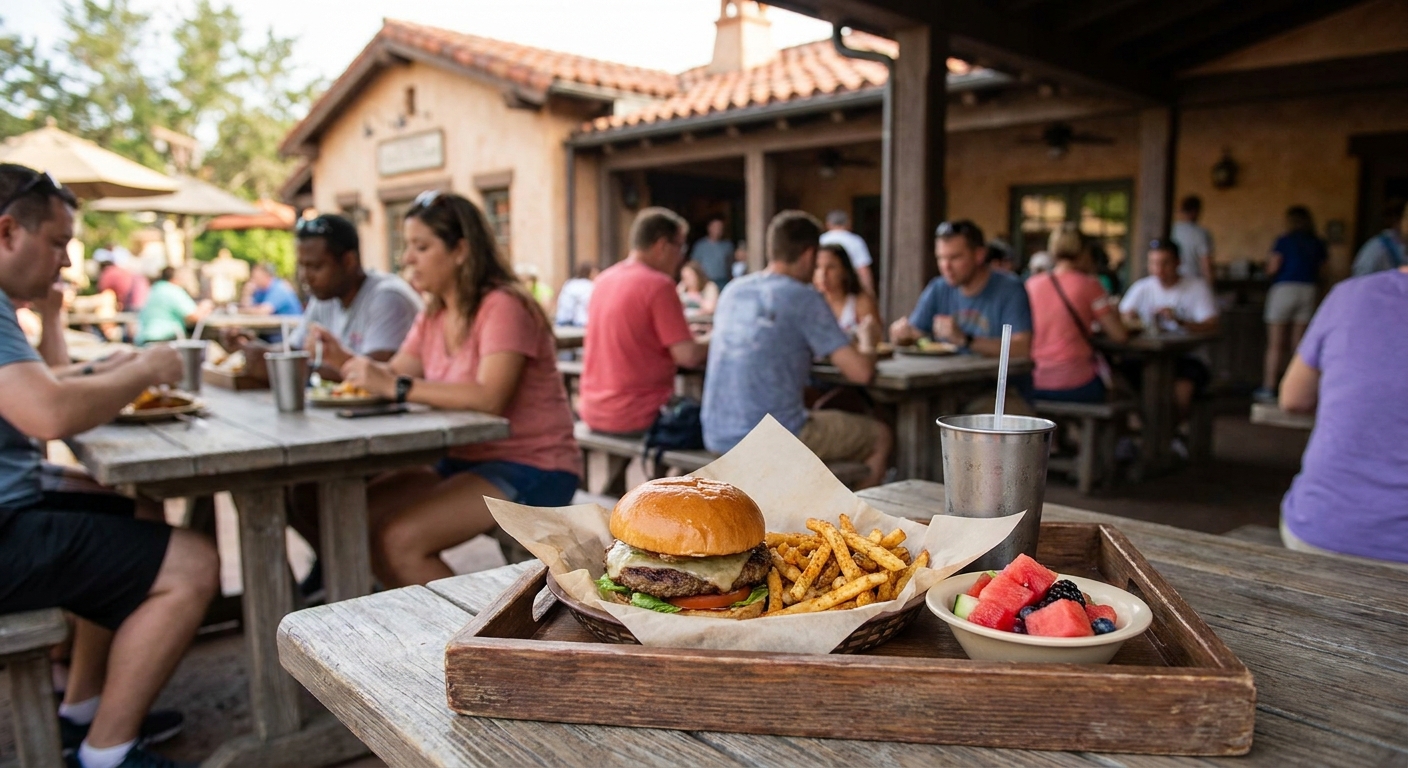
Harambe Market: The Best Quick-Service Value in the Land
If you only eat one counter-service meal in Africa, eat it here — Harambe Market is where the price-to-portion math actually works, and the Harissa Chicken Wrap (around $11) is the cheapest full meal in the corridor.
Harambe Market sits in Harambe, a short walk from Kilimanjaro Safaris and the Wildlife Express Train platform, directly across from Tusker House. It’s built as an open-air village square rather than one big counter: a handful of separate order windows ringing a shared courtyard with covered seating in the middle. Once you understand the layout, you stop wandering and start ordering.
How ordering actually works
The windows are specialized, not identical — so the line you join determines what you can get.
- Grilled skewer and sausage-style plates — the meat-forward window, and the one most groups should target.
- Wrap and sandwich window — home of the Harissa Chicken Wrap, the value pick and the only item in the corridor with a genuine East-African spice blend behind it.
- Sides, snacks, and kid-friendly items — smaller plates and simpler options for picky eaters.
- Drinks — soft drinks, beer and specialty beverages; faster than a food window if that’s all you need.
Mobile order through My Disney Experience is typically available here, and it’s the single biggest time lever at this location. Fire your order at least 10 minutes before you walk up and you’re collecting food instead of standing in it.
Pro tip: Lines at Harambe Market don’t build on a clock — they build on a ride. Kilimanjaro Safaris dumps a vehicle’s worth of hungry people into Harambe every few minutes, so the courtyard bunches hard right after a wave of safari exits. Order on your way into the queue, not on your way out, and you’ll skip the surge entirely. During the noon–2 PM rush, mobile order tends to cut a roughly 12-minute wait to under 5.
What to order, and what it’s worth
| Order | Roughly | Why it works |
|---|---|---|
| Harissa Chicken Wrap | ~$11 | Cheapest real meal in Africa; actual spice, not Disney-timid. Travels best for splitting. |
| Grilled skewer / sausage-style plate | low-to-mid teens | Biggest protein portion per dollar here; the plate sides make it a true meal, not a snack. |
| Side or shareable small plate | under ~$10 | The move when you’re grazing across several windows instead of buying four entrées. |
Portion sizes here are honest — these are plated meals with sides, not three bites of something photogenic. For a family of four that doesn’t want to commit to a buffet, two plates plus a wrap and a side usually feeds everyone for less than one adult buffet seat across the street.
What travels well if you’re splitting
- [ ] Send one adult to claim a shaded table before anyone orders — this is the real pitfall.
- [ ] Wraps: easiest to cut and share, least likely to go soggy on a walk.
- [ ] Skewers and plates: eat these at the table; they don’t travel to a bench well.
- [ ] Grab a cold drink (Dawa Bar is steps away) while the kitchen finishes your mobile order.
- [ ] Add popcorn from the nearby Mahindi stand if you’re stretching one plate across two kids.
The honest cons
Shade and seating are genuinely limited. The covered seating is a real asset — rare at Animal Kingdom, where “shade” often means standing under a tree — but there isn’t much of it, and it fills the moment a safari load arrives. If you roll up with a tray and no table, you’re eating standing in the sun.
The rest of the trade-offs:
- Weather exposure. It’s outdoor dining. A Central Florida afternoon storm or a 95-degree stretch can turn a good meal into a rushed one. Tusker House is your air-conditioned fallback if the heat wins.
- Line timing is lumpy. The windows can sit nearly empty, then back up five deep in two minutes.
- Window-hopping costs time. Splitting one group’s order across three windows sounds efficient and usually isn’t — assign one person per window or just mobile order.
The smart move
Mobile order the Harissa Chicken Wrap plus one skewer plate, send a scout for a covered table, and eat before you ride Safaris rather than after. You’ll pay roughly a quarter of what the buffet across the street costs, and you’ll spend the saved 20 minutes in a queue that’s about to get longer.
Tusker House: Is the Character Buffet Worth the Price?
Honest verdict: Tusker House is worth it if you have kids under 10 and want character photos without sacrificing a Magic Kingdom table-service slot. For almost everyone else, it’s a lot of money for food you’d rate “pretty good.”
That’s the whole calculus. Tusker House, in Harambe Marketplace right across from Harambe Market, is a fixed-price, all-you-can-eat buffet with Donald’s Safari character experience — Donald, Daisy, Mickey and Goofy in safari gear, working the room table by table. You’re not paying for the best meal in Animal Kingdom. You’re paying for characters, variety, air conditioning, and a chair.
What’s actually on the buffet
The spread splits cleanly into three lanes, which is exactly why it works for mixed-age groups:
- Globally spiced options — African- and North African-inspired stews, roasted meats, curries, and grain salads. This is the adventurous-adult lane and it’s genuinely more interesting than counter-service fare.
- Kid-safe standbys — simple proteins, pasta-style sides, fruit. Nobody melts down.
- Carving station and salads — the protein variety is the real differentiator versus a quick-service window.
The trade is structural: it’s one price whether your four-year-old eats three bites or your teenager eats four plates. That math decides everything.
Breakfast vs. lunch vs. dinner
| Meal | What you get | Who it suits |
|---|---|---|
| Breakfast | Characters, American breakfast classics plus African-inspired items; typically the lowest price point of the three | Rope-drop families — eat early, then hit Africa and Asia with the park still soft |
| Lunch | Characters, the full savory spread with the most African-inspired variety | Big eaters and anyone who needs a real midday reset out of the heat |
| Dinner | Characters, savory spread similar to lunch; usually the priciest | Groups who ride all day and want one sit-down to close it out |
The timing play matters more than the menu difference. A breakfast reservation buys you a cool, calm start before the Kilimanjaro Safaris line thickens. A midday lunch is damage control for Central Florida afternoon heat. Dinner is the weakest value because by then you’ve already eaten elsewhere and the characters haven’t changed.
Pro tip: The sneaky reason to book Tusker House isn’t the food — it’s that it absorbs your character-dining need on an Animal Kingdom day, which frees your Magic Kingdom day for a non-character table service (or no table service at all). People burn a precious Magic Kingdom reservation on characters when Animal Kingdom does it at a lower stress level with shorter travel time and a better themed room.
Who it’s genuinely worth it for
- Families with kids roughly 3–10 who want guaranteed character interaction without the Magic Kingdom scramble.
- Big eaters — teens especially. The all-you-can-eat format only pencils out if someone’s going back for thirds.
- Anyone managing food allergies. Tell the host at check-in and a chef will walk the buffet with you; that level of hand-holding is hard to get at a counter.
- Groups who need a hard-stop air-conditioned break built into the day instead of hoping they find one.
Who should skip it
- Couples and adult parties. You’re paying a character premium you’ll actively dodge.
- Light eaters and picky kids. Fixed price, three bites, bad trade.
- Budget-focused planners. Cross the street to Harambe Market and get the Harissa Chicken Wrap for around $11 — the cheapest full meal in the land and the only item with a real East-African harissa kick. Add a Mango-Passion Smoothie at Dawa Bar (well under about $5) in actual covered shade. Same neighborhood, roughly a third of the commitment.
The booking trade-off if you wait
Tusker House reservations open 60 days before arrival at 6:00 AM Eastern in My Disney Experience, and the popular windows fill within hours. Here’s the honest cost of hesitating: decide late and you don’t get “no Tusker House,” you get bad Tusker House — a 10:50 a.m. breakfast that wrecks your morning touring, or a 3:15 p.m. lunch nobody’s hungry for. The slot you want goes first.
- [ ] Day 60, 6:00 AM ET: book the time you actually want, not whatever’s left
- [ ] Note allergies on the reservation, then repeat them to the host at check-in
- [ ] Budget 75–90 minutes door to door, and don’t schedule it against a safari window
- [ ] Changed your mind? Cancel inside Disney’s window so you’re not eating a no-show fee
If you missed the opening, cancellations do shake loose — this is where SupaPark’s dining Drop Watch earns its keep, pinging you the moment a Tusker House table frees up so you can grab it in My Disney Experience. Free accounts get those alerts by email at supapark.com.
Booking Tusker House: Timing, Drop Watch, and the 60-Day Rule
If you want a prime character breakfast slot, you need to be in My Disney Experience at 6:00 a.m. Eastern exactly 60 days before your arrival date — not 6:05, and not 180 days out like the old rule everyone still repeats.
Advance Dining Reservations (ADRs) open 60 days ahead of your check-in, at 6:00 a.m. ET, in My Disney Experience. If you’re staying at a Disney resort, that 60-day window covers your whole stay from your arrival date, so one early morning books the entire trip. Off-site, you book day by day, 60 days out from each date — which is why off-site planners feel like Tusker House is impossible. It isn’t; you just get fewer shots.
What actually disappears first
Tusker House runs character breakfast (Donald and friends in safari gear), then transitions to lunch and dinner service. Demand is wildly uneven across those, and knowing the pattern tells you where to aim.
| Slot | How fast it goes | Realistic read |
|---|---|---|
| Pre-park-open / earliest breakfast | First to vanish, often within minutes | The grail: eat, then walk onto Kilimanjaro Safaris |
| 8:30–10:00 a.m. breakfast | Goes quickly, usually same morning | Best balance of characters and a sane wake-up |
| Late breakfast / brunch transition | Lingers longer | Great if you rope-dropped Flight of Passage first |
| Mid-afternoon lunch (roughly 2–3 p.m.) | Frequently open days out | The underrated win — air conditioning at peak heat |
| Early or late dinner | Most often still bookable | Easiest table in the building |
Walk-up odds? Treat them as near zero on a moderate or busy day, especially at breakfast. You can ask at the host stand, and occasionally the Mobile Dine Walk-Up Waitlist in My Disney Experience coughs something up at an odd hour — but do not build a park day around it.
The 60-day morning, step by step
- [ ] Count back 60 days from your arrival date, not your Animal Kingdom day
- [ ] Add your whole party to Friends & Family in My Disney Experience before the morning
- [ ] Store a credit card in your account — character buffets hold one, and fumbling costs you the slot
- [ ] Be logged in and awake by 5:50 a.m. ET; the app refreshes the window right at 6:00
- [ ] Search the date, party size, and a wide time range first — then narrow
- [ ] Book anything decent immediately; modify later (an in-hand reservation beats a perfect one you didn’t get)
Pro tip: Search with a party size one larger than you need. Buffet tables seat in blocks, and a party of four will sometimes surface inventory a party of three can’t see — then you simply arrive with fewer people, which the host stand handles routinely.
Missed the window? Cancellations are the real market
Here’s the part most planners don’t internalize: the 60-day rush is not the only way in. Disney’s standard dining cancellation policy charges a per-person fee for no-shows within about 24 hours, so plans shuffle constantly — park-hopping decisions change, kids nap through breakfast, and tables get dumped back into the pool all day long. The highest-churn windows tend to be the day before and the morning of.
The problem is that catching one means refreshing My Disney Experience over and over, usually while you’re in a line somewhere. That’s exactly what SupaPark’s dining Drop Watch is for: set a watch on Tusker House for your date and time range, and the moment a table frees up, you get pinged — then you grab it yourself in My Disney Experience. Free accounts get Drop Watch alerts by email; paid plans add instant push so you’re not waiting on an inbox refresh. SupaPark never books, holds, or manages the reservation. It watches and alerts; the booking always happens in Disney’s app, by you, directly with Disney.
Set the watch smart
- Widen the time range. A 7:30–10:30 a.m. window catches three times the drops a single 8:00 slot does.
- Watch the shoulder days. If your Animal Kingdom plan is flexible, watching two dates roughly doubles your odds.
- Don’t cancel your fallback. Hold the 2:30 p.m. lunch while you watch for breakfast, then release it once you’ve got the better slot.
- Decide before the ping. When the alert hits, you may have minutes. Know your party size and whether you’ll actually pay buffet pricing — roughly $50–$65 per adult is the ballpark for character buffets, and it fluctuates by season.
The honest caveat
Drop Watch is a pattern-based advantage, not a guarantee. Some combinations — a prime pre-open breakfast on a holiday week — genuinely may never free up. Be realistic about the odds, keep a quick-service backup across the street at Harambe Market, and treat the buffet as a bonus rather than the thing your whole day hinges on.
Quick-Service and Snack Spots Compared
The fast read: Harambe Market is the only true meal, Dawa Bar is the only real shade, and everything else is a snack with a trade-off. Africa’s food corridor is compact enough that you can hit three of these stops in under 30 minutes — if you know which one solves which problem.
The Africa cheat sheet
| Spot | Best for | Signature order | Price band | Seating / shade | Indoor? | Mobile order | Peak wait | Kid rating | Verdict |
|---|---|---|---|---|---|---|---|---|---|
| Harambe Market | A real lunch on a budget | Harissa Chicken Wrap (~$11) | $ | Communal outdoor tables, patchy shade | No | Yes | ~12 min at noon–2 PM | 4/5 | The cheapest full meal in Africa and the only genuine East-African spice. Order ahead and it’s unbeatable. |
| Dawa Bar | Cooling down, regrouping | Mango-Passion Smoothie (under ~$5) | $ | Covered outdoor seating — the best shade in the land | No (but roofed) | No | Short; bar service moves | 5/5 | A drink stop, not a meal stop. Worth a detour purely for the shade. |
| Tamu Tamu Refreshments | Dole Whip and sweet resets | Dole Whip / Dole Whip float | $ | Shaded courtyard nooks nearby | No | Yes | Builds fast mid-morning onward | 5/5 | Hit it early. By afternoon you’re paying in line time for soft-serve. |
| Kusafiri Coffee Shop & Bakery | Breakfast, caffeine, pastry grabs | Coffee + a pastry or baked treat | $ | Minimal — grab and walk | No | Yes | Fast early, slower at open rush | 4/5 | Best used as a pre-safari fuel stop, not a destination. |
| Mahindi | A cheap, shareable savory snack | Popcorn | $ | None — it’s a stand | No | No | Walk-up, basically none | 5/5 | The best value pairing in Africa. Turns a smoothie into an actual refuel. |
| Roaming carts | Emergency kid-pleasers | Frozen treats, drinks, pretzels | $–$$ | Wherever you’re standing | No | No | None | 5/5 | Convenience pricing, zero wait. Useful in a meltdown, not a plan. |
How to actually use that table
- Picking one stop? Harambe Market. It’s the only option that ends hunger rather than postponing it, and it sits right next to Kilimanjaro Safaris and the Wildlife Express Train, so it fits the Africa touring loop without a backtrack.
- Picking two? Harambe Market plus Dawa Bar. Food from one, shade and a cold drink from the other, roughly a five-minute walk apart.
- Traveling with a picky eater? Mahindi popcorn plus a Tamu Tamu Dole Whip covers savory and sweet with zero spice risk and zero menu negotiation.
Pro tip: Most Africa quick-service hands you food and a problem — nowhere comfortable to eat it. Dawa Bar’s covered seating is the fix, and it’s genuinely rare at Animal Kingdom: actual roof, not “stand under a tree.” The play is to mobile-order at Harambe Market, walk your tray to Dawa Bar, buy a juice as your table fee, and eat in the shade. On a Central Florida afternoon that’s the difference between a 15-minute reset and a meltdown.
Mobile order: where it earns its keep
Mobile ordering only helps at the three counters that accept it, and only if you fire the order before you’re hungry.
- [ ] Open My Disney Experience and order at least 10 minutes before you plan to arrive
- [ ] Choose Harambe Market for lunch, Kusafiri for breakfast, Tamu Tamu for a dessert window
- [ ] Tap “I’m here, prepare my order” only when you’re genuinely close — the clock starts then
- [ ] Send one adult to Dawa Bar for drinks while the kitchen finishes
- [ ] Ask a cast member which items can be modified if you’re managing allergies — quick-service counters usually can swap more than the menu board suggests
Done right, a noon-to-2 PM Harambe Market order drops from roughly a 12-minute wait to under five. Walk up cold at peak lunch and you’re trading safari time for a line.
The order-of-operations that saves the most time
Africa’s food demand peaks in two distinct waves, and they don’t overlap:
- Mid-morning: Tamu Tamu and Kusafiri get hit as the post-open crowd drifts off the safari. Get your Dole Whip before the rush builds, not after.
- Noon to 2 PM: Harambe Market is the pressure point. This is the window mobile ordering was invented for.
- Mid-afternoon: Everything slows, but the heat does not. This is Dawa Bar’s hour.
Build the breaks before you need them. The classic mistake is winging the midday slump and ending up melting in a standby line with a hungry four-year-old.
The one thing to remember: Harambe Market for the meal, Mahindi for the cheap add-on, Dawa Bar for the shade — and mobile-order anything you plan to eat between noon and 2 PM.
The Snack Shortlist: What to Order and What to Skip
The move: one frozen treat, one savory cart item, and nothing else — Africa’s snack lineup has two genuine winners and a couple of things people buy because they’re standing in front of them.
Snacks here run roughly $5–$15, which means a lazy grazing plan can quietly outspend the Harissa Chicken Wrap at Harambe Market (around $11 for a full meal). So be picky. Here’s the ranked read.
The frozen treats at Tamu Tamu — worth a detour, early
Tamu Tamu Refreshments is the Dole Whip-style soft-serve stop in Africa, and it’s the single best heat-management purchase in the corridor. Pineapple-forward, tart, genuinely cold, and it hits that “okay, I can keep walking” switch faster than anything else on this list.
Two honest caveats:
- It melts fast. Central Florida afternoon plus a walk back toward Kilimanjaro Safaris equals soup. Eat it where you buy it, in shade, or don’t buy it.
- The line snowballs. The post-open rush builds as morning safari and Flight of Passage crowds spill back through. Hit it early — late morning, before the midday peak — or wait for the lull after about 3 PM.
A plain soft-serve cup or cone is the value play; the loaded sundaes and float builds push toward the top of the snack price range for volume you probably won’t finish before it liquefies.
Kusafiri bakery items — the “already walking past” tier
Kusafiri Coffee Shop & Bakery is a counter, not a destination. Pastries, cookies, cupcakes, grab-and-go breakfast, decent coffee. The portions are fair and the baked goods hold up in heat far better than anything frozen — which makes this the right call for a stroller pocket snack or a 7-something-AM pre-rope-drop bite.
- Order: a sturdy pastry or cookie you can carry, plus coffee if you somehow didn’t caffeinate before Flight of Passage.
- Don’t: reroute across Africa for it. Nothing here is unique enough to justify backtracking.
The grilled corn cart — the sleeper
Mahindi, the corn and popcorn stand near Harambe, is the most underrated snack in the land. Grilled corn on the cob, warm, savory, and a real break from the sugar spiral every family falls into by hour four. It’s filling for its price tier, it travels fine, and it’s the answer when someone needs food but not a meal.
Pro tip: Ask for it plain. The default seasonings can run spicy or heavily buttered, and a plain cob is the one savory item in Africa a spice-averse kid will reliably eat — which makes it the perfect partner to a Mango-Passion Smoothie from Dawa Bar (under about $5) for a legitimate shaded refuel instead of a dessert break.
The croissant-doughnut pastries — the honest skip
These layered croissant-doughnut hybrids draw a line wherever they’re sold, and the math rarely works. You’re paying a premium snack price for something that’s mostly sugar glaze and air, it goes greasy in the heat within a half hour, and the queue tends to be longer than the queue for actual food. If you want a pastry, Kusafiri gets you there faster and cheaper. If you want a treat worth waiting for, Tamu Tamu wins.
Two more skips, said plainly
- Souvenir-cup upcharges. Frozen drinks are Animal Kingdom’s best weapon, but the cup fee buys you a thing to carry all day. Ask to skip it.
- Volume sundaes and loaded desserts. Big, photogenic, melting on a timer, and priced like a meal. Split a basic soft-serve instead and put the difference toward the wrap.
The quick comparison
| Snack | Taste read | Portion vs. price | Heat durability | Verdict |
|---|---|---|---|---|
| Tamu Tamu frozen treat | Tart, pineapple-forward, very cold | Fair in a plain cup | Poor — minutes | Worth a detour, early |
| Mahindi grilled corn | Warm, savory, filling | Best value on the list | Good | Worth a detour |
| Kusafiri pastry/cookie | Solid, familiar bakery | Fine | Strong | Only if passing |
| Croissant-doughnut pastry | Sweet, glaze-heavy | Weak for the price | Poor — goes greasy | Skip |
| Loaded sundae / souvenir cup | Fine, oversized | Poor | Poor | Skip |
Run it in this order
- [ ] Plain soft-serve at Tamu Tamu before the midday rush — eat it in the shade
- [ ] Mahindi corn (plain) when someone needs real food, not dessert
- [ ] Dawa Bar smoothie or tropical juice as the shaded reset
- [ ] Kusafiri only if you’re already walking past
- [ ] Skip the hybrid pastry line and the souvenir-cup fee
One more timing note: snack lines move with the crowd, not the clock, so the “early” advice only works if the park actually opened quiet. SupaPark’s crowd calendar and live waits will tell you whether your Africa window is a 3-minute stop or a 20-minute one before you commit the walk — that’s a free check at supapark.com.
Drinks in Africa: Dawa Bar, Coffee, and Beating the Heat
Treat Africa’s drink menu as cooling infrastructure, not a splurge — the right $5 smoothie at 2 PM saves the afternoon that a $0 bottle of water won’t.
Animal Kingdom runs hotter than the other three parks. More pavement, more walking, less indoor air conditioning to duck into. Africa’s advantage is that Dawa Bar is the rare spot with real covered seating, so you can actually sit in shade while you drink, instead of cooling off on a curb.
Dawa Bar: the shade is the product
Harambe’s drink stop sits in the middle of the village with covered outdoor tables and live music rotating through the day — it’s the one place in Africa where you can park a group for 15 minutes without anyone standing.
- Mango-Passion Smoothie — the headliner. Cold, tropical, and the fastest route to “okay, I can keep walking.” Typically well under about $5.
- Tropical juices — same price tier, no alcohol, easy win for kids.
- Cocktails — fine for the adults, but the smoothie-and-juice side is where the value is.
Pro tip: Order the cheap non-alcoholic stuff at Dawa Bar and pair it with popcorn from the nearby Mahindi stand — that turns a drink break into a legitimate refuel for a couple of dollars more, instead of committing to a sit-down meal you don’t need.
Real coffee: Kusafiri, not a park cart
If you want actual espresso-based coffee in Africa, Kusafiri Coffee Shop & Bakery is the stop — hot coffee, iced coffee, and pastries. Two timing notes:
- Morning: Fine on the way to Kilimanjaro Safaris if you’re already past the rope-drop rush. If you’re racing a headliner, caffeinate second. Coffee lines have cost plenty of people their walk-on window.
- Afternoon: Iced coffee is the adult version of the smoothie play — caffeine plus cold, which is what the 3 PM wall actually needs.
Africa vs. Asia: where the frozen drinks really are
Here’s the thing nobody tells you — Africa does smoothies and coffee well, but the park’s best frozen drinks are a short walk away in Asia. Plan a loop rather than picking a side.
| Drink | Where | Why it wins | Best moment |
|---|---|---|---|
| Mango-Passion Smoothie | Dawa Bar, Africa | Cheapest cool-down with shade and seating attached | Midday reset with kids |
| Iced coffee | Kusafiri, Africa | Cold + caffeine in one order | Early-afternoon slump |
| Frozen Coca-Cola | Drinkwallah, Asia | The only truly icy soda around — stays slushy for minutes | Right after Expedition Everest |
| Frozen Chai | Royal Anandapur Tea Company, Asia | Hand-crafted spiced slush with a real caffeine kick | When you need to make it to park close |
| Pink Lotus | Thirsty River Bar, Asia | Fruity palate reset, grown-up option | Post-Everest, pre-Kali |
The natural route: snack in Africa, walk to Asia, hit a frozen drink after Everest, then let Kali River Rapids finish the job. Save Kali for the early-afternoon heat peak — it’s the one time of day getting soaked is a feature, not a problem.
Souvenir cups: the quiet upcharge
Several frozen and specialty drinks get offered in a souvenir cup that adds a few dollars to the base price. It’s not a scam — it’s just an opt-in you’ll be opted into unless you speak up.
- Say this at the register: “Regular cup, please — no souvenir cup.” Cast members do it without blinking.
- When it’s worth it: You genuinely want the cup, or you have a kid who will use it all trip.
- When it isn’t: Everyone else. You’ll be carrying a sticky plastic cup through a safari.
Water strategy: stop buying what’s free
The single cheapest heat move in Animal Kingdom: ask for a cup of ice water at any quick-service counter. It’s free, it’s available all over Africa and Asia, and it works whether or not you buy anything else.
- [ ] Pack a refillable bottle — Africa’s quick-service counters will fill it with ice water
- [ ] Ask for free ice water at Harambe Market, Kusafiri, or Tamu Tamu rather than buying bottles
- [ ] Buy a bottled water only when you need to carry volume between lands with no counter stops
- [ ] Spend your drink money on the cooling drinks — frozen, icy, smoothie — not on hydration you can get free
- [ ] Hit the shaded seating at Dawa Bar before anyone in your group says they’re done for the day
The pattern to internalize: free water for hydration, paid drinks for cooling, and shade for recovery. Treat those as three separate jobs and you’ll spend less and last longer.
Mobile Order Strategy in Africa
The move: place your mobile order from inside the Kilimanjaro Safaris queue, not from the Harambe Market courtyard. By the time you’re standing in front of the menu boards at 12:30 p.m., the good arrival windows are already claimed and you’re choosing between “40 minutes from now” and giving up.
Mobile order lives in My Disney Experience (not SupaPark — we’ll tell you when a dining table drops, but every order and reservation happens on Disney’s side). You pick the location, build the order, pay, and then tap “I’m Here, Prepare My Order” when you actually arrive. That last tap is the part people get wrong: the kitchen does nothing until you press it, so pre-ordering while you’re still three minutes away is the entire trick.
Where mobile order actually works in Africa
| Location | Mobile order | Realistic use |
|---|---|---|
| Harambe Market | Yes | The corridor’s best value — the Harissa Chicken Wrap runs around $11 and is the cheapest full meal in Africa |
| Mahindi (popcorn stand) | Typically walk-up | Fast anyway; no real line to skip |
| Dawa Bar | Walk-up | Smoothies and tropical juices under about $5 — order at the bar while your food finishes |
| Tusker House | No — reservation only | Table-service character buffet; ADRs open 60 days out at 6:00 a.m. ET |
So in practice, “mobile order strategy in Africa” means Harambe Market, with Dawa Bar as the drink hand-off and Tusker House as the air-conditioned, sit-down alternative.
Why the 12:00–1:30 p.m. window jams
Africa’s lunch crush is geographically caused. Kilimanjaro Safaris dumps truckload after truckload of hungry guests out within a two-minute walk of Harambe Market, and the Gorilla Falls Exploration Trail empties into the same corridor. Everyone finishes their animal loop at roughly the same time, everyone opens the app at roughly the same time, and arrival windows get claimed in blocks.
Order at least 10 minutes ahead of when you want to eat and the payoff is real: your wait at the window typically drops from around 12 minutes at peak to under 5. Wait until you’re hungry and standing there, and you’ve turned lunch into a safari-time expense.
The order-while-you-ride sequence
- [ ] On the Safaris ride vehicle (or in the queue), open My Disney Experience and pick Harambe Market
- [ ] Build the whole order — wraps, kids’ items, drinks — before you lose signal in a dead spot
- [ ] Pay, but do not tap “I’m Here” yet
- [ ] Finish the safari, walk the Gorilla Falls trail if you’ve got it on the plan
- [ ] Tap “I’m Here, Prepare My Order” when you’re about 3–5 minutes out
- [ ] Grab a Mango-Passion Smoothie at Dawa Bar while the kitchen finishes
- [ ] Eat under Dawa Bar’s covered seating — genuine shade, which is rarer in Animal Kingdom than it should be
Pro tip: Cell service in the Africa corridor gets flaky in the animal-trail stretches, so build and pay for the order while you still have bars, then tap “I’m Here” wherever you end up — the payment step is the one that needs a solid connection, not the arrival tap.
When every window is booked
It happens, especially on a holiday week around 12:45 p.m. Your options, in order of how much time they cost you:
- Take a later window and reorder your day. Push lunch to 1:45 or 2:00 p.m., do Gorilla Falls or hop over to Asia in the meantime, and come back to a quieter counter. Later windows are almost always available.
- Flip to snack mode. Mahindi popcorn plus a Dawa Bar smoothie is a legitimate hold-the-line refuel for not much money, and neither requires a window.
- Walk up and eat the wait. Harambe Market’s line at peak is roughly 12 minutes — annoying, not catastrophic. Send one adult to stand in it while the rest of the group sits in the shade.
- Check Tusker House for a late cancellation. Character buffets shed tables constantly. This is where Drop Watch pays off: SupaPark pings you the moment a hard-to-get reservation frees up, and you confirm it in My Disney Experience.
The allergy exception
Mobile order carries allergy filters and some standard swaps, but it does not cover everything. Anything that needs a real kitchen conversation — cross-contact questions, a substitution that isn’t a tap-to-select option, multiple allergens in one order — is often faster and safer handled at the counter with a cast member, who can pull a chef if needed.
Two practical consequences: build in an extra 10 minutes for an allergy order at peak, and know that Tusker House is your strongest Africa play for complex dietary needs, because a chef will walk the buffet with you and point at what’s safe. Tell the host at check-in, not after you’ve been seated.
Eating Around the Africa Crowd Curve
The move: eat before 11:45 a.m. or after 2:00 p.m., and ride during the hour everyone else is holding a tray. Africa doesn’t fill gradually — it gets dumped on. Kilimanjaro Safaris unloads full truckloads of guests directly into Harambe all morning, and most of them are hungry by noon.
How the land actually fills
- Mid-morning: Safaris hits its stride and starts pushing waves of guests into Harambe. Food lines are still short, but the walkways get busy.
- Roughly 12:00–1:30 p.m.: peak lunch. Harambe Market walk-up lines stack, Dawa Bar seating disappears, and the heat is climbing.
- After 2:00 p.m.: the land noticeably quiets. People scatter to Asia, Pandora, or back to the resort for a nap.
That curve is the whole strategy. Lunch demand and ride demand peak at the same time — so pick one and do the other.
The two windows that work
| Window | What you gain | Watch out for |
|---|---|---|
| Before 11:45 a.m. | Near-zero food line, fully stocked menus, then you walk straight into the lunch-dip ride window | You’re eating early — plan an afternoon snack |
| 12:00–1:30 p.m. (ride instead) | Standby waits often soften while the crowd eats | You’ll be hungry and the lines will be long if you cave |
| After 2:00 p.m. | Quiet counters, easier shaded seating, calmer Harambe | Occasional item sell-outs at quick service late in the day |
Pro tip: Mobile order in My Disney Experience at least 10 minutes before you walk up. During the noon-to-2 crush, that’s the difference between roughly a 12-minute wait and under 5 — and the single highest-leverage thing you can do in this corridor.
The early-lunch play, step by step
- [ ] Rope drop or ride Safaris first — before 10:00 a.m. if you can
- [ ] Open mobile order around 11:00 a.m. and tap “I’m Here” by about 11:15
- [ ] Grab the Harissa Chicken Wrap at Harambe Market (around $11, the cheapest real meal in Africa)
- [ ] Add a Mango-Passion Smoothie at Dawa Bar — under about $5 and the best shaded seating in the land
- [ ] Be back in a queue by 12:15, while everyone else is ordering
The late-lunch play
If you’d rather use the dip for rides, flip it: ride through 12:00–1:30, then eat at 2:00 when the counters clear. This is the better version for families with older kids who can hold out, and it pairs well with Kali River Rapids — getting soaked during the early-afternoon heat peak is a feature, not a bug.
One honest caveat: this is a pattern, not a law. Holiday weeks, late park opens, and a rained-out morning can shove the whole curve an hour in either direction. Festival-style crowd surges don’t follow the textbook either.
Let the live data pick your window
This is exactly where checking the actual numbers beats following a plan you made in April. SupaPark shows live wait times across Animal Kingdom and the best-time forecaster calls when each ride tends to be shortest — so you can look at Safaris, Expedition Everest and Kilimanjaro side by side at 11:30 a.m. and decide, that day, whether to eat now or ride now.
Two ways guests use it in Africa:
- Check the dip before committing. If the standby numbers near you are already sagging at 11:45, eat at 2:00 instead and bank the short queues.
- Get pinged instead of refreshing. Set a wait-drop alert on the ride you actually care about, put your phone away, and enjoy your wrap. If something craters to a walk-on while you’re eating, you’ll hear about it. Live waits, the forecaster and the crowd calendar are all on the free tier at supapark.com; paid plans add instant push delivery and unlimited watches.
What a veteran skips
- Walking up to Harambe Market at 12:30 with no mobile order. You’re trading safari time for a line you could have skipped with one tap.
- A sit-down lunch you didn’t actually want. Tusker House is a character buffet at a fixed price — great for mixed-age groups, but it eats 75–90 minutes of your day. Reservations open 60 days out at 6:00 a.m. Eastern and fill fast, so if it’s not your group’s thing, don’t force it. Quick service plus a Dawa Bar smoothie costs a fraction and takes 20 minutes.
- Winging the midday slump. The families melting down in a 2:00 p.m. standby line are almost always the ones who never decided when they were going to eat.
The one thing to remember: Africa’s food lines and its ride lines peak at the exact same hour. Decide in advance which one you’re spending noon on, mobile order either way, and check the live numbers before you commit — the land hands the quiet back to you after 2:00 p.m. if you’re patient enough to take it.
Allergies, Picky Eaters, and Kid-Safe Orders
The single best move in Africa isn’t a menu item — it’s telling the host about allergies the second you check in at Tusker House. Disney chefs will come out and physically walk the buffet with you, line by line, pointing out what’s safe and what to avoid. That’s a service most families never ask for, and it turns the scariest format for allergy groups (an all-you-can-eat buffet) into one of the easier meals on property.
The five-minute allergy routine
Do these in order and you’ll spend the meal eating instead of interrogating:
- [ ] Flag allergies at check-in, not after you’re seated — it gives the kitchen lead time
- [ ] Ask for a chef to walk the buffet with you before anyone loads a plate
- [ ] Ask specifically about gluten-free, dairy-free, and nut-free swaps (there are usually more than the buffet labels suggest)
- [ ] Confirm the kids’ options if you’re avoiding spice or strong flavors — “kid-friendly” and “mild” aren’t the same thing
- [ ] At quick-service windows, ask a cast member which items can be modified before you order, not at pickup
Pro tip: Note allergies in your Advance Dining Reservation when you book — ADRs open 60 days before arrival at 6:00 AM ET — and then still mention them at check-in. The booking note gets the kitchen prepped; the check-in mention gets you the chef walkthrough. Guests who rely on only one of those are the ones waiting around.
Reliably kid-safe orders in Africa
Africa’s reputation for bold, globally spiced food scares cautious families off, but the mild stuff is sitting right there:
| Order | Where | Why it works |
|---|---|---|
| No-spice corn on the cob | Mahindi cart | Plain, hot, recognizable; the easy yes for a kid who’s rejecting everything |
| Mango-Passion Smoothie | Dawa Bar | Cold, sweet, under about $5, and no alcohol |
| Tropical juices | Dawa Bar | Same price tier, zero flavor risk |
| Dole Whip / frozen treats | Snack carts | The universal reset button in a Florida afternoon |
| Simple grilled proteins, pasta-style sides, fruit | Tusker House buffet | Familiar carving-station and salad options alongside the adventurous dishes |
| Popcorn | Mahindi stand | Pairs with a Dawa Bar drink into a real refuel |
Tusker House is the strongest play for a mixed-age group precisely because it’s two meals in one building: North African and African-inspired stews, roasted meats, curries and grains for adults who want something interesting, plus carving-station proteins and plain sides for the kid who will only eat beige food. The trade-off is honest — it’s fixed-price, all-you-can-eat whether your four-year-old eats three bites or not. You’re paying for the characters and the variety, not for value.
What has real heat (and who should order it)
The flavor-forward dishes are the reason Africa is worth eating in, and they’re not secrets — they’re just mislabeled in most families’ heads as “too risky.”
- Harissa Chicken Wrap, Harambe Market (around $11) — the cheapest full meal in the corridor and the only menu item with a genuine East African spice blend. Adventurous eaters will love it; a spice-averse seven-year-old will hand it back after one bite. Order it for yourself and get the kid corn.
- Stews, curries, and grain dishes at Tusker House — layered warm spice rather than scorching, but “warm spice” is still a wall for a kid who thinks ketchup is bold. Let them taste from your plate before you commit a whole serving.
The split-the-difference tactic: adults order the harissa wrap at Harambe Market, kids get corn and a frozen treat, everybody sits in Dawa Bar’s covered outdoor seating — genuine shade, which is rarer at Animal Kingdom than it should be. You eat well, nobody melts down, and you skip the fixed-price gamble entirely.
If the buffet isn’t your group’s thing
Don’t force the character meal just because it’s the allergy-friendly option. You can build a cheaper grazing meal from Harambe Market plus the snack carts and still eat better than most quick-service counters elsewhere in the park. Keep Tusker House in your back pocket as the air-conditioned, chef-supported fallback for the day the heat wins or the allergy math gets complicated — that’s genuinely what it’s best at.
The thing to remember: ask before you load the plate. A sentence at check-in gets you a chef; a sentence at a quick-service window gets you a modification. In Africa, the mild options always exist — you just have to request them out loud.
Cost Breakdown: What a Day of Eating in Africa Actually Costs
You can feed a family of four in Africa for the price of one Tusker House brunch — the gap between the cheapest day and the splurge day is roughly triple, and almost all of it comes down to whether you sit down.
Africa is one of the few corridors at Animal Kingdom where a real meal and a cheap meal live across the street from each other. Harambe Market runs around $10–11 for a full plate (the Harissa Chicken Wrap sits right at that line), Dawa Bar’s tropical juices and the Mango-Passion Smoothie come in under about $5, and snack-cart items generally land in the $5–$15 band. Tusker House is the fixed-price character buffet — a different budget category entirely.
Three modeled days, family of four
Treat these as planning estimates, not quotes. Disney re-prices menus regularly and party size, appetites, and alcohol swing the total fast.
| Scenario | What it looks like | Approx. per person | Approx. per family of four |
|---|---|---|---|
| Budget grazing | Two shared Harambe Market plates split four ways, one snack-cart round (popcorn, a fruit cup), free ice water | ~$10–15 | ~$40–60 |
| The balanced day | One Harambe Market meal each, one snack round, one drink each from Dawa Bar | ~$20–30 | ~$80–120 |
| The Tusker House day | Character buffet lunch plus one snack round later in the afternoon | ~$55–75+ | ~$220–300+ |
The jump from grazing to balanced is mostly drinks and the second snack — small line items, four times over. The jump to Tusker House is structural: it’s all-you-can-eat pricing whether your four-year-old eats three bites or four plates, and you’re paying for the characters and the protein variety (carving station, globally spiced stews, kid-safe standbys) as much as the food.
Who each day actually fits
- Budget grazing — short park days, groups that ate a big resort breakfast, families planning a real dinner outside the park.
- Balanced — the default I’d run. Everyone gets their own entrée, nobody’s hangry, and the Dawa Bar stop doubles as the shaded midday reset.
- Tusker House — mixed-age groups where character interaction is the point, or days when the heat genuinely wins and you need 75–90 minutes of air conditioning. If characters aren’t your group’s thing, this is the easiest line item in the whole trip to cut.
The money levers, ranked by what they actually save
- [ ] Share the big plates. Harambe Market portions are generous enough that two plates plus a kids’ item often covers four people. Biggest single saving on the list.
- [ ] Skip the souvenir cup. Ask for the regular cup when you order a frozen drink — the souvenir version carries an upcharge you’ll pay once per kid, then carry around all day.
- [ ] Drink the free ice water. Any quick-service counter will hand you a cup of ice water for nothing. Four bottled drinks is a snack round’s worth of money.
- [ ] Bring a refillable bottle. Fill it at water fountains and counters; it also saves the “I’m thirsty” cart stop that turns into a cart snack.
- [ ] Move one meal out of the land. Eat breakfast at your resort or plan dinner off-property, and a $220 Africa day quietly becomes a $90 one.
Pro tip: Mobile-order your Harambe Market meal in My Disney Experience at least 10 minutes before you walk up. It doesn’t save a dollar directly, but during the noon–2 PM rush it drops your wait from roughly 12 minutes to under 5 — and the families who bail on the line are the ones who end up buying a second round of snacks later because lunch never happened.
The hidden cost nobody budgets for
Snack creep. One Dole Whip at open, popcorn at the safari exit, a frozen drink in Asia, another smoothie at 4 PM — that’s four separate $5–15 decisions that never felt like a meal but cost more than one. The fix isn’t willpower, it’s sequencing: plan one deliberate snack round, anchor it in the shade at Dawa Bar, and keep a no-spice kid-pleaser (corn, Dole Whip) in your back pocket for the actual meltdown rather than spending it on boredom.
One more honest caveat on the Tusker House line: reservations open 60 days before arrival at 6:00 AM Eastern in My Disney Experience and tend to fill within hours, so the decision usually has to happen well before you know what the weather or your budget mood will be. SupaPark’s dining Drop Watch covers the change of heart in both directions — it pings you the second a cancelled Tusker House table frees up so you can grab it in My Disney Experience, which means you don’t have to overcommit at 60 days just to keep the option alive.
The takeaway: Decide the Tusker House question first, because it’s the only line item big enough to change your day’s total. Everything else is a $10–15 plate and a few $5 drinks.
Africa vs. the Rest of Animal Kingdom: Where Should You Actually Eat?
Here’s the honest verdict: Asia deserves your one sit-down meal, Africa deserves your quick-service meal, and Pandora only wins if you’re already standing in Pandora. Africa is the best-value eating corridor in the park — but it is not the best restaurant corridor, and pretending otherwise costs you money.
The head-to-head
| Where | Order this | Rough cost | Seating + shade | Peak line | Wins for |
|---|---|---|---|---|---|
| Harambe Market (Africa) | Harissa Chicken Wrap | around $11 | Shared outdoor tables, patchy shade | ~12 min walk-up at noon–2 PM; under 5 with mobile order | Cheapest real meal in the park; the only genuine East-African spice on a menu |
| Dawa Bar (Africa) | Mango-Passion Smoothie or a tropical juice | under about $5 | Covered outdoor seating — real shade | Short; it’s a drink stop | Cooling a kid down fast; the midday reset |
| Tusker House (Africa) | Carving station + the spiced stews | Fixed-price buffet | Indoor, air-conditioned, allergy-friendly | Reservation only | Mixed-age groups, characters, picky eaters, heat refuge |
| Satu’li Canteen (Pandora) | Build-your-own bowl | Mid quick-service | Indoor, air-conditioned, but fills fast | Long at lunch; mobile order essential | Customizable, veg-friendly, best indoor quick-service |
| Flame Tree Barbecue (Discovery Island) | Ribs or the smoked platter | Mid quick-service | Best seating in the park — tiered covered pavilions over the water | Long counter, but seating absorbs it | Hot, loud days when you want a quiet shaded table |
| Yak & Yeti (Asia) | Ask the bar for the spicy garlic edamame | Full table service | Indoor, two floors, air-conditioned | Walk-ups are tough at peak | Your one real sit-down; adults who want actual cooking |
| Asia counters (Drinkwallah, Royal Anandapur, Thirsty River) | Frozen Coca-Cola; Frozen Chai; Pink Lotus | Snack-tier | Minimal — grab and walk | Fast | Post-Everest recovery and the park’s best frozen drinks |
Restaurantosaurus isn’t a comparison anymore — DinoLand U.S.A. closed for good in February 2026 and that whole corner is being rebuilt as Tropical Americas. If an older plan in your notes routes lunch there, delete it.
The sit-down call: Asia, not Africa
Tusker House is a character buffet wearing Africa’s clothes. It’s excellent at what it does — air conditioning, protein variety, chefs who will walk a buffet with you for allergies — but you’re paying for the characters and the volume, not the cooking. If nobody in your group cares about meeting characters, that fixed price is money burned on a 4-year-old who eats three bites.
Yak & Yeti is the better use of a table-service slot: real menu, real kitchen, no character premium, and it sits a short walk from Expedition Everest so the coaster-then-food combo doesn’t cost you a cross-park trek.
Pro tip: Yak & Yeti’s secret-menu items — the shareable spicy garlic edamame among them — come from the bar inside the restaurant, not the dining room and not the quick-service window outside. Guests burn ten minutes asking at the wrong counter. Walk in, go to the bar.
The quick-service call: Africa, on points
Pandora’s Satu’li Canteen is the better restaurant. Africa is the better decision. The Harissa Chicken Wrap at around $11 undercuts most of the park’s full meals, and Dawa Bar’s covered seating solves the problem every other Africa counter creates — food in hand, nowhere comfortable to eat it. Covered shade is a genuine rarity at Animal Kingdom, not “stand under a tree,” and on a Central Florida afternoon that’s the difference between a 15-minute reset and a meltdown.
Flame Tree Barbecue is the one real challenger: its tiered waterfront pavilions are the best seating in the park, full stop. If your group’s problem is heat and noise rather than budget, hop to Discovery Island instead.
When Africa beats Pandora outright
- [ ] You’re coming off Kilimanjaro Safaris and don’t want to walk to Pandora — that trek in afternoon heat erases any food advantage
- [ ] Your budget is the constraint; Harambe Market plus a Dawa Bar drink lands cheaper than a Pandora bowl
- [ ] Someone in the group is overheating and you need shade and a cold drink in under five minutes
- [ ] You want one genuinely spiced dish instead of a build-your-own bowl
- [ ] You’re eating 12–2 PM — mobile order in My Disney Experience about 10 minutes ahead and skip the rush entirely
Skip Africa when you’re already deep in Pandora or Asia at mealtime. Crossing the park for an $11 wrap isn’t a win once you’ve spent 20 minutes and a gallon of sweat getting there. Let SupaPark’s live waits and crowd heat map tell you which corridor you’re actually standing in before you commit — and if Tusker House or Yak & Yeti is full, set a dining Drop Watch so you get pinged the second a cancellation frees up a table, then grab it in My Disney Experience.
Building Africa Into a Full Animal Kingdom Day
Africa isn’t a destination you plan around — it’s the shaded middle of your day, and the whole park sequence gets easier once you treat it that way. Animal Kingdom front-loads its best rides and peaks its heat in the early afternoon. Africa happens to be where the food, the shade, and the air conditioning all live. Build around that.
Rope-drop day: ride first, eat second
The non-negotiable rule — do not stop for coffee on the way in. Showing up at posted open isn’t rope drop; it’s joining the line after the rope-drop crowd already formed.
- [ ] Be in the holding area before Early Theme Park Entry begins (on-site guests get 30 minutes)
- [ ] Avatar Flight of Passage first — it’s the one ride that justifies a Lightning Lane Single Pass if you can’t be early
- [ ] Kilimanjaro Safaris second, while animal activity and the morning light are both at their best
- [ ] Africa breakfast or early lunch around 10:30–11:30 AM, before the Harambe Market rush
- [ ] Expedition Everest, then Kali River Rapids at the heat peak
- [ ] Festival of the Lion King late afternoon — air conditioning disguised as a show
- [ ] Pandora walk at dusk, when the bioluminescence actually reads
That order works because Safaris gets worse as the day heats up (animals retreat to shade), while Kali River Rapids gets better — getting drenched at 2 PM is a feature, not a bug.
Where the food actually goes
| Your arrival | Eat here | When | Why it works |
|---|---|---|---|
| Rope drop | Harambe Market (Harissa Chicken Wrap, around $11) | 11–11:30 AM | Beats the noon–2 PM crush; mobile order cuts ~12 min to under 5 |
| Mid-day (11 AM–12 PM) | Tusker House | Late lunch slot | Air-conditioned reset while standby everywhere peaks |
| Half day (4 PM on) | Dawa Bar + Mahindi popcorn | 5–6 PM | Covered shade seating, smoothies under about $5 |
Pro tip: Book your Lightning Lane Multi Pass selections to land before 11:30 AM or after 1:30 PM if you’re holding a Tusker House reservation. A character buffet eats 75–90 minutes door to door, and a Multi Pass return window that expires while you’re at the carving station is money straight in the bin — the refill chain stalls too, because you can’t add your next selection until the current one is redeemed or lapsed.
Mid-day arrival: flip the sequence
Arriving at 11 AM means Flight of Passage standby is already brutal, so stop pretending you’ll win it on foot.
- Buy the Single Pass for Flight of Passage, or ride Pandora’s Na’vi River Journey instead and accept the trade
- Go straight to a Tusker House reservation if you have one — eat while the park is at its worst
- Safaris mid-afternoon is a real compromise; book it as a Multi Pass selection rather than standing 50+ minutes
- Everest and Kali River Rapids from roughly 2–4 PM, when you want the water
- Lion King showtime late, then Pandora after dark
Half-day plan: pick two, eat once
Four or five hours in Animal Kingdom is enough for a genuinely good visit if you stop trying to do everything.
- Pick exactly two headliners. Flight of Passage + Safaris is the “wow” pair; Everest + Safaris is the efficient one.
- One food stop only. Quick-service Africa beats a buffet here — a wrap and a Dawa Bar smoothie keeps you moving.
- Pandora walk on the way out. It costs nothing and it’s the best photo in the park.
- Skip Festival of the Lion King unless a showtime happens to fall in your window; it’s a 30-plus-minute commitment including seating.
Let something else hold the clock
Hand-building this is doable. Keeping it correct in real time — Lion King showtimes shifting, Safaris waits swinging 30 minutes in an hour, your Multi Pass window ticking against a dinner reservation — is where plans fall apart.
That’s the job SupaPark does: the 7:00 AM rope-drop board tells you what to grab the morning your Multi Pass window opens, the day builder sequences Africa’s meals around your actual return windows, and live alerts ping you when Everest or Safaris craters to a walk-on so you can flip the order on the fly. Drop Watch catches a Tusker House cancellation the second it frees up — you still book it yourself in My Disney Experience. Live waits, the best-time forecaster, and the crowd calendar are free at supapark.com, on iPhone and on Android.
The one thing to remember: ride early, eat mid-day in Africa, and get wet at Kali when the sun is worst — that single sequence saves more time than any individual Lightning Lane choice you’ll make.
Rainy Days, Hot Days, and the Seating Problem
Africa’s biggest weakness isn’t the food — it’s that you’ll buy great food and have nowhere to eat it. Harambe is almost entirely open-air, which is exactly what makes it feel like a real market town and exactly what makes it brutal at 2 PM in August or three minutes into a Central Florida downpour. Solve seating before you order, not after.
Where the real shade actually is
Shade in Animal Kingdom gets wildly overstated. “Under a tree” is not shade when it’s 94 degrees and the humidity is doing its thing. Genuinely covered seating in and around the Africa corridor is limited, so treat these as a short list you plan around:
| Spot | Cover level | Best for | The catch |
|---|---|---|---|
| Dawa Bar | Covered outdoor seating — the real thing | A 15-minute reset with a cold drink | Drinks, not meals — pair it with food from elsewhere |
| Harambe Market seating | Mix of covered stalls and open tables | Eating a full quick-service meal | Covered tables go first at noon; the open ones bake |
| Tusker House | Full air conditioning | Heat bailout, allergy questions, mixed-age groups | Reservation-driven; ~75–90 minutes committed |
| Kilimanjaro Safaris queue | Largely covered | Riding out a passing shower productively | Only worth it if the wait is reasonable |
| Wildlife Express Train platform | Covered | Short shelter + a ride to Rafiki’s Planet Watch | Train runs seasonally/limited hours — check before banking on it |
Pro tip: Send one person ahead to claim a covered table at Harambe Market while the rest of the group waits on a mobile order. The order’s ready in minutes; a shaded table at 12:30 can take far longer than the food does — and a mobile order that’s “ready” with nowhere to sit is how a good lunch turns into a standing-up-in-the-sun lunch.
When the afternoon storm hits
Florida summer storms are usually fast and loud rather than day-ending. The mistake is sprinting for the park exit. Instead:
- Duck into Tusker House’s area or a covered market stall first — get out of the rain before deciding anything.
- Use the rain as a ride window. Standby waits on Kilimanjaro Safaris and the Africa-side attractions often soften when a storm rolls through, because a chunk of the crowd leaves. Safaris keeps running in rain (animals are frequently more active and visible in cooler, wetter weather — one of the best trade-offs in the park).
- Don’t buy a full meal mid-storm unless you have a covered table secured. Get a drink, wait it out, eat after.
- Skip the poncho purchase if you packed one. A cheap packable poncho in the bag beats an in-park purchase every time.
The heat-of-day plan
Build structure into the midday slump instead of winging it. Africa rewards a plan:
- [ ] 11:30 AM–12:00 PM — mobile-order lunch in My Disney Experience about 10 minutes before you walk up (the noon–2 PM rush turns a ~5-minute wait into roughly 12)
- [ ] Eat under cover at Harambe Market; claim the table first
- [ ] 1:00–2:30 PM — shaded reset at Dawa Bar: a tropical juice or the Mango-Passion Smoothie runs well under about $5 and is the cheapest way to cool a kid down
- [ ] Add popcorn from the nearby Mahindi stand if the drink stop needs to become a refuel
- [ ] Keep one no-spice kid-pleaser in your back pocket — corn or a Dole Whip
- [ ] If the heat is winning outright, bail to Tusker House’s air conditioning and regroup
The stroller-and-seating note for families
Covered tables in Harambe are tight, and Africa’s pathways get congested fast near Kilimanjaro Safaris. Park strollers in the designated areas rather than wheeling them into the seating clusters — you’ll move faster and you won’t spend the meal apologizing. Pick your seat on the edge of the covered area if you want quick stroller access, and label your stroller, because the lots get dense midday.
If anyone in your group has a food allergy, tell the host at check-in at Tusker House — Disney chefs will walk a buffet with you and talk through gluten-free, dairy-free, and nut-free swaps. At quick-service windows, ask a cast member which items can be modified before you order; that conversation is much easier at 11:30 than at 12:45.
The smart move
Reverse the usual order of operations: shade first, order second. Decide where you’re sitting, then decide what you’re eating. And if you want the midday break to actually happen instead of getting lost in a standby line, the SupaPark best-time forecaster will tell you when Africa’s rides dip — so your heat break lands during the crowd peak, not instead of the ride you wanted. More at supapark.com.
Mistakes Guests Make Eating in Africa
The single most expensive mistake in Africa isn’t what you order — it’s when you show up. Eating here is easy to get right and even easier to fumble, because the whole corridor runs on timing. Here’s what actually costs guests time and money.
Walking up at the exact lunch peak
Noon to 2 PM is when every family coming off Kilimanjaro Safaris hits the same counters at the same moment. Mobile order in My Disney Experience at least 10 minutes before you arrive and you’ll typically walk past a line that’s running around 12 minutes down to under 5. Same food, same price, a third of the wait.
If you forget to tap the order in before you start walking, don’t stand in the queue scrolling — step aside, place it, then get in the pickup line.
Treating Harambe Market like a generic food court
Plenty of guests glance at Harambe Market, read “quick service,” and keep moving toward the safari. That’s the miss. It’s the cheapest real meal in the corridor — the Harissa Chicken Wrap lands around $11 — and it’s the only thing on the Africa menu with a genuine East-African spice blend. Skipping it means paying more somewhere else for something blander.
Booking Tusker House at a day-wrecking time
Tusker House is a legitimately good call for mixed-age groups, but a character buffet eats 75–90 minutes of your park day. Book it at 1 PM and you’ve surrendered your entire midday to a dining room — which is fine if that’s the plan, and painful if it isn’t.
| Your situation | Smart move | Why |
|---|---|---|
| Want characters + AC + variety | Tusker House, early or late slot | Keeps the midday touring window intact |
| Half-day Animal Kingdom only | Skip table service entirely | A 90-min meal is a quarter of your park time |
| Picky eaters, tight budget | Harambe Market + Dawa Bar | Full meal around $11, 15–25 min door to done |
| Just need to cool down | Dawa Bar smoothie or juice | Under about $5, shaded seating |
Pro tip: Tusker House reservations open 60 days before arrival at 6:00 AM Eastern and the good windows go within hours — that’s the dining window, not the 7:00 AM Lightning Lane window. Mixing up those two times is why people wake up early and still miss both.
Buying the souvenir cup you’ll never refill
Souvenir cups and refillable mugs look like value and usually aren’t — not unless you’re genuinely circling back to the same stand multiple times in one day. If a drink comes with a cup upcharge you don’t want, just ask to skip it. It’s a normal request and it quietly saves a few dollars per round.
Ordering spice for kids without checking
Africa’s menus lean into global flavor on purpose — North African and African-inspired stews, roasted meats, curries, grains. That’s the appeal for adventurous adults and a hard no for a tired seven-year-old. Ask before you order rather than after. There are always familiar standbys (simple proteins, pasta-style sides, fruit), and a Dole Whip or a no-spice corn is the reliable reset.
Not asking about allergy swaps
The food is far more flexible than the menu board suggests, but only if you speak up.
- [ ] Tell the host about allergies at check-in — chefs will walk a buffet with you
- [ ] Ask specifically about gluten-free, dairy-free, and nut-free swaps before you load up
- [ ] Confirm the kids’ options if you’re avoiding spice or strong flavors
- [ ] At quick-service windows, ask a cast member which items can be modified
Dragging a sit-down meal into a half-day park
This is the big one. If Animal Kingdom is your morning and you’re hopping later, a table-service lunch is the wrong tool. Quick-service in Africa is a 15–25 minute commitment; the buffet is three to four times that. Graze instead — a wrap from Harambe Market, popcorn from the nearby Mahindi stand, a Mango-Passion Smoothie at Dawa Bar under the covered seating — and you’ve eaten properly without donating half your day to a dining room.
The one thing to remember
Order ahead, eat off-peak, and match the meal format to how long you’re actually in the park. If you want a hard-to-get Tusker House window that’s already gone, set a Drop Watch on supapark.com and let it ping you the second someone cancels — then grab it in My Disney Experience.
Frequently Asked Questions
The short version: order the Harissa Chicken Wrap, book Tusker House only if you want characters, and treat Dawa Bar as your shade stop. Here are the questions that come up most about eating in Africa.
What’s the single best thing to order in Africa?
The Harissa Chicken Wrap at Harambe Market — around $11, it’s the cheapest full meal in the corridor and the only item on the land’s menus with a genuine East-African spice blend. If you want one order that’s both the value play and the most interesting flavor in Africa, that’s it.
Is Tusker House worth the money?
Only if your group actually wants character dining. You’re paying a fixed, all-you-can-eat price for the characters and the buffet variety — the carving station, the globally spiced stews and curries, the kid-safe simple proteins and fruit — whether your four-year-old eats three bites or clears a plate.
| Your group | Better call | Why |
|---|---|---|
| Mixed ages, picky eater + adventurous adult | Tusker House | Buffet covers both ends; A/C and seating included |
| Characters are the whole point | Tusker House | That’s the actual product you’re buying |
| Two adults who want to keep moving | Harambe Market + Dawa Bar | Fraction of the cost, 15–25 min instead of 75–90 |
| Allergies in the party | Tusker House | Chefs will walk the buffet with you |
Pro tip: If you love the Africa setting but not the character-buffet format, cross to Harambe Market, grab the wrap, and add a Dawa Bar smoothie — same neighborhood, roughly a quarter of the commitment, and you’re back on Kilimanjaro Safaris in half the time.
When should I book Tusker House, and what if it’s full?
Reservations open 60 days before your arrival date at 6:00 AM Eastern in My Disney Experience, and popular character meals here tend to fill within hours of opening. Don’t confuse that 6:00 AM dining window with the 7:00 AM Lightning Lane Multi Pass window — two different alarms, two different mornings.
If you miss it, cancellations happen constantly as plans shift. This is exactly where SupaPark’s Drop Watch earns its keep: set a watch on Tusker House and you get pinged the second a table frees up, then you grab it in My Disney Experience. Free accounts get those alerts by email; paid tiers get instant push.
How do I avoid the lunch line at Harambe Market?
Mobile-order in My Disney Experience at least 10 minutes before you walk up. During the noon–2 PM rush that typically drops your wait from around 12 minutes to under five — order from the safari queue or while you’re grabbing a cold drink, and the food’s ready when you arrive.
- [ ] Open My Disney Experience and mobile-order 10+ minutes ahead
- [ ] Walk to Dawa Bar and grab a smoothie while the kitchen works
- [ ] Tap “I’m here” when you’re close, then collect
- [ ] Eat in Dawa Bar’s covered seating, not standing in the sun
Where can I actually sit in the shade in Africa?
Dawa Bar. Most quick-service stops in this part of Animal Kingdom hand you food and then leave you hunting for somewhere tolerable to eat it — Dawa Bar has genuine covered outdoor seating, which is rarer in this park than it should be. On a Central Florida afternoon that’s the difference between a 15-minute reset and a full meltdown.
The drinks are the other half of the value: the Mango-Passion Smoothie and the tropical juices come in well under about $5, making this the cheapest way to cool a kid (or yourself) down without committing to a snack. Pair it with popcorn from the nearby Mahindi stand and you’ve turned a drink stop into a real refuel for not much more.
Can Africa handle food allergies and picky eaters?
Yes, and Tusker House is your strongest play for both — tell the host at check-in and a chef will walk the buffet with you, pointing out gluten-free, dairy-free, and nut-free options and swaps.
- [ ] Flag allergies at check-in, before you’re seated
- [ ] Ask about swaps before anyone loads a plate
- [ ] Confirm the mild, no-spice kid options if strong flavors are a problem
- [ ] At quick-service windows, ask a cast member which items can be modified
For picky eaters outside the buffet, keep a no-spice corn or a Dole Whip in your back pocket — simple, cold, and reliably accepted. And grab the Dole Whip and sundaes early, before the post-open rush builds.
Key Takeaways
If you only remember one thing: order the Harissa Chicken Wrap at Harambe Market, mobile-ordered 10 minutes ahead, and spend your money on Pandora instead. Africa is the most underrated eating corridor at Animal Kingdom, but only because the cheap stuff is genuinely good — not because the expensive stuff is a steal.
The short list
| The call | What to get | Why it wins |
|---|---|---|
| Best quick-service | Harissa Chicken Wrap, Harambe Market | Around $11 — the cheapest full meal in the corridor and the only genuine East-African spice on the menu |
| Best sit-down | Tusker House | Worth it only for mixed-age groups who actually want character dining and a wide buffet with kid-safe standbys |
| Best snack | Mahindi popcorn stand, or a Dole Whip-style frozen treat | Cheap, fast, shareable, and no seating required |
| Best drink | Mango-Passion Smoothie at Dawa Bar | Under about $5, and Dawa Bar has real covered shade — rare at this park |
| Skip | The buffet if characters aren’t your thing | Quick-service plus a Dawa Bar smoothie gets you fed for a fraction of it |
The timing rule
Mobile-order lunch between noon and 2 PM, at least 10 minutes before you walk up. That one habit drops your wait from roughly 12 minutes to under five during the peak rush — and those minutes come straight out of your Kilimanjaro Safaris window. Snacks and frozen treats go the other way: hit them early, before the post-open crowd stacks up at the carts.
Pro tip: Dawa Bar’s covered seating is the actual asset, not the drink menu. Most Africa quick-service hands you food and no comfortable place to eat it. Buy the cheap smoothie, claim the shade, and use it as your scheduled midday reset instead of melting in a standby line later.
The booking window
- [ ] Advance Dining Reservations open 60 days before your arrival date, 6:00 AM Eastern, in My Disney Experience
- [ ] Set your alarm — Tusker House fills within hours on busy dates
- [ ] Don’t confuse that with the 7:00 AM ET Lightning Lane Multi Pass window (7 days out for Disney resort guests, 3 days for off-site) — two different clocks
- [ ] Flag allergies at check-in; Disney chefs will walk the buffet with you
- [ ] No reservation? Default to Harambe Market and don’t feel bad about it
What to expect to spend
Plan on roughly $10–11 for a full quick-service meal and $5–$15 for snacks. Tusker House is a fixed-price, all-you-can-eat buffet, which means you pay the same whether your four-year-old eats three bites or four plates — you’re buying characters, air conditioning and variety, not value. Budget 15–25 minutes for quick-service versus about 75–90 minutes once you sit down. That time cost is the real price tag.
Africa or Pandora for your main meal?
The one-line rule: if your group wants a real meal, eat in Africa and spend your splurge on Pandora’s Flight of Passage Single Pass instead. Africa’s quick-service is cheaper and faster, which protects your budget for the one à la carte Lightning Lane Single Pass actually worth buying on an Animal Kingdom day. Pick one — maybe two — Single Pass rides per trip, and let your lunch be the cheap part of the equation. The exception: a mixed-age group with a character-dining lover in it. Then Tusker House earns its slot, and you plan the rest of the day around that 90-minute block.
Make the plan adapt on the day
Even a good plan drifts. Tusker House shows as fully booked until a cancellation drops at 4 PM. Safaris posts 65 minutes right when you finish your wrap. That’s where SupaPark (supapark.com) does the boring work: Drop Watch catches hard-to-get dining reservations the moment they free up and pings you so you can grab them in My Disney Experience, live waits tell you whether to walk to Safaris now or snack first, and Lightning Lane refill alerts fire when a slot you wanted comes back. It’s free on the web, iPhone and Android, and the data layer costs nothing — you’re just deciding how fast you want the alerts to reach you.
The one thing to remember: order strategically in Africa, book Tusker House at 60 days only if characters are the point, and keep your real splurge for the ride, not the buffet.
Check it live: dining drop odds · hardest reservations · real waits