Best Japanese Restaurant at EPCOT: Teppan Edo Wins
Published June 11, 2026 · Updated October 15, 2026
Live now: Teppan Edo availability
At a Glance
- Best for: EPCOT visitors who want genuinely good Japanese food — ramen, sushi, hibachi theatrics, or a quiet splurge — without burning a meal slot on the wrong one
- Where: Japan Pavilion, World Showcase — Katsura Grill, Kabuki Café, Teppan Edo, Tokyo Dining, Takumi-Tei
- Time needed: 20–30 minutes at quick service; 90+ minutes for table service or a multi-course dinner
- Typical cost: $ for Katsura Grill and Kabuki Café snacks; $$ for sushi and hibachi; $$$ special-occasion territory at Takumi-Tei
- Best time to go: Lunch for table service — hibachi runs roughly 30% cheaper than dinner for the same show; save Takumi-Tei for a slower World Showcase evening
- Book ahead: Advance Dining Reservations open 60 days before arrival at 6:00 AM ET in My Disney Experience; set a Drop Watch on supapark.com for the sit-downs, since cancellations free up fast
- Don’t miss: Tonkotsu ramen at Katsura Grill, eaten in the quiet garden seating behind the building; kakigōri at Kabuki Café (the large is shareable, around one snack credit)
- Skip: The pre-packaged sushi rolls at the counter, and any premium reservation pinned to a ride-heavy night — you’ll spend it watching the clock
This guide is for anyone staring at five Japan Pavilion options and wondering which one actually deserves a table-service slot. The biggest win is timing: book hibachi at lunch for the same performance at a lower price, keep Katsura Grill as your no-reservation fallback, and treat Takumi-Tei as the evening’s event rather than a stop between rides.
The Short Answer: Which Japan Pavilion Spot to Pick
The Japan Pavilion isn’t one decision — it’s five, and the only wrong move is showing up hungry without having made it. Pick your lane before you walk under the torii gate, because the pavilion packs quick-service value, a hibachi floor show, a sushi-forward sit-down, a shaved-ice window, and a genuine fine-dining room into one small footprint. They serve completely different purposes at completely different prices.
The decision shortcut
| You want… | Go here | Why it’s the right call |
|---|---|---|
| Ramen, teriyaki, value, speed | Katsura Grill | Counter-service prices on actual Japanese food — bowls run around $15-ish and eat like a full meal. Two adults here cost about what one hibachi entrée does. |
| A show, mixed eaters, kids who need a distraction | Teppan Edo (hibachi table service) | The chef performance keeps restless kids occupied, and steak, noodles, and veggie plates all land at the same table. Lunch runs roughly 30% cheaper than dinner for the identical show. |
| Sushi and a calmer sit-down | Tokyo Dining | Table service without the flat-top theatrics — quieter room, sushi and cooked entrées, and you can actually hold a conversation. |
| A milestone meal | Takumi-Tei | The pavilion’s food-first splurge: paced, plated, rooms built around water, wood, stone, washi, and earth. It’s an event, not a refuel. |
| One snack and keep moving | Kabuki Café | Kakigōri (shaved ice) at the window. The large is shareable and lands at roughly one snack credit — the best snack value in the pavilion. |
What happens if you don’t decide in advance
You eat wherever has room. In the Japan Pavilion at peak, that’s the counter — which is fine, because Katsura Grill is good, but it’s a very different outcome than the hibachi dinner your kid was promised. Table service here books out early and stays booked; “fully reserved” is the normal state of things, not a bad-luck day.
So sequence it:
- [ ] At 60 days before arrival, 6:00 AM Eastern, open My Disney Experience and book your Japan sit-down first — before you fill in the rest of the trip
- [ ] Book lunch, not dinner, for Teppan Edo or Tokyo Dining — same kitchen, lower midday pricing, and your evening stays free for the lagoon
- [ ] Put Takumi-Tei on a slower World Showcase night so you’re not watching the clock between courses
- [ ] Strike out? Set a Drop Watch in SupaPark on the sit-downs — cancellations free up at random hours and that’s the window most people never see
- [ ] Keep Katsura Grill as your fallback, and add it to Mobile Order favorites so it’s two taps, not a decision
Pro tip: The cheapest way to “do” the Japan Pavilion properly is to book your table service at lunch and spend your evening money on kiosks around the lagoon. You get the full hibachi performance at the midday price, then roll the savings into snacking your way through more pavilions — which is where EPCOT’s real value lives anyway.
Quick gut-checks by group type
- Tight budget, hungry crew: Katsura Grill lunch plus a shared kakigōri. Everyone eats, the “treat” costs single digits.
- Divided table with allergies in the mix: Hibachi table service is the MVP. The chef can adapt on the spot, and the steak person, the noodle kid, and the veggie eater all get fed at one meal. Still note allergies in your reservation profile and ask for the chef or manager at check-in — soy sauce contains wheat, so gluten-free diners need to flag it early.
- Date night or anniversary: Takumi-Tei, deliberately, on a calm night. Skip it if you’ve got restless kids or a Lightning Lane return time looming.
- Grazing across countries: Skip the sit-down entirely. Do kiosks and the Kabuki Café window, and stretch your budget across more pavilions.
The one line to remember
In the Japan Pavilion, you’re choosing between feeding the family and buying a performance. Katsura Grill feeds everyone cheaply. Teppan Edo’s lunch buys the show at a discount. Takumi-Tei is a deliberate splurge, never a default. Match the venue to what your group actually needs that day — and decide it before you’re standing in the pavilion at 12:30 with four hungry people and no plan.
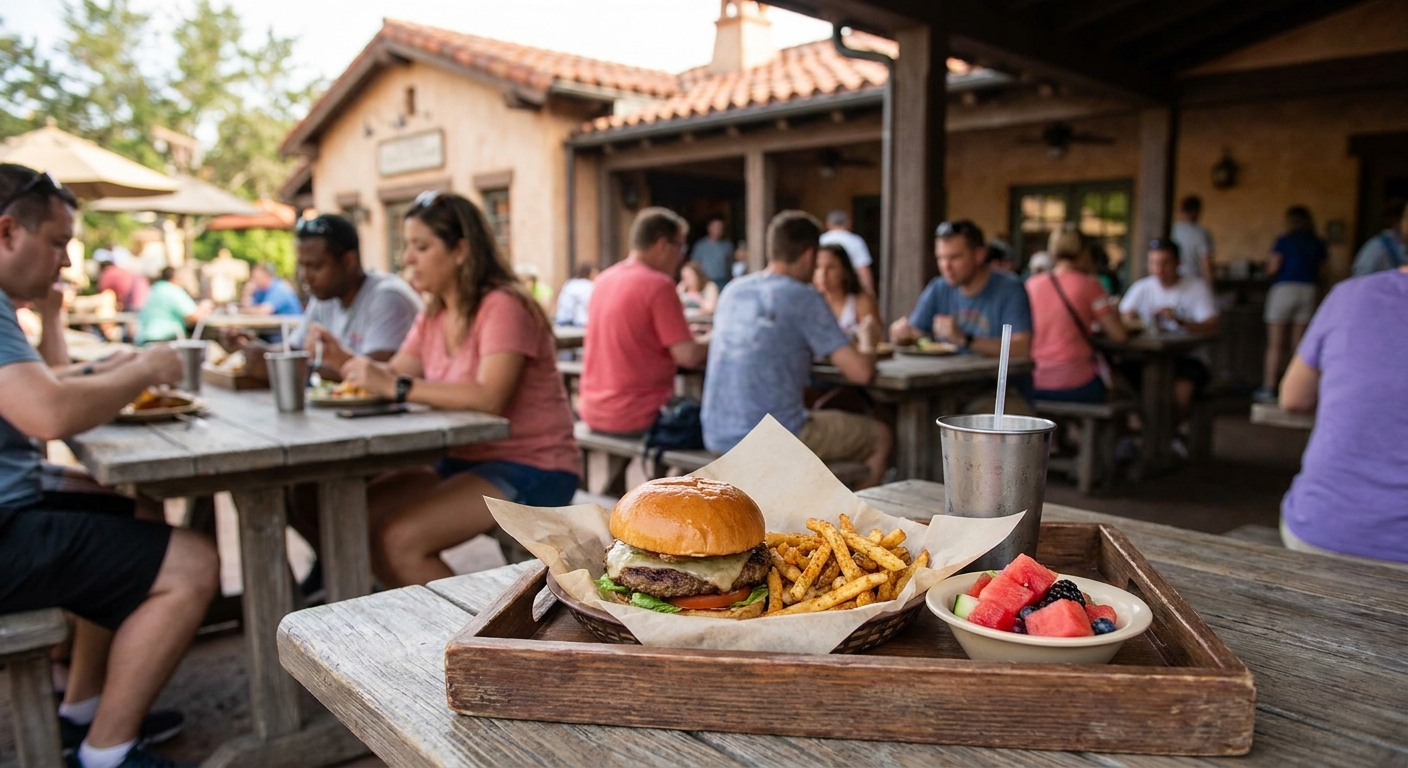
What’s Actually in the Japan Pavilion: The Five Options Compared
Five venues, and only two of them require a reservation — which means the Japan Pavilion is one of the few World Showcase stops where you can eat well with zero advance planning. The trick is knowing which door to walk through, because three of the five are hiding in plain sight.
The layout, so you can picture the walk
Everything sits in a tight cluster, but it’s stacked vertically — that’s what throws people.
- Ground level, left of the pagoda: Katsura Grill, tucked back past the garden path. The ordering counter is indoors, which is why most guests never clock the patio out by the pagoda and koi pond.
- Ground level, attached to the big store: Kabuki Café, a walk-up snack window on the outside of the Mitsukoshi building. You’ll pass it on the way to the lagoon without registering it as “food.”
- Inside the Mitsukoshi store: Walk in, look for the staircase. Everything else is up there.
- Upstairs: Teppan Edo (hibachi tables), Tokyo Dining (sushi and izakaya-style plates) on the same level, and Takumi-Tei in its own quiet corner — separate entry, separate mood, intentionally sealed off from the retail noise below.
So: quick food stays on the ground, sit-downs live above a department store. If you’re meeting family and say “the Japan restaurant,” specify a floor.
The five options at a glance
| Venue | Service | Cuisine focus | Price band | Typical length | Energy | Reservation difficulty | Kids | Best for |
|---|---|---|---|---|---|---|---|---|
| Katsura Grill | Quick service | Ramen, teriyaki bowls, udon, curry, tempura | $ | 20–30 min | Low, garden-calm | None needed | Great | Feeding everyone fast without burning a table-service slot |
| Kabuki Café | Snack window | Kakigōri shaved ice, small bites | $ | 10 min | Walk-up, no seating to speak of | None needed | Great | One shareable treat on the way to the lagoon |
| Teppan Edo | Table service | Hibachi-style flat-top, cooked at your table | $$ | 75–90 min | Loud, theatrical, communal | Hard at dinner, easier at lunch | Excellent | Buying the show — and the only one that satisfies a split table |
| Tokyo Dining | Table service | Sushi, sashimi, izakaya-style plates | $$ | 60–90 min | Moderate, conversational | Moderate to hard | Okay | Real sushi, sit-down, without special-occasion pricing |
| Takumi-Tei | Signature / fine dining | Premium Japanese, multi-course | $$$ | 90+ min | Hushed on purpose | Hardest in the pavilion | Poor | A deliberate splurge on a slow evening |
What the table doesn’t tell you
- Teppan Edo seats communally. Each grill holds several parties, so unless your group fills a table, you’re sharing with strangers. Social groups love it; anyone picturing a quiet two-top wants Takumi-Tei instead.
- Lunch is the value play at the hibachi tables — roughly 30% cheaper than dinner for the same chef, the same flair, the same show.
- Takumi-Tei’s dining rooms are each built around a traditional element — water, wood, stone, washi paper, earth. You’re paying for stillness as much as the plate.
- Katsura Grill’s portions punch above the price. Around $15-ish for a main, and the bowls are a full meal. Two adults can eat there for roughly what one entrée costs upstairs.
Pro tip: Head out to the patio by the pagoda and koi pond at Katsura Grill instead of the cramped indoor seating. It’s shaded, quieter, has an actual view, and most guests walk past it because the ordering counter is inside — the best free seat in the pavilion.
Pick your lane in 30 seconds
- [ ] Hungry crew, tight budget: Katsura Grill, Mobile Order ahead in My Disney Experience, eat on the patio.
- [ ] Want the spectacle, not the spend: Teppan Edo at lunch.
- [ ] Sushi is the actual goal: Tokyo Dining — and skip the pre-packaged rolls at the counter downstairs.
- [ ] Anniversary or milestone: Takumi-Tei, on a slower World Showcase evening only.
- [ ] Just grazing the countries: Kabuki Café kakigōri and keep walking.
Reservations for the three upstairs spots open 60 days before arrival at 6:00 AM ET in My Disney Experience, and in this pavilion they go fast. If you strike out, set a Drop Watch on SupaPark — cancellations free these tables up at odd hours, and you confirm the grab in My Disney Experience.
Katsura Grill: The Best-Value Meal in the Pavilion
Two adults can eat a full meal here for roughly what one entrée costs at the hibachi place next door — and it still tastes like the country it’s themed after. That combination is rarer in EPCOT than it should be.
Most quick service in World Showcase defaults to burgers and the predictable theme-park lineup. Katsura Grill actually commits: ramen, teriyaki bowls, udon, curry, a small sushi case. You order at the counter, grab a tray, and eat. No reservation, no 90-minute table commitment, no watching the clock between courses.
What to order
- The move: tonkotsu ramen. Rich pork broth, noodles made on-site, and it holds heat long enough that you can actually eat it slowly instead of inhaling it. Best single bowl for the money in the pavilion.
- Reliable backups: chicken or beef teriyaki bowls — filling, familiar, and the easiest sell to a hesitant kid. Tempura is crisp and good to share.
- Sleeper hit: katsu curry when it’s on the menu. Hearty, and consistently underordered next to the ramen and the sushi case.
- Cheap starter: edamame, ordered first, buys you five minutes of peace while the rest of the order lands.
- Skip: the pre-packaged sushi rolls. They’re fine, not memorable. If sushi is the actual goal, sit down at the izakaya-style table service instead and spend the money properly.
Portions run generous for the price — the bowls and noodle dishes are a real meal, not a snack. Plan on roughly $15-ish for a main, with rolls and edamame as cheaper add-ons.
Mobile Order it, always
Katsura Grill is on Mobile Order in My Disney Experience, and there’s no reason not to use it. The ordering counter is indoors and the line backs up into a bottleneck right at lunch.
- [ ] Open My Disney Experience and add Katsura Grill to your Mobile Order favorites before your park day
- [ ] Place the order while you’re still walking World Showcase — mid-pavilion, not at the door
- [ ] Pick your arrival window, then tap “I’m Here” when you’re actually outside
- [ ] Send one person to collect the tray while the rest of the group claims seats
On a busy day that’s an easy 5–10 minutes saved. More importantly, it locks a pickup window before the noon rush pushes the next available slot an hour out — which is the failure mode that turns a cheap, fast lunch into a stressful one.
Pro tip: Skip the cramped indoor seating and the front patio scramble. Walk around to the garden seating behind the sushi bar, tucked near the pagoda and the koi pond. It’s quieter, shaded, and has a genuine view — and most guests never find it because the ordering counter is inside and nothing points them around back. Best free seat in the pavilion.
Who it’s for — and who should skip it
| Your situation | Katsura Grill? | Why |
|---|---|---|
| Feeding a family, watching the budget | Yes | One counter bill instead of four entrée prices |
| Lunch, don’t want to burn a table-service slot | Yes | 20–30 minutes door to door |
| Table service fully booked | Yes | In the Japan Pavilion, that’s the normal state of things |
| Want the hibachi show | No | This is a counter, not a performance |
| Anniversary or milestone dinner | No | Go upstairs to the quiet, high-end room |
| Sushi is the whole point of the meal | No | Sit down for it instead |
The honest framing: this isn’t a consolation prize, it’s a deliberate choice. You’re trading theatrics for food value and your afternoon back.
The smart move
Reservations in the Japan Pavilion disappear fast, so don’t gamble your entire lunch plan on landing one. Build Katsura Grill in as your fallback from the start — Mobile Order placed, garden seating as the plan, table service treated as the upgrade rather than the baseline.
And if you do want a sit-down, the reservation game is a two-step thing: Advance Dining Reservations open 60 days before arrival at 6:00 AM Eastern in My Disney Experience, and cancellations free up tables at random hours after that. Set a Drop Watch in SupaPark (supapark.com) on the table-service spot you want — you’ll get pinged the second one frees up and can grab it in My Disney Experience. Keep Katsura Grill as the plan that needs no luck at all.
Teppan Edo: Hibachi, the Show, and Why Lunch Beats Dinner
The move: book Teppan Edo at lunch, not dinner. Same chef, same knife tricks, same onion volcano — for roughly 30% less than the dinner menu. That’s the single best value play in the Japan Pavilion, and almost nobody books it that way because lunch reservations feel like a waste of a midday hour.
How the table actually works
Teppan Edo is communal teppanyaki — flat-top grills with a chef cooking in front of you, table-side. Each grill seats several parties, so unless your group fills the whole thing, you’re sharing it with strangers.
That’s a feature for social groups and a problem if you were picturing a quiet two-top. If “romantic and private” is the goal, that’s Takumi-Tei upstairs — not here.
- Window seats (the right-most grill) get the best angle on the chef and a calmer World Showcase Lagoon backdrop. Ask when you check in — it’s free and people rarely request it.
- Big party? On busy nights you can still get split across two grills. If staying together matters, confirm it at check-in, not after you’re seated.
- The show is the classic teppanyaki routine: knife work, the volcano, the flipped shrimp tail, rapid-fire chopping. It’s charming and genuinely fun for kids — it is not avant-garde cooking. Go for the energy.
Lunch vs. dinner
| Lunch (~11 a.m.–2 p.m.) | Dinner (~5–8 p.m.) | |
|---|---|---|
| Price | Roughly 30% cheaper | Full price |
| The chef show | Identical | Identical |
| Availability | Easier to land | Fills first on busy nights |
| Best for | Value, kids, mixed groups | Groups who want a later, bigger meal |
| Trade-off | Burns a midday hour | Costs more, competes with fireworks timing |
The only real argument for dinner is schedule. If you want to eat early and still have the evening free, grab the 5 p.m. slot — it’s the most underbooked dinner time and gets you out before the lagoon crowd builds.
What to order
- Steak — the default for a reason. It’s the protein the format flatters most, and the one most likely to justify the price.
- Chicken — the safe, familiar pick. Reliable, mild, kid-approved.
- Scallops — the sleeper. Sears beautifully on a flat-top and gets ordered far less than it should.
- Noodles and vegetable options — not consolation prizes. The udon and the veggie plate are genuinely satisfying, which is exactly why this place solves a divided table.
- Combos — if two people can’t agree, a combination plate plus one shared protein usually feeds more than two separate entrées.
Plan on the mid-$30s-and-up range per adult entrée at dinner, meaningfully less at lunch. Treat those as ballpark — menu pricing shifts.
Why it’s the MVP for a divided table
This is the one Japan Pavilion restaurant that keeps a mismatched group happy in a single sitting. The steak-and-spectacle adult, the noodles-only kid, and the vegetarian all eat well at the same grill, at the same time, watching the same show. And because the chef is cooking in front of you, allergy adjustments can often be handled on the spot.
- [ ] Note allergies in your My Disney Experience reservation profile when you book
- [ ] Mention them again at check-in
- [ ] Ask for the chef or manager at the table — don’t rely on the server alone
- [ ] Gluten-free diners: flag it early. Soy sauce contains wheat, and many sauces need a swap
- [ ] Carry a backup snack for the kid who melts down before food arrives
Timing and pacing with young kids
Budget 90 minutes. There’s check-in, the wait for the grill to turn over, the show, and then the actual eating. This is not a 45-minute refuel — don’t slot it between two Lightning Lane return times.
With little kids, the pacing cuts both ways: the show buys you about 10 minutes of genuine fascination, but food arrives in stages, and the first course isn’t theirs. Order something immediate — soup, edamame, rice — to bridge the gap.
Pro tip: Book the earliest lunch slot you can get, around 11 a.m. You get the cheaper menu, a chef who isn’t eight shows deep into the day, a far better shot at the window grill, and you’re out by 12:30 — before World Showcase hits its afternoon crush. That one reservation choice saves money and time, which almost nothing else at Disney World does at once.
Booking it
Advance Dining Reservations open 60 days before arrival at 6:00 AM Eastern in My Disney Experience. On busy nights Teppan Edo goes fast, so treat that window like a real appointment. If you strike out, don’t settle — set a Drop Watch on SupaPark and it’ll ping you the second a cancellation frees a table, then you confirm it in My Disney Experience. Prime hibachi slots turn over constantly; the people who get them are just the ones who find out first.
Tokyo Dining: Sushi, Tempura, and the Middle-Ground Sit-Down
If you want a real sit-down Japanese meal in the Japan Pavilion without the communal hibachi table or the splurge upstairs, Tokyo Dining is the slot that makes the most sense — and it’s usually the easiest of the three to actually book.
It sits right beside the teppanyaki room, and most guests never separate the two in their heads. That’s the opportunity. Tokyo Dining is quieter, à la carte, and paced like a normal restaurant — you order what you want, you’re not locked into a set performance, and nobody’s flipping shrimp into your kid’s mouth. For a couple, a pair of teens, or anyone who came to EPCOT specifically to eat sushi, it’s the right room.
What to order
- Sushi and sashimi. This is the reason to choose it over the hibachi side. Rolls, nigiri, and sashimi plates are the house strength, and it’s the only sit-down in the pavilion where you can build a meal entirely out of raw fish without going into special-occasion pricing. Sushi eaters: order here, not from the little pre-packaged case at the quick-service counter.
- Tempura. Light batter, good to share, and the safest bridge order for anyone at the table who’s nervous about raw fish. Shrimp or vegetable both land.
- Bento-style combinations. The combo plates are the smart value play — you get a little sushi, a little cooked protein, rice, and sides in one price instead of stacking three à la carte orders. This is also the single best order for a teen who’s curious but not committed.
- Save room for dessert. Dessert here is more thought-through than at most World Showcase table service, and it’s an easy way to make the meal feel like an occasion without upgrading the whole reservation.
The seat you should actually ask for
- [ ] Request a window table when you check in — not when you book
- [ ] Ask specifically for the side facing World Showcase Lagoon
- [ ] Aim for a reservation 45–60 minutes before dark so you get the view and the light
- [ ] If they can’t seat you by the window, take the booking anyway — the food doesn’t change
Pro tip: Book the lunch slot, not dinner. The sit-downs in this pavilion run noticeably cheaper midday — hibachi lunch lands around 30% below dinner — and the midday crowd in World Showcase is thinner, so you get a calmer room and you free up your evening for fireworks and snacking your way around the lagoon, which is where EPCOT’s real value lives.
Tokyo Dining vs. hibachi for a mixed group
| Tokyo Dining | Hibachi table service (Teppan Edo) | |
|---|---|---|
| Vibe | Calm, conversational | Loud, theatrical, performance-driven |
| Seating | Your own table | Communal — you’ll likely share a grill with strangers |
| Menu style | À la carte: sushi, sashimi, tempura, bento combos | Set cook-at-the-table meals |
| Best for | Couples, teens, sushi eaters, anyone who wants quiet | Kids, big social groups, picky-eater tables |
| Allergy handling | Ask for the chef or manager at check-in | Chef adapts at the grill in front of you |
| Pacing | Normal restaurant rhythm | Locked to the show |
| Cost | $$ | $$, cheaper at lunch |
The honest read: if your table is genuinely divided — a steak-and-show adult, a noodle kid, a veggie eater — the hibachi room is still the MVP, because the chef solves everyone’s problem in one meal. But if nobody at your table needs the show, Tokyo Dining is the better food and the better conversation. Three adults who all like sushi should not be sitting at a communal flat-top.
A real caution: soy sauce contains wheat, and tempura batter is off-limits for gluten-free diners without a swap. Note allergies in your My Disney Experience reservation profile, then flag them again at check-in and ask for the chef — don’t leave it with the server alone.
Where this fits in your day
Advance Dining Reservations open 60 days before arrival at 6:00 AM Eastern in My Disney Experience. Japan Pavilion sit-downs fill fast, but Tokyo Dining tends to hold availability longer than the teppanyaki room or the upstairs splurge — so if you’re striking out everywhere else at 60 days, check here before you give up on a table.
And if it is gone: set a Drop Watch on SupaPark (supapark.com) for the table you actually want. Cancellations free these slots up at random hours, and SupaPark pings you the second one opens so you can grab it in My Disney Experience. That’s the window most planners never see.
Remember this: Tokyo Dining is the pavilion’s sensible middle — real sushi, a lagoon-side window if you ask for it, and a calm room at a fraction of the splurge. Book it at lunch, request the window at check-in, and let the hibachi side handle the groups that need a show.
Takumi-Tei: Is the Splurge Worth It?
Yes — but only if you treat the meal as the event, not a refuel between rides. Takumi-Tei is the Japan Pavilion’s quiet, food-first, high-end room: paced courses, serious plating, and a dining experience you genuinely can’t replicate elsewhere at Walt Disney World. It also fails badly when you slot it into a busy park night, which is exactly what most people do.
The room is half of what you’re buying
Each dining space is built around a traditional Japanese element — water, wood, stone, washi paper, and earth — and the effect is deliberate: hushed, considered, sealed off from the World Showcase noise outside. That’s the real product. EPCOT evenings get loud and shoulder-to-shoulder, and this is a pocket of stillness inside the park without leaving it.
The contrast with the hibachi tables a few steps away is the whole point. Those are theatrical, boisterous, fantastic with kids. Takumi-Tei is the deliberate opposite. Don’t book it expecting energy — book it expecting quiet. If your table can’t lean into that, your money goes further almost anywhere else in the pavilion.
What you’re actually paying for
Premium ingredients and a slow, structured, course-by-course meal with a prix-fixe/omakase lean. Plan on 90+ minutes at the table and a $$$ special-occasion spend — not a casual table-service night out. You are not buying volume. If your mental math is calories per dollar, this will read as a bad deal, and honestly, it is one by that measure.
| What you want | Takumi-Tei delivers? | Better pick in the pavilion |
|---|---|---|
| Quiet, grown-up, special occasion | Yes — this is the only one | — |
| Dinner and a show | No, by design | Teppan Edo (hibachi) |
| Feeding a family affordably | No | Katsura Grill |
| Fast — in and out in 30 min | No, plan 90+ | Katsura Grill, Kabuki Café |
| Same experience for less | Not available at lunch pricing | Teppan Edo lunch, ~30% under dinner |
Go if / skip if
Go if:
- You’re marking an anniversary, birthday, or milestone
- You genuinely care about food, technique, and presentation
- You want a grown-up escape from the evening crush without leaving EPCOT
Skip if:
- You’ve got restless kids who need a show, not silence
- You’re squeezing dinner between attractions
- You want maximum food value per dollar — that is simply not the assignment here
The scheduling rule that makes or breaks it
This is the single biggest mistake with Takumi-Tei, and it has nothing to do with the menu: people book it on a headliner-heavy night and then spend the meal watching the clock against a Lightning Lane return window. A long, paced, multi-course dinner cannot survive that. You’ll rush the courses you paid a premium for.
Put it on a slower World Showcase evening instead — a night where the plan is strolling, drinking, and snacking, not sprinting. That one choice improves the meal more than any order you place.
Pro tip: Book Takumi-Tei the night after your big ride day, not the night of it. The post-headliner evening is already your low-intensity night, your feet are done, and nobody at the table is secretly calculating whether they can still make one more attraction before close.
How to actually land the table
- [ ] Pick your slow World Showcase evening first — check crowd forecasts before you pick the date, not after
- [ ] Set a calendar alarm for 60 days before arrival, 6:00 AM Eastern, in My Disney Experience (that’s the dining window; the 7:00 AM Lightning Lane window is a separate thing entirely)
- [ ] Be logged in and loaded a few minutes early — the good slots move fast
- [ ] Struck out? Don’t downgrade to a worse restaurant out of panic. Set a Drop Watch on SupaPark and keep your dates flexible — cancellations free up at odd hours, and that’s the window most planners never see. SupaPark pings you the second a table opens; you confirm it in My Disney Experience.
- [ ] Decide your fireworks strategy now: eat early and walk straight to the lagoon, or book late and let the crowd thin while you dine
Both work. What doesn’t work is a mid-evening reservation that lands you leaving the restaurant exactly when 20,000 people are converging on the water.
The honest verdict
Takumi-Tei is worth it for the occasion and the calm, not for the calories per dollar — and only on a night you can genuinely slow down. Treated that way, it’s one of the most distinctive meals in the park. Treated as a default table-service pick, it’s an expensive way to feel rushed.
Kabuki Café and the Snack Stops
The move: treat Kabuki Café as a cooling station, not a meal — one large kakigōri, split two ways, on the hottest stretch of your World Showcase lap.
Kabuki Café is the outdoor window tucked near the pagoda, and it exists for exactly one reason: shaved ice. Everything else on the board is pleasant. The kakigōri is the thing people actually walk across the lagoon for.
Order this: kakigōri
Shaved ice, flavored syrup, optional sweetened condensed milk on top. The texture is the point — it’s shaved fine, not crushed into gravel, so it eats more like a cold cloud than a snow cone.
- Get the large. It’s genuinely shareable between two adults or a kid and a parent, and if you’re on a dining plan it typically lands at one snack credit — the best snack value in the pavilion by a wide margin.
- Add the condensed milk if you want it to read as dessert rather than refreshment. Skip it if you’re overheated and want something clean.
- Eat it fast. Central Florida does not negotiate with shaved ice. Ten minutes in the sun and you’ve got flavored soup.
The rest of the board
| Pick | What it actually is | Best for |
|---|---|---|
| Kakigōri (large) | Fine shaved ice, syrup, optional condensed milk | The whole reason to stop. Split it. |
| Maple popcorn | Sweet-coated popcorn, sold in bags | Walking snack that survives the stroller basket |
| Sweet/savory bites | Rotating Japanese-leaning snack items | Grazers who want one bite, not a plate |
| Sake flight or cup | Chilled and warm options at the window | Adults doing a slow World Showcase lap |
| Japanese beer | Cold, crisp, drinkable in the heat | Pairing with a shared kakigōri, honestly |
A note on the maple popcorn: it’s the easiest thing here to carry and share, and it’s the one that keeps kids quiet between pavilions. If anyone in your group avoids wheat, ask about the seasoning — the popcorn itself is fine; the coating is the question.
Pro tip: Kakigōri is also a stealth bribe. If you’ve got a melting-down kid and a 20-minute walk left to Canada, the shaved ice window resets the whole group faster than a sit-down break — and costs a fraction of one. Build it into the route, not the budget.
When a snack here replaces a meal (and when it doesn’t)
Be honest with yourself about this one. Shaved ice is water and sugar. It will not carry a four-year-old through to the fireworks.
- It replaces a meal when you’ve already grazed your way through two or three pavilions and just need a cold punctuation mark — or when you ate a big Katsura Grill lunch and dinner is a snack crawl by design.
- It does not replace a meal when anyone in the group hasn’t had real food in four hours. Walk twenty feet to the Katsura Grill counter instead, get a teriyaki bowl or tonkotsu ramen, and come back for the kakigōri afterward.
The smartest sequence in the pavilion is both: a real bowl at the counter-service spot, then the shaved ice as dessert on the way out. You’ll spend less than one hibachi entrée and leave actually full.
Working it into a hot afternoon
World Showcase has very little shade, and the stretch between pavilions is where afternoon energy dies.
- [ ] Hit the window in the 2–4 p.m. heat trough, not at lunch — that’s when it earns its keep
- [ ] Order one large to share rather than two smalls; fewer dollars, same relief
- [ ] Carry it to the garden seating behind the Katsura Grill building — shaded, quieter, and most guests walk straight past it
- [ ] Give yourself ten minutes off your feet while you eat it; that’s the real recovery, the ice is just the excuse
- [ ] Refill water bottles before you move on — the sugar hit isn’t hydration
Lines at the window move quickly because the order is simple, but they stack up in the late afternoon when everyone else has the same idea. If the queue looks long, note that it’s one of the fastest-clearing lines in the pavilion — five minutes, usually, not twenty.
Remember this: Kabuki Café isn’t a dining decision, it’s a pacing decision. One large kakigōri, shared, in the worst heat of the day, with ten minutes of shade attached — that’s the whole play, and it costs less than almost anything else in World Showcase.
What to Order If You’ve Never Eaten Japanese Food Before
If one person at your table is nervous about Japanese food, order teriyaki chicken and a bowl of plain white rice and stop worrying — it’s the combo a hesitant eater almost always finishes. The Japan Pavilion looks intimidating on paper (raw fish, unfamiliar broths, a prix-fixe room upstairs), but the actual menus at the quick-service counter are full of flavors you’ve already eaten somewhere else under a different name.
The four safe anchors
These are the dishes that translate across almost any palate:
- Teriyaki chicken — sweet, mild, glazed, closer to a barbecue sauce than anything exotic. The reliable default for adults and kids alike.
- White rice — plain, filling, and something nearly every spot in the pavilion can plate for you.
- Udon and ramen — these read as “just noodles” to a hesitant kid. Ask for the broth on the side if the soup part is the sticking point; the noodles stand on their own.
- Tempura — battered and fried is universal food language. Shrimp or vegetable both work, and it’s the easiest thing on the menu to share around a table.
Low-risk starters while you decide
Order these first so nobody is making decisions while hungry:
- Edamame — salted soybeans you pop out of the pod. Cheap, fast, mild, and weirdly fun for kids.
- Gyoza — pan-fried dumplings. If your family eats pot stickers from a mall food court, they eat gyoza.
- Cucumber or avocado rolls — rice and a vegetable, no raw fish involved. The gentlest possible on-ramp to sushi.
Pro tip: At the counter, a bowl of plain white rice plus a side of teriyaki chicken is often cheaper and faster than the kids’ meal — and it’s the one plate a picky eater reliably clears. Build it in Mobile Order in My Disney Experience so you’re assembling the order on a bench, not negotiating substitutions at the register with a line behind you.
What to order if you like X
| If you normally like… | Order this | Why it works |
|---|---|---|
| Chicken teriyaki takeout, BBQ chicken | Chicken teriyaki bowl | Sweet-savory glaze over rice; the single safest entrée in the pavilion |
| Chicken tenders, fish and chips | Shrimp or vegetable tempura | Light batter, fried, dippable — familiar texture, new ingredient |
| Chicken noodle soup, pho | Udon, or tonkotsu ramen if you want richer | Noodles in broth; udon is the milder of the two |
| Chicken parm, breaded cutlets | Katsu curry, when it’s offered | Breaded pork or chicken with a mild, gravy-like curry — the pavilion’s most underordered dish |
| Steak and a show | Hibachi table service | The performance carries the meal; lunch runs noticeably cheaper than dinner for the same show |
| California rolls only | Cucumber or avocado rolls | Rice, nori, vegetable. No raw anything |
| Soft pretzels, mall snacks | Kakigōri (shaved ice) at the snack window | Shareable in the large size, and about one snack credit on a dining plan |
| Tasting menus and fine dining | The upstairs prix-fixe room | Quiet, paced, premium — a destination meal, not a refuel |
What “authentic-leaning” actually means here
Be honest with yourself about the ceiling. The quick-service counter leans genuinely into the cuisine — teriyaki bowls, udon, curry, a small sushi case, noodles made on-site for the ramen — which is a real step up from the burger-and-nuggets default elsewhere in EPCOT. But it’s still theme-park Japanese: sweeter glazes, milder spice, portions sized for American appetites, and a menu built to move a lunch rush.
What that means practically: it’s a great first taste, not a benchmark. If someone decides they don’t like Japanese food based on a theme-park teriyaki bowl, that verdict isn’t fair to Japan — and if they love it, the real thing will likely be even better.
Dietary notes first-timers miss
- [ ] “Vegetarian-looking” isn’t always vegetarian — many broths and dressings are built on dashi or fish stock. Ask specifically.
- [ ] Vegetable tempura, edamame, cucumber and avocado rolls, and steamed rice are the easy plant-forward picks at the counter.
- [ ] Soy sauce contains wheat, so gluten-free diners need to flag it early — tempura batter and most sauces need a swap.
- [ ] Note allergies in your My Disney Experience profile and again at check-in; at table service, ask for the chef or manager rather than relying on the server.
The smart move: Put the safe order in before you arrive via Mobile Order, then let the adventurous eaters at your table order something unfamiliar to share. Nobody goes hungry, and somebody discovers a new favorite — which is the whole point of eating in World Showcase.
Feeding Picky Kids Without Overpaying
The move: skip the kids’ meal entirely and build your own — a bowl of plain white rice plus a side order of teriyaki chicken at the quick-service counter is usually cheaper, faster, and the combo a picky eater will actually finish.
Kids’ meals at Disney World are priced for convenience, not for the kid who’s going to eat four bites of something unfamiliar and then ask for a pretzel. In the Japan Pavilion you have an unusual advantage: nearly every item on the counter-service menu is a single, recognizable component. Rice is rice. Chicken is chicken. That’s the whole hack.
The picky-eater order sheet
Ranked by how reliably a hesitant kid will eat it:
| Order | Why it works | Watch out for |
|---|---|---|
| Teriyaki chicken | Sweet, mild, familiar — reads as “chicken nuggets’ grown-up cousin” | Sauce can be sweeter than expected; ask for it on the side if your kid is sauce-averse |
| Plain white rice | Fillable, neutral, and nearly every spot can plate it | Nothing — this is the universal fallback |
| Tempura (shrimp or veggie) | Battered and fried is universal kid-language | Shared-fryer and wheat-batter issues for allergy families |
| Udon or ramen | Noodles are noodles to a kid who won’t try sushi | Order broth on the side; hot soup plus a tired four-year-old is a bad combination |
| Edamame | Cheap, fast, eat-with-your-hands, arrives before the mains | Some kids need to be shown how to pop them |
Why Mobile Order is the real parenting tool here
Katsura Grill is on Mobile Order in My Disney Experience, and the reason to use it isn’t just the roughly 5–10 minutes you save on a busy day. It’s that you build the order sitting down, away from a register, with no line behind you and no child negotiating in real time. You can quietly add plain rice, drop the sauce, split one main into two — all decisions that are miserable to make at a counter with a crowd.
- [ ] Add Katsura Grill to your Mobile Order favorites in My Disney Experience before your trip
- [ ] Order before you walk into the pavilion, not when you arrive
- [ ] Lock a pickup window before the noon rush pushes the next slot an hour out
- [ ] Send one adult to collect the tray while the other claims seats
Pro tip: The quiet patio by the pagoda and koi pond — and the garden area behind the building — are the real meltdown insurance. Most guests never find them because the ordering counter is inside, so you get shade, space, and a kid who can be loud without you apologizing to a table of strangers.
Splitting adult portions beats buying more meals
Portions at the counter run generous for the price — the teriyaki bowls and noodle dishes are a genuine full meal, not a snack, at roughly $15-ish for a main. Practically, that means:
- Two kids, one bowl. Order one teriyaki bowl and one side of rice and split it across two plates. Often cheaper than two kids’ meals and more food.
- One adult, one kid. Share a ramen or curry; add edamame so the kid has something to eat immediately.
- Big family. Two adults can eat at the counter for roughly what one entrée costs at the hibachi spot next door — so the savings fund the shaved ice at the snack window later.
If anyone at the table has an allergy, slow down: soy sauce contains wheat, tempura batter is off-limits without a swap, and many broths and sauces are fish- or dashi-based even when the dish looks vegetarian. Note allergies in your My Disney Experience profile, re-state them at check-in, and at table service ask for the chef or a manager rather than relying on the server alone.
Which venue handles a meltdown best
| Situation | Best venue | Why |
|---|---|---|
| Kid is already hungry and fading | Counter service (Katsura Grill) | Mobile Order, food in hand fast, no 90-minute commitment, easy exit |
| Mixed group — steak eater, noodle kid, veggie eater | Hibachi table service | Everyone gets something at the same meal, the chef adapts on the spot, and the show distracts |
| Restless kids, tight schedule | Snack window + patio | A shared kakigōri buys you twenty calm minutes for almost nothing |
| Kids who can’t sit still | Not the upstairs splurge | A long, paced, multi-course dinner and a restless kid is money set on fire |
The hibachi tables are the MVP for a divided table — loud, theatrical, and genuinely good with kids — but they’re communal, so you’ll likely share a grill with strangers. Lunch runs noticeably cheaper than dinner for the same show, which is the better call with children who won’t last until 8 p.m. anyway.
Remember this: Build the meal from components instead of buying the kids’ meal, order it on Mobile Order before you arrive, and eat it on the quiet patio. Carry one backup safe snack for the kid who melts down before food lands — that single granola bar has saved more Japan Pavilion lunches than any menu recommendation.
Vegetarian, Vegan, Gluten-Free, and Allergy Planning
The single most important thing to know in the Japan Pavilion: “looks vegetarian” and “is vegetarian” are different things, and the culprit is dashi.
Dashi — the foundational Japanese stock — is typically made with bonito (dried, fermented fish) and kombu. It shows up in broths, dipping sauces, miso soup, simmered vegetables, and salad dressings. A vegetable tempura plate can arrive with a fish-based dipping sauce. A “veggie” udon can sit in a broth that started with bonito. None of that is a mistake on Disney’s part; it’s just how the cuisine is built. The fix is specific vocabulary, not a general request.
Ask the right question
Don’t say “is this vegetarian?” Say: “Is there dashi, bonito, or fish sauce in the broth, sauce, or dressing?” That phrasing gets a real answer, because it names the ingredient a cook recognizes rather than a dietary category they’re guessing at.
- Vegans should also flag egg (tempura batter, some noodles) and honey (glazes).
- At the hibachi-style table service, the chef cooks in front of you — which makes it the easiest venue in the pavilion to get a clean, on-the-spot adaptation. Shared flat-top surfaces are still shared, so say so if cross-contact matters.
- At counter service, you’re asking a cast member to check a prep sheet. Build in a minute of patience and order before the lunch rush, not during it.
Plant-forward picks that usually work
| Pick | Where | Why it works | What to verify |
|---|---|---|---|
| Edamame | Counter service | Steamed, salted, no sauce | Just salt on top |
| Steamed white rice | Counter service | Universal fallback, cheap, fills a kid | Plain, no furikake |
| Vegetable tempura | Counter or table | Fried veg, visibly meat-free | Batter (egg/wheat) + dipping sauce |
| Cucumber or avocado rolls | Counter service | Rice, nori, veg — nothing hidden | Rice seasoning; shared sushi station |
| Shaved ice at the snack window | Snack window | Ice and syrup; naturally dairy-free unless topped | Condensed-milk or cream toppings |
Gluten-free needs a head start
Standard soy sauce contains wheat. That one fact rules out a surprising amount of a Japanese menu by default: teriyaki glaze, dipping sauces, marinades, and most tempura batter. Gluten-free diners are not stuck here, but you cannot order normally and sort it out when the plate lands.
- Flag it at booking and again at check-in so the kitchen has time to pull a substitute sauce.
- Assume tempura is out unless the kitchen confirms a dedicated gluten-free preparation — fryer oil is usually shared.
- Grilled proteins with plain rice and steamed vegetables are the most adaptable order on the table-service side.
- Ramen and udon are wheat noodles. Rice is your friend.
Pro tip: Ask about the seasoning, not the food. Popcorn-style snacks with maple or sweet coatings are the classic trap — the popcorn itself is fine, but the flavored coating is where wheat, dairy, or soy hides. Same logic applies to furikake, panko garnishes, and anything described as “crispy” on top of an otherwise safe dish.
The allergy checklist
- [ ] Note allergies in your My Disney Experience reservation profile before you arrive
- [ ] Repeat them out loud at check-in — the profile note is a flag, not a guarantee
- [ ] At table service, ask to speak with the chef or manager; don’t rely on the server relaying it
- [ ] Name ingredients, not categories: dashi, bonito, fish sauce, wheat-based soy sauce, egg, sesame
- [ ] Ask about shared fryers and shared grill surfaces if cross-contact matters
- [ ] Question snack coatings and toppings separately from the base item
- [ ] Carry a backup safe snack for the kid who melts down before food arrives
Which venue flexes best
If your group has mixed needs, the hibachi-style table service does the most work in one sitting: the steak-and-show crowd, the noodle kid, and the plant-based eater all get fed at the same table, and the chef can adjust live. Lunch typically runs noticeably cheaper than dinner for the same performance, which makes it the value play. Counter service is the better call if the allergy is severe and you’d rather build a simple plate yourself — rice, edamame, a grilled protein — with fewer sauces in play. The high-end upstairs room can absolutely accommodate restrictions, but flag them at booking; a tasting-style menu needs lead time to re-engineer, not a heads-up at the table.
Remember this: the Japan Pavilion is one of the easier World Showcase stops to eat in with restrictions, as long as you ask about dashi and wheat-based soy sauce by name, and ask early. Set your Advance Dining Reservations 60 days out at 6:00 AM Eastern in My Disney Experience with the allergy note already attached — and if the table you want is gone, a Drop Watch on SupaPark will ping you when a cancellation frees it up, so you’re not downgrading to a restaurant that can’t feed half your group.
Cost Breakdown: What a Japan Pavilion Meal Really Runs
The gap between the cheapest and most expensive meal in this one pavilion is enormous — and the single biggest lever isn’t what you order, it’s whether you sit down and what time you do it.
Japan has the widest price spread of any World Showcase pavilion: a shaved ice at a snack window and a multi-course dinner upstairs are both “a Japan meal,” separated by an order of magnitude. Here’s roughly where each choice lands.
What each scenario typically costs
| Party & venue | Typical range | What’s driving it |
|---|---|---|
| Solo snack (Kabuki Café kakigōri) | $ | One item, no tip, no tax drama; a large is genuinely shareable |
| Two adults, Katsura Grill counter | $ | Two mains around $15-ish each, plus drinks |
| Family of four, Katsura Grill | $–$$ | Shareable tempura/edamame plus rice let you buy three mains for four people |
| Family of four, hibachi lunch | $$ | Per-person entrées, no shared plates, but midday pricing |
| Family of four, hibachi dinner | $$–$$$ | Same food and same show, typically ~30% more than lunch |
| Two adults, Takumi-Tei | $$$ | Premium ingredients, long pacing, multi-course format |
Treat those as shapes, not quotes — Disney menu prices shift by season and by menu refresh, so confirm current pricing in My Disney Experience before you commit a meal slot.
Where the money actually leaks
Three places, and none of them are the entrée you were worried about:
- Per-person entrées with no shared option. At the hibachi tables everyone buys their own protein. There’s no “the kids will split one.” That structure, not the price per plate, is what turns a table of four into a serious number.
- Drinks. Four sodas or two cocktails quietly add a third plate’s worth to the bill. Water is free at every counter, and at table service you can order it without any fuss.
- Tax and tip at table service. Budget your table-service estimate and then mentally add roughly a quarter on top — Florida sales tax plus a standard 18–20% gratuity. A dinner you penciled in at one number lands meaningfully higher when the check prints. Counter service has no tip, so a quick-service meal costs very close to what the menu board says.
Quick service is also where shared plates work in your favor. Portions at the counter run generous, and the bowls and noodle dishes are full meals — so a family of four can often get away with three mains plus a side of rice and edamame. That flexibility doesn’t exist at a hibachi grill.
The choice that saves most without gutting the experience
Book hibachi at lunch instead of dinner. You get the same chefs, the same flat-top, the same knife-flipping performance — typically around 30% less. That’s the rare Disney saving where you give up nothing but the hour.
Pro tip: Two adults can eat a full counter-service meal at Katsura Grill for roughly what one hibachi entrée costs next door. So if your group cares about the food more than the show, the pavilion’s best value isn’t a cheaper sit-down — it’s skipping the sit-down entirely and rolling the difference into a second country’s snack stand.
Cost-control checklist
- [ ] Price lunch and dinner slots side by side at the hibachi spot before booking — the show is identical
- [ ] At quick service, buy three mains for four people and add rice plus edamame instead of a fourth entrée
- [ ] Order water at the counter; save the paid drinks for the one meal where you’ll actually enjoy them
- [ ] Add ~25% to any table-service estimate for tax and gratuity so the check isn’t a surprise
- [ ] Use Mobile Order at Katsura Grill — it won’t save money, but it saves 5–10 minutes and keeps you from panic-buying elsewhere when the line is long
- [ ] Confirm current menus and prices in My Disney Experience the week of your trip
Which tier fits which trip
- Feeding people on a budget: Katsura Grill, plus one shared kakigōri from Kabuki Café. Everyone eats, the “treat” costs single digits.
- Want the spectacle, not the spend: Hibachi at lunch. Same performance, lower price, and your evening stays free for fireworks and lagoon snacking.
- Marking an occasion: Takumi-Tei, deliberately — on a slow World Showcase evening so you’re not rushing courses.
- Grazing across pavilions: No sit-down at all. Kiosks stretch further and you see more of the park.
The money question in Japan really comes down to one thing: are you buying food, or buying a performance? Decide that first, and the price sorts itself out. If you want the sit-downs but the 60-day window didn’t go your way, a Drop Watch on SupaPark pings you when a Teppan Edo or Takumi-Tei table frees up from a cancellation — including lunch slots, which is exactly where the value hides. You confirm it in My Disney Experience; SupaPark just catches it first. More at supapark.com.
How to Actually Get a Reservation When Everything’s Booked
The Japan Pavilion sit-downs being “fully booked” is the normal state, not bad luck — so stop treating the 60-day window as your only shot and start playing the cancellation game instead.
Here’s the mechanic most people get wrong: Advance Dining Reservations open 60 days before your arrival date at 6:00 AM Eastern, inside My Disney Experience. That is a completely different window from the 7:00 AM Eastern Lightning Lane Multi Pass window. Two alarms, two tasks, two hours — don’t blend them into one groggy scramble.
Nail the 60-day window first
- [ ] Be logged into My Disney Experience the night before — not fumbling your password at 5:58 AM
- [ ] Know your exact 60-day date (it’s 60 days before arrival, and on-site stays let you book the rest of your trip from that one morning)
- [ ] Have your target, time, and party size decided in advance: Takumi-Tei on a slow World Showcase night, Teppan Edo at lunch, Tokyo Dining as the flexible middle
- [ ] Search a 2-hour window, not an exact time — “7:00 PM” returns nothing; “evening” returns options
- [ ] Book the best thing available, then refine later. A held reservation is leverage; an empty slot is nothing
Why these tables vanish — and come back
The Japan Pavilion has a small number of seats chasing a very large number of EPCOT guests, and Takumi-Tei in particular seats a handful of parties per night across its themed rooms. Teppan Edo’s communal grills fill fast on busy nights. So inventory sells out early and then reappears — because people cancel, reschedule, shift park days, or bail when a kid melts down.
That churn is the real opportunity, and it’s where most planners quit too early.
| When to recheck | Why it works |
|---|---|
| Right at the 60-day drop, then again 30–60 min later | Early hoarders release held slots once they finalize |
| Evenings, roughly a week out | Final-planning stage — people trim over-booked itineraries |
| 24–48 hours before your date | Cancellation-policy deadlines push out the no-shows |
| Morning of, and again mid-afternoon | Same-day schedule changes free up prime dinner slots |
These are patterns, not guarantees — but they’re a far better use of your time than refreshing at random.
Let a Drop Watch do the refreshing
Nobody wins this by manually checking the app 40 times a day, and the drops that matter rarely happen when you’re looking. That’s exactly what SupaPark’s dining Drop Watch is for: you set a watch on the restaurant, date, and time window you want, and it pings you the second a table frees up from a cancellation. You then confirm the booking in My Disney Experience — SupaPark never books anything, it just catches the opening first.
- Free accounts can set dining watches and get alerts by email (10 a day), so this costs nothing to try.
- Silver and Gold add unlimited push alerts and unlimited watches, which matters when you’re racing other families for one Takumi-Tei table.
- Pair it with SupaPark’s crowd forecasts to pick the calmest World Showcase evening, then watch that night specifically — a slow-park night is both easier to land and the night Takumi-Tei actually works, since you won’t be clock-watching between courses.
Start at supapark.com; it’s also a free app on iPhone (App Store) and Android (Google Play) if you want the alerts on your phone.
Pro tip: If you strike out at 60 days, do not panic-book a restaurant you don’t actually want. Leave your evening open, set the Drop Watch, and stay flexible on which night you dine — people who can move their Takumi-Tei plan from Tuesday to Thursday land tables that rigid planners never see.
Walk-up reality check
The walk-up waitlist in My Disney Experience is worth a tap, but be honest about the odds:
- It only opens when the restaurant actually has availability that day — on a normal EPCOT evening, Japan’s sit-downs often won’t appear at all.
- Your best shot is right at opening, at the tail end of lunch service, or late — after the fireworks crowd clears out.
- You generally need to be in the park to join, and you’ll get a short window to show up once you’re pinged. Don’t wander to the far side of World Showcase.
- Takumi-Tei is the least likely of the three; the hibachi tables are the most likely, since a party of two can slide into a half-empty grill.
Keep Katsura Grill as your floor
This is the part that turns a bad reservation night into a fine one: Katsura Grill needs no reservation at all, it’s on Mobile Order in My Disney Experience, and it’s genuinely good — the tonkotsu ramen is the single best bowl in the pavilion for around $15-ish. Place the Mobile Order before you walk up to shave roughly 5–10 minutes off the line, then take it to the garden seating behind the building by the pagoda and koi pond.
The move: book at 60 days, Drop Watch the table you really want, tap the walk-up list when you’re in the pavilion anyway — and never leave the Japan Pavilion hungry, because Katsura Grill is always there.
Fitting Japan Into Your EPCOT Day: Timing, Walking, and the Fireworks Crowd
The single biggest mistake with a Japan Pavilion meal isn’t the restaurant you pick — it’s the night you pick. Japan sits deep in World Showcase, and EPCOT’s evening fireworks crowd moves like weather. Get the slot right and the whole day flows around it. Get it wrong and you’re speed-eating sushi while glancing at a Lightning Lane return time.
Where Japan actually sits (and how long the walk really takes)
Japan is on the far side of World Showcase, on the right-hand (clockwise) leg of the lagoon loop past Germany and Italy. From the front entrance — past Spaceship Earth, through the main concourse and into World Showcase Plaza — you’re looking at a solid 15–20 minute walk at family pace, longer with a stroller, a bathroom stop, or a kid who spots a popcorn cart.
Two things that shave real minutes:
- Come in clockwise (via Mexico and Norway) and Japan lands roughly two-thirds of the way around — fine if you’re already touring the lagoon.
- Come in counter-clockwise (via Canada and the UK) and Japan arrives earlier in your loop. If dinner is the anchor, this is the direction you want.
- The International Gateway entrance (between the UK and France) drops you much closer to the back half of World Showcase than the main gate does — a genuine advantage if you’re staying at a hotel with boat or walking access.
Build in 20 minutes of buffer either way. Disney’s check-in windows are not generous when you’re sweaty and halfway across the lagoon.
Lunch vs. dinner: what each costs you
The honest trade-off isn’t money, it’s ride time. Midday is when standby lines peak and the park is hottest — the worst hour to be queuing anyway. Evening is when EPCOT is at its best on foot.
| Lunch (~11 a.m.–2 p.m.) | Dinner (~5–8 p.m.) | |
|---|---|---|
| Price | Noticeably cheaper — hibachi runs roughly 30% under dinner | Full price |
| What you give up | Peak-heat standby time (low value) | Prime evening touring and fireworks position |
| Availability | Easier to land, especially last-minute | Fills first, 60-day-window territory |
| Best for | Teppan Edo’s show at a discount; families with young kids | Takumi-Tei, special occasions, a slow night |
| Risk | Eats the middle of your ride day | Clock pressure if you’ve stacked headliners |
The move for most groups: book table service at lunch, graze kiosks at night. You get the same kitchen and the same hibachi performance for less, and your evening stays free for World Showcase snacking — which is where EPCOT’s real value lives.
The two clean fireworks strategies
EPCOT’s nighttime spectacular pulls a wall of people toward the lagoon, and the surge starts well before showtime — people begin staking out railings a good while out, and the pavilion walkways get genuinely congested long before the first shell. There are only two clean plays here. Anything in between means eating in a rush and watching from behind somebody’s shoulders.
- [ ] Eat early, then claim a spot. Target a seating that has you paying the check comfortably before showtime, then walk straight to a waterfront railing. Early dinner slots (that first dinner block around 5 p.m.) exist for exactly this.
- [ ] Eat late, skip the scrum. Book after the show. The lagoon empties fast, the walkways clear, and you dine while everyone else is funneling toward the exits. This is the better version if you actually care about the meal.
Pro tip: If you want the fireworks and a real meal, eat late — not early. A pre-show reservation puts you on a countdown from the moment you sit down, and servers are juggling an entire room doing the same thing. A post-show table is the calmest service of the night, and you walk out of a nearly empty park.
Pick the night, not just the restaurant
Takumi-Tei and any upstairs sit-down deserve a slow World Showcase evening — not the night you’ve stacked Test Track and Guardians of the Galaxy: Cosmic Rewind with return windows ticking. That one scheduling choice does more for the meal than any menu pick.
This is where a little data beats guessing. SupaPark’s crowd forecasts show you which EPCOT evenings run calmest across your trip dates, so you can line the splurge up with the quiet night instead of hoping. The park-day builder then slots the reservation against your ride plan, so you can see the conflict before you book it rather than at the table.
And if the time you want is already gone: cancellations free up at random hours, including same-week. Set a Drop Watch at supapark.com and it pings you the moment a prime Japan Pavilion table opens — you confirm it in My Disney Experience. Keep your dates flexible and let the alert find the night for you.
Japan Pavilion vs the Rest of EPCOT’s Dining
The Japan Pavilion wins on food-per-dollar and loses on spectacle — so the question isn’t “is Japan good,” it’s whether you’re buying a meal or buying a room. EPCOT’s dining competition breaks into three camps: the theme-forward flagship, the World Showcase sit-downs, and the festival booths during EPCOT’s seasonal food events when they’re running. Japan beats one of those outright and splits the other two.
The honest comparison
| Option | What you’re really paying for | Time | Rough spend | Book it when |
|---|---|---|---|---|
| Katsura Grill (Japan, quick service) | Actual Japanese cuisine at counter-service speed — bowls, udon, curry | 20–30 min | Around $15 for a main | Any day. It’s the fallback that doesn’t feel like one |
| Teppan Edo (Japan, hibachi) | The chef performance + a shared grill | 90 min | $$ — lunch runs roughly 30% under dinner | You want the show; book lunch, not dinner |
| Takumi-Tei (Japan, upstairs) | Quiet, pacing, presentation — a destination meal | 90+ min | $$$ | A milestone, on a slow World Showcase night |
| Space 220 (Future World side) | The space-station fantasy and the “above Earth” view | 75–90 min | $$$ | The theming is the point and you’ve made peace with that |
| Other World Showcase sit-downs | Country-specific cuisine, variable value | 60–90 min | $$–$$$ | You want a cuisine Japan doesn’t serve |
| Festival booths (seasonal events) | Breadth — small plates across many pavilions | Graze all day | Pay per plate | You’d rather taste twelve things than sit for one |
When Japan is the right call
- You want food over fantasy. Katsura Grill and the hibachi tables deliver more plate for your money than the premium theme-first flagships. Two adults can eat at Katsura for roughly what one entrée costs at the sit-down next door.
- You want a performance on a budget. Teppan Edo’s lunch is the same chef, same flat-top, same flair for noticeably less than dinner. That’s the single best value trade in the pavilion.
- You want quiet without leaving the park. Takumi-Tei is the only EPCOT room built to feel removed from the evening crush — each dining space is themed around a traditional element (water, wood, stone, washi paper, earth). Nothing else in World Showcase does calm like this.
When to spend the slot elsewhere
- The kids want the wow more than the food. Space 220 is the most theme-forward flagship near Japan, and the view is genuinely the draw. Just order with your eyes open: you’re paying for the space-station fantasy, not best-value cooking. Go for the experience, not the calories-per-dollar.
- A seasonal festival is running. During EPCOT’s food events, the booths are the better use of a day. Grazing across pavilions beats a 90-minute table-service commitment, and a table service slot actively costs you booth time. Skip the sit-down, roll the budget into more small plates.
- Somebody in the group specifically wants a different cuisine. Japan’s strength is depth in one kitchen, not variety. A divided table that wants steak and pasta and tapas is better served pavilion-hopping.
The scheduling decision that matters more than the menu
Don’t pin any premium reservation to a ride-heavy night. Put Takumi-Tei — or any upstairs sit-down — on a slower World Showcase evening so you’re not checking the clock between courses to make a Lightning Lane return. That one choice does more for the meal than any order you place.
Then pick a side on the fireworks. The nighttime spectacular pulls a wall of people toward the lagoon and the surge starts well before showtime:
- [ ] Eat early, then claim a spot — finish before showtime and walk straight to the waterfront
- [ ] Eat late, skip the scrum — book after the fireworks and let the crowd thin while you dine
- [ ] Never book straight through the show window — that’s the one slot where you get the crowd and lose the view
Pro tip: Book your table-service meals at lunch and leave your evenings for fireworks and snacking your way around the lagoon. Same kitchen, lower midday price — and the night is where EPCOT’s real value lives, not in a dinner reservation that traps you indoors during the best two hours of the day.
Advance Dining Reservations open 60 days before arrival at 6:00 AM Eastern in My Disney Experience. If the slot you want is gone, don’t downgrade to a restaurant you don’t actually want — set a Drop Watch in SupaPark and it pings you the second a cancellation frees a Takumi-Tei or prime hibachi table, then you confirm it in My Disney Experience. SupaPark’s crowd forecasts also show you which World Showcase evenings run calmest, so you can aim that slow dinner at the right night instead of guessing.
Beyond the Food: Mitsukoshi, the Garden, and the Pavilion Itself
The Japan Pavilion is one of the few World Showcase stops where the non-food half is genuinely worth your time — budget 20–30 minutes around your meal and the walk pays for itself.
Most guests treat Japan as a sushi stop or a photo of the pagoda and keep moving. That’s a miss. This pavilion has the best browsing in World Showcase, the quietest free seating in the park, and enough shade to reset a melting family — all within about a two-minute walk of the restaurant doors.
Mitsukoshi: the one store that isn’t just Disney merch
The department store at the back of the pavilion is the anchor. Unlike most World Showcase shops, it isn’t a rack of pavilion-branded spirit jerseys — it’s a genuine import shop: Japanese snacks and candy, tea and sake, kitchenware and ceramics, stationery, anime and collectible figures, and a clothing section.
Two interactive stops inside are the real draw for kids:
| Experience | What happens | Time | Best for |
|---|---|---|---|
| Pick-an-oyster / pearl | Cast member opens an oyster, you keep the pearl; settings sold separately | ~10 min | Kids 5+, a keepsake souvenir |
| Candy-ball style pick | You choose a wrapped ball, prize varies by what’s inside | ~5 min | A cheap thrill, little ones |
Both carry a ceremony element — a bit of noise, a bell, cast-member fanfare — which is exactly why they land better with kids than another plush purchase. Expect around $20 and up for the pearl experience before you add a setting, and know the setting is where the real spend hides. Decide in advance whether you’re buying one.
Pro tip: Do Mitsukoshi before your table-service check-in, not after. Browsing a store while you’re waiting on a pager beats browsing one while you’re carrying leftovers, and if you buy something breakable you can send it to Package Pickup or your resort instead of hauling ceramics around World Showcase all night.
The garden paths are the actual hidden gem
Head up and to the left of the pagoda. The stone paths, koi pond, and small waterfall tucked behind the main plaza are consistently among the emptiest square footage in World Showcase — even on crowded evenings, because the foot traffic flows along the promenade and almost nobody climbs.
What you get up there:
- Real shade, which World Showcase is short on between Mexico and Morocco
- Benches and low walls with lagoon-side views
- Dramatically lower noise than the promenade
- A clean fireworks sightline from parts of the elevated area — not the best in the park, but far less of a scrum than the waterfront
This is also the stroller nap spot. If someone in your group needs 15 minutes of quiet, this beats paying for a drink somewhere just to sit down.
Taiko drumming and pavilion entertainment
The pavilion schedules live cultural performances, and when the taiko-style drumming act is running, it’s one of the better short shows in World Showcase — percussive, loud in the good way, and completely free. Showtimes vary by season and staffing, so check the entertainment schedule in My Disney Experience the morning of rather than assuming. If one lands within 20 minutes of your reservation time, build around it.
Logistics: restrooms, strollers, and the actual walking
- Restrooms: located near the pavilion, and generally less slammed than the ones flanking the big festival kiosk clusters. Worth a strategic stop before the lagoon loop.
- Strollers: the main plaza and store are easy. The elevated garden path involves steps and inclines — doable but not smooth, so park the stroller below if you’re only going up for a few minutes.
- Elevated dining: the upstairs restaurants mean stairs or an elevator, which matters if you’re arriving with a loaded stroller right at your reservation time. Arrive five minutes early rather than exactly on time.
The 25-minute pavilion loop that actually works
- [ ] Arrive 20–25 minutes before your reservation
- [ ] Restroom stop first, while the group is still patient
- [ ] 10 minutes in Mitsukoshi — snacks aisle and one interactive experience, cap the spend
- [ ] 5 minutes on the garden path for photos and a sit-down
- [ ] Check in, with any purchase sent ahead so your hands are free
If you’re doing quick service instead, flip it: order on Mobile Order, eat on the patio by the pagoda and koi pond, then browse while the kids burn off the last of the meal.
Remember this: the food gets you into the Japan Pavilion, but the garden and Mitsukoshi are what make it a stop instead of a meal — and the 10 minutes uphill behind the pagoda is the best free seat in World Showcase.
Which Is the Best Japanese Restaurant at EPCOT?
If you only get one Japanese meal at EPCOT, book Teppan Edo — it’s the best overall restaurant in the Japan Pavilion for most groups. It feeds a split table (steak, noodles, seafood, vegetables all off the same flat-top), the chef performance buys you 20 minutes of calm from restless kids, and at lunch you get the identical show for roughly 30% less than dinner. No other Japan Pavilion venue solves that many problems at once.
That’s the “most people” answer. Three honest caveats:
- Best food on the plate: Takumi-Tei. If you’re judging purely on cooking, the fine-dining room upstairs is the strongest Japanese food at EPCOT — paced, plated, deliberately quiet. It’s also the one that punishes a ride-heavy night. Book it as the evening, not a stop inside one.
- Best value: Katsura Grill. Counter service, no reservation, real ramen and teriyaki bowls, and two adults eat for about what a single hibachi entrée runs. The garden seating behind the building is the quietest lunch spot in World Showcase.
- Best for sushi: the izakaya-style sit-down upstairs — sushi, sashimi, tempura and small plates, in a room where you can actually talk.
The practical move: Advance Dining Reservations open 60 days before arrival at 6:00 AM ET in My Disney Experience, and the Japan sit-downs are routinely “fully reserved” long before you check. If you miss the window, set a dining Drop Watch on supapark.com — it pings you the moment a cancellation frees a table, and you grab it in My Disney Experience. Katsura Grill stays your no-reservation safety net either way.
Frequently Asked Questions
The short version: book the sit-downs at 60 days, keep Katsura Grill as your no-reservation safety net, and never schedule Takumi-Tei on a ride-heavy night. Here are the questions guests actually ask about eating in the Japan Pavilion.
Which Japan Pavilion restaurant is the best value?
Katsura Grill, easily — it’s counter service with real Japanese cooking (tonkotsu ramen, teriyaki bowls, udon, curry), mains land around $15, and two adults can eat there for roughly what one entrée costs at the hibachi spot. If you want table service without the dinner premium, the hibachi lunch seating runs about 30% cheaper than dinner for the same chef, the same show, and the same menu.
| Pick | Why it wins | Watch out for |
|---|---|---|
| Katsura Grill (quick service) | Full meals, single-digit-dollar add-ons, Mobile Order, no reservation needed | Skip the pre-packaged sushi — it’s forgettable |
| Teppan Edo lunch | Same hibachi performance at roughly 30% off dinner pricing | Communal grills; you may share with strangers |
| Kabuki Café | Kakigōri (shaved ice), large size is shareable, about one snack credit | It’s a window, not a meal |
| Takumi-Tei | Quiet, paced, premium — the pavilion’s special-occasion room | Worst value per dollar; book it as the event |
Do I need a reservation for the Japan Pavilion?
For Teppan Edo, Tokyo Dining, and Takumi-Tei — yes, treat it as mandatory; Advance Dining Reservations open 60 days before arrival at 6:00 AM Eastern in My Disney Experience, and the prime nights vanish fast. Katsura Grill and Kabuki Café take no reservations at all, which is exactly why they’re your fallback when the sit-downs are full (which, in this pavilion, is the normal state of things).
Pro tip: If you strike out at 60 days, don’t panic-book a restaurant you don’t want. Set a Drop Watch on SupaPark and let it catch the cancellation — hard-to-get tables free back up at odd hours, and that’s the window most planners sleep through. You confirm it in My Disney Experience; SupaPark just spots it first.
Is Takumi-Tei worth the money?
Yes, if you treat it as the evening rather than a refuel between attractions — you’re paying for calm, pacing, and presentation you can’t get elsewhere at Disney World, with each dining room built around a traditional element (water, wood, stone, washi paper, earth). Skip it if you’ve got restless kids, a tight dinner window, or you’re optimizing food value per dollar; that money goes further at the hibachi lunch or across the World Showcase kiosks.
Who it’s actually for:
- [ ] Anniversary, birthday, or milestone meal
- [ ] Guests who genuinely care about food and plating
- [ ] Anyone wanting a grown-up escape from EPCOT’s evening crush without leaving the park
- [ ] Booked on a slower World Showcase night, not a headliner-heavy one
Can picky eaters and vegetarians eat here?
Yes, and more easily than most World Showcase pavilions. Teriyaki chicken, plain white rice, udon or ramen noodles, and tempura cover nearly every hesitant kid — and at the quick-service counter, a bowl of white rice plus a side of teriyaki chicken is often cheaper and faster than a kids’ meal. Vegetarians should order with their eyes open: many broths and dressings are dashi- or fish-based, so vegetable tempura, edamame, cucumber and avocado rolls, and steamed rice are the safer plant-forward picks.
How do I handle allergies in the Japan Pavilion?
Speak up early and more than once — soy sauce contains wheat, so gluten-free diners need a swap, and tempura batter plus many sauces are off-limits without one.
- [ ] Note allergies in your My Disney Experience reservation profile
- [ ] Repeat them at check-in
- [ ] At table service, ask for the chef or manager rather than relying on your server
- [ ] For snacks, ask whether seasonings hide wheat (maple popcorn: the popcorn is fine, the coating is the question)
- [ ] Pack a backup safe snack for the kid who melts down before food arrives
The hibachi-style table service is the MVP for a divided table with allergies in the mix — the chef can adapt on the spot, and the steak-and-show crowd, the noodle kid, and the veggie eater all get fed at the same meal.
Should I eat before or after the fireworks?
Both work; just pick one deliberately, because the crowd surge toward the lagoon starts well before showtime. Eat early and walk straight to a waterfront viewing spot, or book after the show and let the park thin out while you dine — the one thing that fails is a reservation landing mid-surge, when you’re squeezing through the wall of people on your way in.
Is Shiki-Sai the same as the sushi restaurant upstairs in the Japan Pavilion?
Yes — the sushi-and-small-plates table service above the Mitsukoshi store has operated under more than one name, and the menu stays centered on sushi, sashimi, tempura and izakaya-style plates. Check the current listing in My Disney Experience so you book the right upstairs room.
Which Japan Pavilion restaurant is best if you only have 30 minutes?
Katsura Grill — it’s quick service with no reservation needed, and a ramen or teriyaki bowl is a full meal in about 20 to 30 minutes. Add it to Mobile Order favorites so ordering is two taps.
Key Takeaways
The Japan Pavilion isn’t one decision — it’s a choice between feeding your family and buying a performance, and the two have very different price tags. Here’s the compressed version of everything above.
The picks, ranked by job
| Your goal | The move | Rough spend | Why it wins |
|---|---|---|---|
| Best value | Katsura Grill (counter service) | $ — around $15 for a main | Tonkotsu ramen with noodles made on-site; two adults eat for the price of one hibachi entrée |
| Best for families | Hibachi-style table service (Teppan Edo) | $$ | One table satisfies the steak crowd, the noodle kid and the veggie eater; chef adapts for allergies live |
| Best splurge | Takumi-Tei | $$$ | Quiet, paced, premium Japanese dining built around traditional elements — water, wood, stone, washi paper, earth |
| Best snack | Kabuki Café kakigōri (shaved ice) | $ | The large is genuinely shareable and lands at about one snack credit — the best snack value in the pavilion |
The money move nobody books correctly
Hibachi lunch runs roughly 30% cheaper than dinner for the same chef, same knife tricks, same onion volcano. Book the ~11 a.m.–2 p.m. block instead of the ~5–8 p.m. block and you’ve bought the show at a discount — then spend the evening snacking around World Showcase, which is where EPCOT’s actual food value lives.
- [ ] Tight budget, hungry crew → Katsura Grill lunch + one shared kakigōri
- [ ] Want the show, not the bill → hibachi at lunch
- [ ] Anniversary or milestone → Takumi-Tei, on a slow World Showcase evening only
- [ ] Grazing across countries → skip the sit-down entirely and roll the budget into more pavilions
Allergies: two specific landmines
Japanese menus look accommodating and often aren’t, for two reasons worth repeating:
-
Dashi. Fish-based broth hides in things that read vegetarian — soups, dressings, dipping sauces. Vegetarians and vegans need to ask about dashi and fish sauce by name, not just say “no meat.”
-
Soy sauce contains wheat. That takes out most sauces and tempura batter for gluten-free diners unless the kitchen swaps in something safe.
-
[ ] Log allergies in your My Disney Experience reservation profile and restate them at check-in
-
[ ] At table service, ask for the chef or manager — don’t stop at the server
-
[ ] For snacks, ask whether the seasoning (not the base food) carries wheat
-
[ ] Pack a safe backup snack for the kid who melts down pre-food
Booking: one window, one backup
Advance Dining Reservations open 60 days before arrival at 6:00 AM Eastern in My Disney Experience. That’s distinct from the 7:00 AM Lightning Lane Multi Pass window — don’t blur the two and miss the earlier one. Japan’s table-service spots fill fast, so treat 6:00 AM as a real appointment.
Struck out? Don’t downgrade. Cancellations release prime tables at random hours, and that’s the window most planners never see. Set a Drop Watch on SupaPark for Takumi-Tei or your hibachi slot and it pings you the second one frees up — you confirm it in My Disney Experience. Free accounts get those alerts by email; paid tiers add instant push.
Pro tip: Build Katsura Grill into the plan as your declared fallback before you know whether the reservation lands. Add it to Mobile Order favorites, order while you’re still walking the promenade, then eat at the patio by the pagoda and koi pond — quieter, shaded, a real view, and most guests walk straight past it because the ordering counter is indoors. That’s the best free seat in the pavilion, and it means a failed reservation costs you nothing.
The one thing to remember
Match the venue to the job, not to the hype. Katsura Grill feeds everyone cheaply, hibachi lunch buys the performance at a discount, and Takumi-Tei is a deliberate splurge — never a default.
The single highest-leverage move: pick your Japan Pavilion sit-down for a slow World Showcase evening, then book it at 6:00 AM on your 60-day mark. One scheduling decision does more for the meal than any menu pick — you’re not racing a Lightning Lane return time between courses, and you dodge the fireworks surge that starts well before showtime.
Check it live: crowd forecast to find the calmest World Showcase evening, dining drop odds to see how likely a cancellation is on your dates, and hardest reservations to know whether you’re chasing a long shot.
Booked up? Get a free dining reservation alert when a table opens, then book it in My Disney Experience.