Walt Disney World Mistakes to Avoid: The Complete Guide
Published June 24, 2026 · Updated September 9, 2026
At a Glance
- Best for: First-timers and over-planners who want to dodge the rookie mistakes that quietly wreck a park day
- Biggest money traps to avoid: Spending a priority Lightning Lane on a ride your kid bails on, and assuming off-property “Disney-adjacent” deals beat the on-site math
- Biggest time traps to avoid: Riding headliners at peak, skipping rope drop, and bailing on TRON Lightcycle / Run the second it rains
- Don’t miss: Riding TRON during the parade or Happily Ever After fireworks, when standby reliably thins out
- Skip: Lining up for big coasters midday — and the burger at any Disney smokehouse
- Smart move: Let SupaPark’s best-time-to-ride forecaster tell you exactly when a line historically craters instead of guessing
This guide helps anyone who’s nervous about “doing Disney wrong” — it turns the 50 most common, day-wasting, money-burning mistakes into clear do-this-not-that calls. The single biggest win: you stop fighting the crowds at the obvious times and start riding when the data says the line drops, like queueing for TRON during the fireworks instead of standing in a 70-minute midday wait.
The Flight and Packing Fumbles
Assuming your luggage still flies free and tossing loose gear into a bottomless backpack is a guaranteed way to bleed money at the airport and waste time in the parks.
The Southwest Airlines Blindside
The trap families fall into is budgeting their trip based on outdated airline perks. For over fifty years, Southwest was the default airline for Walt Disney World planners because of its legendary “two free checked bags” policy. That era is over. As of May 28, 2025, Southwest charges for checked bags on standard fares. If you show up to the airport expecting to check three massive suitcases for free like you did on your last trip, you are going to get hit with hefty fees before your vacation even starts.
If you are flying Southwest and want to avoid the fees, you have to leverage loyalty. Rapid Rewards Credit Card holders get one free checked bag for every ticket purchased on that reservation. Standard A-List members get one free bag, and A-List Preferred members keep the two-bag perk.
The smart move: Rethink your airline booking strategy entirely. Other airlines are aggressively trying to poach Southwest’s frustrated customer base with targeted offers. If you book a nonstop flight with a competing airline’s “Economy Bundle,” you can score a free checked bag, free seat selection, and free flight changes—effectively recreating the old Southwest perks without having to hold status.
| Airline & Fare Type | Checked Bag Status | The Smart Move |
|---|---|---|
| Southwest (Standard Fare) | Paid (as of May 2025) | Consolidate packing or switch to carry-ons to avoid new fees. |
| Southwest (A-List Preferred) | 2 Free Bags | Status still pays off. Business as usual. |
| Southwest (Rapid Rewards Card) | 1 Free Bag per ticket | Book using your airline credit card to maintain the perk. |
| Competitor “Economy Bundle” | 1 Free Bag | Book a nonstop bundle to snag free seat selection and luggage. |
The Airport Transfer Reality Check
Once you land in Orlando, do not wander the terminal looking for Disney’s Magical Express. The complimentary airport bus was retired in 2022. It is gone, and it is not coming back. You now have to pay for your transportation from Orlando International Airport to your Disney resort. Options include rideshare or dedicated motorcoach services like Mears Connect and Sunshine Flyer. Budget for this transit upfront so you aren’t blindsided by a pricey transfer the minute you step off the plane.
Taming the “Black Hole” Park Bag
Choosing the right park bag matters, but how you pack it matters more. Loungefly backpacks are arguably the most popular park bags at Disney World, but they have a fatal flaw: they are essentially giant, cavernous spaces with minimal pouches. When you need to find your lip balm or a credit card while crammed into the standby line for TRON Lightcycle / Run, you end up digging blindly through a disorganized mess. A chaotic bag slows you down at security checkpoints and guarantees you will be that person holding up the line.
The move is to upgrade your bag’s internal infrastructure before you leave home. Here is exactly what belongs in your Disney World survival kit to keep your gear accessible and powered up:
- [ ] Mini-backpack organizer insert: This slides right into a Loungefly and instantly adds structured pockets, saving you from the clutter and keeping your essentials at the top.
- [ ] High-capacity portable charger: Managing a Disney day requires serious battery power. You will be on your phone constantly to book Lightning Lane Multi Pass selections, Mobile Order food, and check SupaPark’s live ride wait times. A dead battery means you are flying blind.
- [ ] Multi-device MagicBand+ charger: The Swiss Army knife of park tech. This cable juices up to four MagicBand+ devices at once from a single outlet, saving your family from playing musical chairs with the limited wall plugs in your hotel room.
- [ ] Lightweight rain gear: Florida downpours are sudden and heavy. Keep ponchos easily accessible in an outer pocket so you don’t have to empty your bag on the pavement when the sky opens up.
Pro tip: Do not wait until your MagicBand+ dies in the middle of EPCOT to realize you left the charger in the room. Pack the multi-charger in your organized park bag so you can easily top off your bands using a portable power bank during a sit-down meal at Regal Eagle Smokehouse or while taking a break in the shade.
The Transportation Delusion
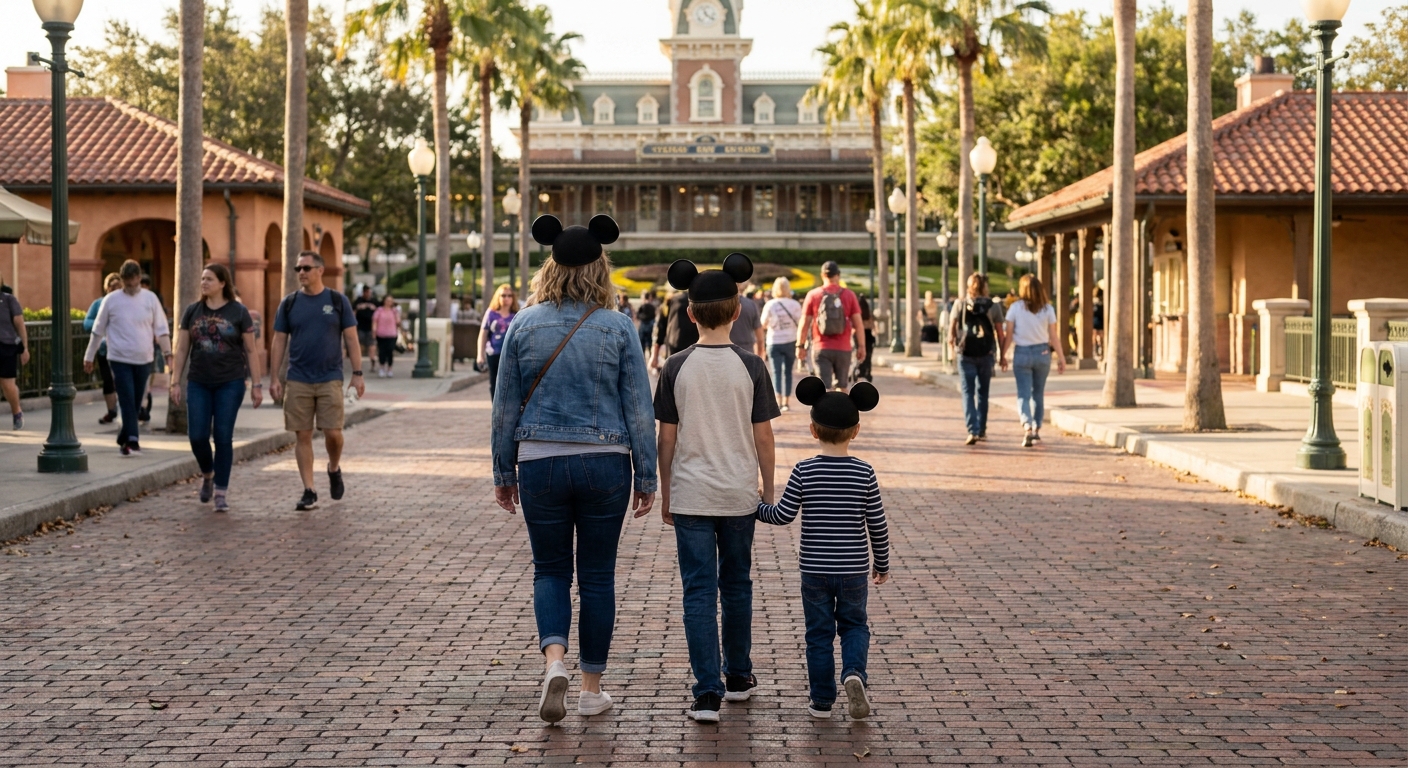
The biggest money pit in Disney transportation isn’t a ride — it’s the airport transfer you book on autopilot. Magical Express is gone (it ended in 2022), and the free Disney bus to the airport went with it. If you’re still planning around it, you’re planning around a ghost.
Stop waiting for a bus that isn’t coming
There is no free Disney-run airport shuttle anymore. What replaced it is a menu of paid options — and the prices swing wildly depending on which one you grab without thinking.
| MCO → Disney option | Roughly what you’ll pay | Best for |
|---|---|---|
| Mears Connect (shared shuttle) | ~$18–$45/person round trip | Solo travelers, couples, light luggage |
| Sunshine Flyer (themed shuttle) | similar to Mears | Same shared-ride model, fun for kids |
| Rideshare (Uber/Lyft) | ~$35–$70 per car one way | Families of 3+, door-to-door speed |
| Town car / private transfer | $$ premium | Large groups, late flights, no waiting |
| Public bus (Lynx Route 111) | around $2/person | Budget die-hards with time and patience |
The math flips fast: a shared shuttle charges per person, so a family of four can pay more for a slow shuttle than for a single rideshare that goes straight to the resort. Price the car, not the seat.
Pro tip: Lynx Route 111 will get you from MCO toward the Disney area for around $2 — but it’s a true public city bus, not a magic carpet. Expect transfers, real travel time, and no luggage handling. It’s a legit hack for a solo traveler on a shoestring; it’s a mistake for a tired family arriving at 11 PM with four suitcases.
Inside the parks: the bus is the slow default, not the fast one
Once you’re on property, the reflex move is “wait for a bus.” Sometimes that’s right. Often it’s the slowest tool in the box.
- Skyliner — the gondola line connecting EPCOT and Hollywood Studios to the Caboose of resorts (Pop Century, Art of Animation, Caribbean Beach, Riviera). If you’re staying on the Skyliner loop, it usually beats the bus to those two parks and it’s genuinely pleasant. Wind or lightning can pause it, so keep a backup in mind.
- Monorail — the fastest way around the Magic Kingdom resort area and the EPCOT line. From a monorail resort, it routinely outpaces the bus to Magic Kingdom, especially at rope drop and after fireworks.
- Boats — quietly faster than buses for a handful of routes (and far more scenic).
- Buses — your only option for Animal Kingdom and the water parks from most resorts, and the connective tissue everywhere else. Reliable, just not quick.
The smart-move checklist before you commit to a ride
- [ ] Check whether your resort sits on the Skyliner or Monorail loop — if it does, that’s usually your fastest park link.
- [ ] For Magic Kingdom from a monorail/boat resort, default to monorail or boat over bus.
- [ ] Price airport transfers per vehicle for groups, per person for solos — pick whichever is genuinely cheaper for your party.
- [ ] Save the bus for Animal Kingdom, the water parks, and resort-to-resort hops with no rail or boat option.
- [ ] Build a backup: Skyliner pauses for weather, so know your bus fallback before you’re standing in line.
Don’t over-romanticize “free”
Free Disney transport is great until it costs you an hour you wanted on Avatar Flight of Passage. The veteran read: treat transportation as a time budget, not just a money budget. A $40 rideshare that saves a stressed family 45 minutes on arrival day can be the best money you spend all trip — and a “free” bus that turns a 9 AM rope drop into a 9:40 arrival can quietly cost you a headliner.
The one thing to remember: Magical Express is history, the airport transfer game is now all about pricing per-vehicle vs. per-person, and inside the bubble the bus is the fallback — not the fast lane. Know your resort’s Skyliner and Monorail access before you ever step on a bus, and let speed, not habit, pick your ride.
The Hotel Booking Traps
Assuming you have to stay “inside the bubble” and paying a premium for a basic room when massive deals sit right outside the gates.
It is the most common financial mistake in Disney planning: defaulting to a Disney Value Resort just to say you are staying on property. While staying inside the Disney bubble has its conveniences, blindly booking a standard Disney hotel room often means you are passing up huge off-property deals that offer better amenities and significantly lower prices.
If you are a Disney World Annual Passholder, the savings just outside the gates can be staggering. You can often snag up to 30% off room rates at nearby Good Neighbor hotels, transforming a budget-stretching trip into a highly affordable stay.
The Good Neighbor Advantage
Consider the Delta Hotels Orlando Celebration. Located just five minutes from Disney World, it is a Disney World Good Neighbor hotel that aggressively caters to Annual Passholders. While a standard Disney Value Resort charges a premium just for the location and theming, booking a Good Neighbor hotel with an Annual Passholder discount completely flips the math on your vacation budget.
Here is how the comparison breaks down when you step slightly outside the Disney gates:
| Feature | Disney Value Resort | Delta Hotels Orlando (AP Deal) |
|---|---|---|
| Room Rate | Premium theme park pricing | Up to 30% off regular rates |
| Breakfast | Out-of-pocket at the food court | Free daily breakfast for up to four people |
| Parking | Free at the resort | Free at the hotel |
| Theme Park Transport | Free Disney buses or Skyliner | Complimentary shuttle to Disney World parks |
| Universal Access | You are on your own | Complimentary shuttle to Universal Orlando |
The Breakfast and Transport Math
The room rate discount is just the beginning; the hidden savings are in the daily incidentals. Feeding a family of four breakfast at a Disney food court adds up fast. A hotel offering free breakfast for up to four people eliminates that daily expense entirely, putting cash back in your pocket before you even leave for the parks.
Transportation is another crucial factor. While Disney provides excellent internal transit, it is designed to keep you on property. If you plan to split your trip and visit Universal Orlando, staying at a Good Neighbor hotel that provides a complimentary shuttle to both Disney and Universal saves you the cost and hassle of navigating rideshares or renting a car.
Pro tip: Never book a Disney Value Resort without pricing out a Good Neighbor hotel first—the combination of a 30% Annual Passholder discount and free daily breakfast often saves enough cash to cover your Lightning Lane Multi Pass for the entire trip.
Before You Book
Run this quick checklist before you lock in a Disney hotel reservation:
- [ ] Check current Annual Passholder or special offer discounts for Good Neighbor hotels.
- [ ] Calculate the daily cost of breakfast for your group and compare it against hotels where it is included.
- [ ] Review the hotel’s shuttle schedule to ensure the complimentary transportation aligns with your rope drop strategy.
- [ ] Factor in any Universal Orlando days and see if the hotel offers a free shuttle there to save on transportation costs.
Staying on property is great for the full immersion, but if your priority is maximizing your budget without sacrificing convenience, the smartest move is often just five minutes down the road.
The Lightning Lane Advance-Booking Blunder
Treating Lightning Lane Multi Pass like the old day-of Lightning Lane Multi Pass scramble is the rookie move that quietly wrecks park days. Multi Pass is now a plan-ahead system, and the families who win are the ones who book before they ever leave the hotel. Wake up the morning of, and you’re fighting for scraps the planners already claimed.
Why “morning of” is too late
The old Lightning Lane Multi Pass habit was: roll out of bed at 7 AM on your park day and grab whatever you could. Multi Pass doesn’t work that way anymore. You buy it per day, then make your selections in advance:
- Disney resort / on-site guests: start booking up to 7 days before arrival — for your whole trip.
- Off-site guests: start 3 days before.
- Either way, your window opens at 7:00 AM Eastern on your eligible day. You book an initial set, then once you redeem one (or its time passes), you add the next, one at a time, through the day in My Disney Experience.
By the time the off-site crowd logs on three days out, on-site guests have had a four-day head start on the same finite inventory. Headliner return times for the popular Multi Pass attractions get scarce fast. Show up at the gate with no selections and you’ve handed away your biggest line-skipping tool.
Pro tip: Single Pass is a separate purchase from Multi Pass. The à-la-carte headliners — TRON Lightcycle / Run and Seven Dwarfs Mine Train (Magic Kingdom), Guardians of the Galaxy: Cosmic Rewind (EPCOT), Rise of the Resistance (Hollywood Studios), and Avatar Flight of Passage (Animal Kingdom) — are NOT covered by Multi Pass. Don’t build your morning around one of those expecting Multi Pass to skip it.
Your advance-booking game plan
- [ ] Confirm your booking window (7 days on-site / 3 days off-site) and set a 7:00 AM ET alarm for that day.
- [ ] Decide which park days actually justify buying Multi Pass before you book (see below).
- [ ] Grab your hardest-to-get Multi Pass return times first — the popular attractions thin out fast.
- [ ] Don’t waste a selection on a ride your kid might bail on (more on that next).
- [ ] Plan to refill all day: redeem one, add the next, repeat.
SupaPark’s sell-out and refill forecasts tell you which selections vanish first and when a redeemed slot is likely to reappear — so you’re refilling on data, not guessing.
Don’t spend a pass on a ride your kid won’t ride
This is where families burn selections. The single worst feeling is spending a Lightning Lane on a ride your child noped out of at the gate. Decide by temperament, not age, and settle it for free before the trip:
- Pull up an on-ride video at home and watch your kid watch it. “I want to do that!” is a green light. Covering their eyes just answered the question — and saved you a pass.
- Slinky Dog Dash: a family coaster — bunny-hop hills, no inversions, no launch. Do the home-video test, and if there’s real doubt, don’t make it your priority Multi Pass. You can rope-drop it nearly for free instead (be at the front well before posted open, head straight to Toy Story Land).
- Cosmic Rewind: a launch coaster and a Single Pass. Green light for a kid who already loves speed; yellow for the cautious 42-inch kid the launch could tip to “never again”; a flat no under 42 inches. Don’t burn your only Single Pass of the day on a maybe.
Pro tip: Split group? Use Rider Switch. One adult waits with the non-rider, the other rides, then they swap without re-queuing — no second standby wait, no wasted pass.
Is Multi Pass actually worth it?
Not every day. It earns its keep on high-crowd days at ride-heavy parks; it’s often skippable on a low-crowd day or a park where you’ll rope-drop and tour efficiently.
| Multi Pass is worth it when… | Skip it / lean on free tactics when… |
|---|---|
| Peak-season or holiday crowds | Genuinely low-crowd day |
| Ride-dense park (Magic Kingdom, Hollywood Studios) | Festival/show day where you’re touring, not riding |
| You arrive late and can’t rope-drop | You’re at the front gate before open |
| You want shorter waits on several headliners | One or two must-dos you can knock out early |
The free lever is always timing: rope drop the first hour, then ride headliners during the big distractions — standby lines reliably thin during fireworks and parades while everyone’s packed onto Main Street.
The one thing to remember
Multi Pass rewards planners, not scramblers. Book your selections the moment your window opens, decide by temperament before you spend a pass, and only buy it on days the crowds justify it. SupaPark watches the sell-out and refill patterns so you book the right rides at the right moment — and never wake up to find the inventory already gone.
Rope Drop Disasters: Showing Up ‘On Time’
If the park opens at 9:00 and you arrive at 9:00, you didn’t rope drop — you joined the line of people who thought they did. The single most expensive mistake in a Disney morning is treating the posted opening time as your arrival time. By 9:00 sharp, the holding areas are already full, the first wave is already walking on to headliners, and you’re standing behind hundreds of people who did the math you didn’t.
The clock that actually matters
Disney rarely starts the morning at the time printed on the schedule. Security and the front taps usually open well before posted open, and guests get funneled into holding areas inside the park while it’s still “closed.” That pre-open window is the real prize — the first 15–30 minutes is when a top ride is a walk-on instead of a 60–90 minute wait three hours later.
So work backwards from the ride, not the gate:
| If posted open is… | Be at security by… | On a heavy day, target… |
|---|---|---|
| 9:00 AM (no Early Entry) | ~8:00 AM | 7:45 AM or earlier |
| 8:30 AM Early Theme Park Entry | ~7:45 AM | 7:30 AM |
| Holiday / peak week | Add 15–30 min to all of the above | — |
Pro tip: Your enemy isn’t the line at the ride — it’s the bottleneck at bag check, the tram or Skyliner queue, and the walk to the back of the park. Budget that transit time separately from your “be inside the park” time, because a 10-minute security backup can erase your whole head start.
Early Theme Park Entry rewrote the rules
Here’s what trips up first-timers: on-site hotel guests get Early Theme Park Entry — 30 minutes before official open, every park, every day. (This replaced the old Extra Magic Hours; that name is gone.) That means the “real” rope drop happens half an hour before the time on your app, and the crowd that matters most has already been inside for 30 minutes by the time off-site guests are allowed through.
What that does to the morning:
- The first wave is hotel guests, and they head straight for the same headliners you want.
- Off-site guests get held at a secondary rope until official open, then released into a park where the front-runners are already in line.
- Staying on-site is the cheapest line-skip there is for a rope-drop-focused trip — those 30 minutes routinely save more standby time than a paid Lightning Lane would.
Stack Early Entry against the right rides
Use the 30 minutes on something that can’t be smoothed over with a paid pass:
| Goal | Smart Early Entry play |
|---|---|
| Lightning Lane Single Pass headliners (Seven Dwarfs Mine Train, TRON, Cosmic Rewind, Rise of the Resistance, Avatar Flight of Passage) | Hit one at rope drop so you don’t have to buy the à-la-carte pass at all |
| A crowd-magnet land (Toy Story Land, Galaxy’s Edge) | Walk in first — the land fills within minutes of open |
| Multi Pass rides | Skip them at rope drop; save them for a booked Lightning Lane window |
Toy Story Land is the textbook case: Slinky Dog Dash draws a wall of people the second the rope drops. Get there first and you ride at a fraction of the midday wait — and you’ve saved your Lightning Lane for something else.
Your rope-drop pre-flight
- [ ] Confirm whether your hotel includes Early Theme Park Entry (on-site = yes)
- [ ] Note official open and assume the gates open earlier
- [ ] Pick your ONE rope-drop target the night before — decide, don’t debate at the tap stiles
- [ ] Mobile order or pre-plan breakfast so food doesn’t eat your head start
- [ ] Subtract security + transit time, then set your alarm to that
The one thing to remember: “On time” is late. Get inside before the posted clock, point yourself at a single high-value ride, and let everyone arriving at 9:00 be the crowd you’re already walking past. SupaPark’s best-time-to-ride forecaster and live walk-on alerts can tell you the exact moment a headliner craters — so even if your morning slips, you’ll know the next window before the line does.
The ‘Tall Enough But Not Ready’ Coaster Trap
A 38-inch toddler who can board Seven Dwarfs Mine Train and a kid who’s ready for it are two different children — and confusing them costs you a meltdown and a wasted line-skip. “Tall enough” is a measurement, not a green light. The smart families decide by temperament, not the birthday or the height stick.
Stop asking “is my kid old enough?”
The trap at Magic Kingdom is asking, “Is my three-year-old old enough for Seven Dwarfs Mine Train?” Wrong question. The right one: is this specific kid the kind who loves speed and the dark, or the kind who freezes? A bold 4-year-old who already begs for coasters is a green light. A cautious 7-year-old who panics on anything fast or unexpected is a yellow light — and that’s exactly the kid who flips from nervous-excited to never-again on a single ride.
Here’s the honest read on the three coasters families push toddlers onto, sorted by what they actually feel like:
| Coaster | Park | Height | What makes it intense |
|---|---|---|---|
| Slinky Dog Dash | Hollywood Studios | posted minimum | Bright, sunny, bunny-hop hills. No drops, no inversions, no launch. The true gateway coaster. |
| Seven Dwarfs Mine Train | Magic Kingdom | 38" | Mostly gentle — but plunges into a pitch-black mine with sudden movement. The dark is the dealbreaker, not the speed. |
| Cosmic Rewind | EPCOT | 42" | A genuine launch coaster with real speed. Thrilling for fans, overwhelming for the cautious. |
The free “home video test” — your single best tool
This is the trick most planners never use, and it costs nothing.
Pull up an on-ride POV video weeks before your trip and watch your kid watch it. A child who sees the launch or the hills and says “again!” is ready. A child who covers their eyes just answered the question for you — for free, at the kitchen table, with zero pressure and zero wasted park time. It’s the most reliable predictor you’ll get.
- [ ] Queue up an on-ride video for every coaster you’re on the fence about
- [ ] Watch your kid’s reaction, not the screen
- [ ] “I want to do that” = ready · covered eyes = you just saved a pass
- [ ] Measure at home so a too-short surprise doesn’t blindside a tired kid at the gate
Pro tip: Seven Dwarfs Mine Train and Cosmic Rewind are both Lightning Lane Single Pass rides — bought à la carte, and you typically get one for the day. A kid who noped out at the load station just burned your only premium skip. The two-minute video is the cheapest insurance you’ll ever buy.
Don’t make your priority pick a gamble
The costliest version of this mistake: spending your best Lightning Lane on a ride your kid bails on.
- Slinky Dog Dash tends to sell out fast and is many families’ priority Multi Pass selection. Don’t put it at the top if there’s real doubt your kid will ride. Do the video test first, then decide where your passes go.
- Cosmic Rewind is a no for anyone under 42 inches, full stop — they can’t ride, so don’t build the EPCOT morning around it for them.
If you’d rather not spend a pass on Slinky Dog at all, timing is your lever:
- Rope drop it. Disney often moves guests through security and into the park before the posted open. Be at the front early and head straight to Toy Story Land — you’ll knock out Slinky Dog at a fraction of the midday wait.
- Ride during the big distractions. Standby lines reliably thin out when the park’s attention is somewhere else, like a parade or fireworks.
When your group is split: Rider Switch
If one parent and a brave kid want to ride but you’ve got a little one who’s too short or too scared, this is your tool. One adult waits with the non-rider, the other rides, then they swap — without re-queuing. Nobody’s dragged onto a ride they’re dreading, and nobody waits the line twice.
The one thing to remember
Decide by temperament, not the height stick or the birthday candle. Run the home video test before you leave home, save Rider Switch for the split group, and never spend a Single Pass on a coaster your kid hasn’t already cheered for on a screen.
Dining Nightmares: Wasting Food, Money, and Time
The mistake isn’t where you eat — it’s how much you order, when you show up, and settling for whatever has a table left. Three small fixes save you real money, real time, and a much better meal.
Stop buying two full meals for two light eaters
Quick-service portions at Walt Disney World run big, and ordering one full meal per person is how you end up overpaying and tossing food. The platters are built to share.
Take Regal Eagle Smokehouse in EPCOT’s American Adventure pavilion. The smart play for two light-to-medium eaters:
- [ ] Order one brisket or combo platter (it already comes with two sides)
- [ ] Add a single à la carte side — now you’ve got three sides across two people
- [ ] Split it; you’ll taste more of the menu for less
That’s enough food to share comfortably with less waste, and you get to sample more of the kitchen. Pay with a discounted Disney gift card and the whole thing gets cheaper still.
Pro tip: Taste the meat before you hit the sauce station. The proteins here are smoked to stand on their own — drown them in regional barbecue sauce on the first bite and you’ve wasted the entire point of the kitchen.
What to skip so your check (and stomach) stay happy:
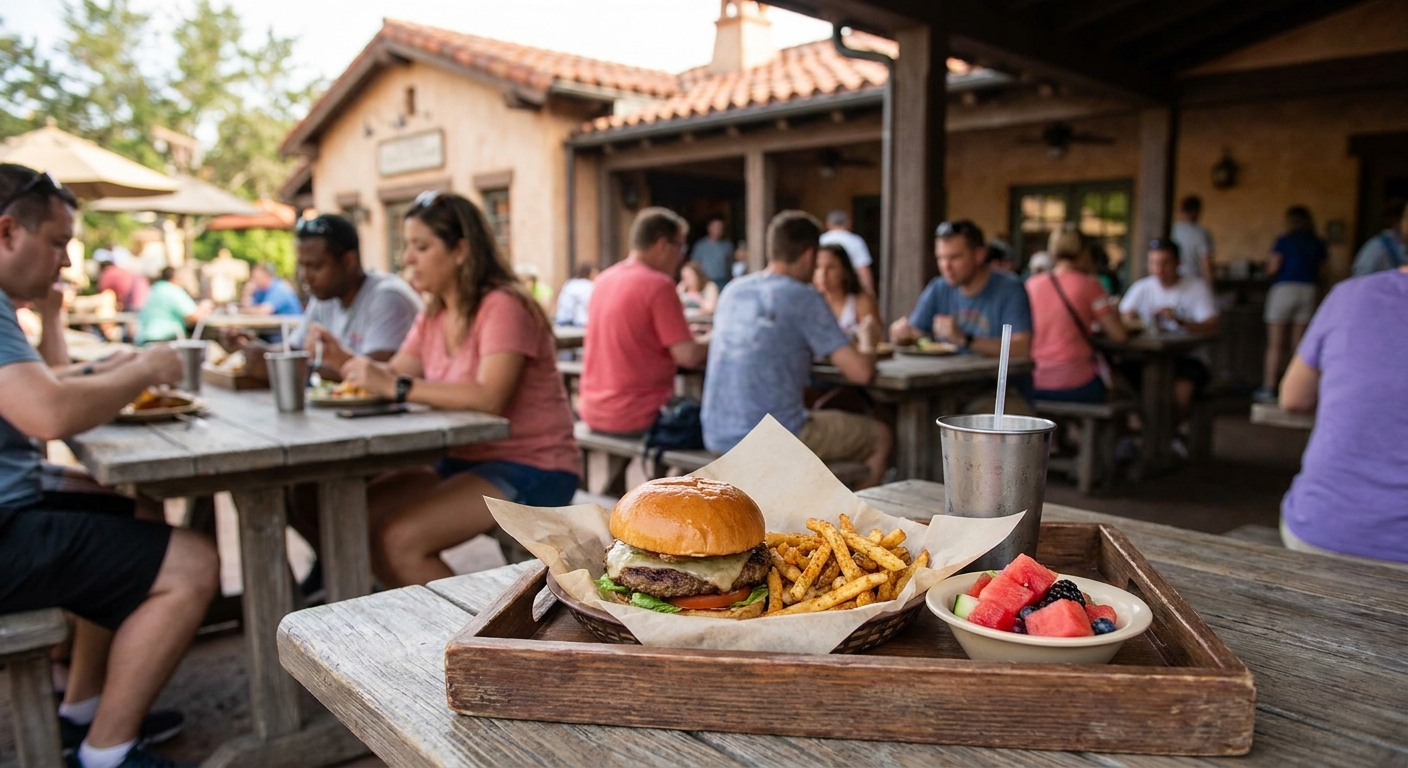
- The burger. You walked into a smokehouse. Don’t default to a standard theme-park burger out of habit — order what the kitchen is actually built to do.
- Doubling up on bready sides. Fries and cornbread means you fill up on starch and leave the actual barbecue behind. Pick one starch, branch out on the other side.
The same split-a-platter logic works at Flame Tree Barbecue in Animal Kingdom — shareable counter-service portions in a park where good quick-service is thinner on the ground, plus free waterfront seating if you walk past the first tables everyone crowds into.
Eat off-peak — let the data set your meal clock
Both Flame Tree and Regal Eagle are quick-service: no reservation, no Lightning Lane, so timing is your only lever. Lines and seating both balloon at the obvious lunch and dinner rushes.
| Meal window | What you get | Smart move |
|---|---|---|
| ~11:30 AM–1:30 PM (lunch peak) | Long counter lines, no open tables | Avoid |
| ~6:00–8:00 PM (dinner peak) | Same crush, hottest part of seating | Avoid |
| Late-morning or mid-afternoon shoulder | Short line, easy seat, A/C reset | Eat here |
Let the wait data — not your stomach’s clock — decide when you sit down. SupaPark’s best-time-to-ride and crowd patterns make the off-peak gap easy to spot, and Regal Eagle doubles as an air-conditioned reset in the heat of EPCOT.
Don’t settle for bad food — snipe the table you actually wanted
Here’s where most planners give up too early: they wanted a sit-down spot, the reservation was gone at the 60-day mark, so they shrug and eat wherever has space. That’s the real dining nightmare — a mediocre meal you didn’t even want.
Top-tier restaurants free up constantly as other guests cancel and reshuffle. You just can’t sit there refreshing My Disney Experience all day.
- What it is: SupaPark’s dining Drop Watch monitors hard-to-get reservations and pings you the instant a cancellation frees one up.
- How it works: You get the alert, you grab the table yourself in My Disney Experience. SupaPark never books for you — it just catches the drop faster than you ever could.
- Why it matters: A canceled table at a headliner restaurant can surface days, or minutes, before your meal. Without a watcher, you’ll never see it.
Pro tip: Set Drop Watch on the restaurant you actually want, then make a no-reservation backup like Regal Eagle your fallback — one that’s good enough you won’t mind if the drop never comes.
The one thing to remember
Don’t crown a single winner — match the spot and the timing to the moment.
- Run the platter-plus-one-side hack instead of buying two full meals.
- Taste before you sauce, and skip the burger at the smokehouse.
- Eat in the off-peak shoulder, not the lunch or dinner crush.
- Put Drop Watch on the reservation you really want, and keep a solid counter-service backup so you never settle.
Do that and the only thing you’ll waste at Disney World dining is… nothing.
EPCOT Festival Financial Ruins
Walking into an EPCOT festival without a strict spending strategy is the fastest way to drop $150 on small plates and still leave hungry.
The Food & Wine Festival is a massive draw, but the financial mechanics of it are built to separate you from your cash as frictionlessly as possible. The smells are incredible, the menus look endless, and paying with a quick tap of a MagicBand or Apple Pay makes the money feel completely fake. It is incredibly easy to swipe your way around the World Showcase, justifying every $5 to $10 dish, only to realize by the time you reach Italy that you’ve spent the equivalent of a signature sit-down dinner on a handful of sliders and melted cheese.
If you aren’t paying attention, the festival stops being a culinary tour and turns into a financial ruin. Here is how you eat well without burning your vacation budget in a single afternoon.
The “Split and Skip” Strategy
The biggest mistake casual planners make is treating festival booths like quick-service restaurants. You do not need your own individual portion of everything. The plates are heavy, the Florida heat is brutal, and stomach space is your second most valuable currency after your budget.
Sharing is the ultimate festival hack. If you have two or three people in your group, split every single item. You will taste twice as many dishes for the exact same price, and you avoid the dreaded afternoon carb-crash that sends families back to the hotel by 3:00 PM.
To keep your spending grounded in reality, follow this festival protocol:
- [ ] Review the menus before you park. Pinpoint your absolute must-dos in advance. Do not waste cash on filler items just because you happen to be standing next to the booth.
- [ ] Buy a wristband Disney gift card. Put your exact daily budget on one of the small, wearable gift cards sold at the park entrance. When the card is empty, your festival eating is done. This forces you to prioritize the headliners over the mediocre options.
- [ ] Skip the booth booze. The alcoholic drinks are the most expensive items at any festival booth, often pushing past the cost of the food itself for a very small pour. Buy your drinks from the permanent pavilions where the value and quality are significantly better.
- [ ] Prioritize protein over bread. A $9 steak dish is a better value and keeps you fueled longer than a $6 waffle or heavy pasta item.
Escape the Heat (and the Bill) at the Morocco Pavilion
If you are a Disney World Annual Passholder, ignoring your exclusive perks during festival season is leaving serious money on the table. When the midday crowds peak and the World Showcase pavement feels like the surface of the sun, do not go buy another overpriced bottled water.
During major events like the Food & Wine Festival or V.I.Passholder Days, Disney frequently opens a secret oasis specifically for passholders or affiliated sponsors (like the Florida Blue Medicare Lounge). You will usually find this hideaway tucked in the back of the Morocco Pavilion, taking over the former Restaurant Marrakesh space.
This lounge is a game-changer for your stamina and your wallet. Inside, you get a break from the EPCOT crowds, plenty of comfortable seating, and—most importantly—glorious, blast-chill air conditioning. The lounge typically provides complimentary beverages, small snacks, and a place to sit down and recharge without spending a dime. That alone makes it worth the walk to Morocco.
The Festival Breakdown
| Festival Strategy | The Rookie Move | The Smart Play |
|---|---|---|
| Budgeting | Tapping a MagicBand linked to a credit card at every single booth | Using a pre-loaded wristband gift card to hard-cap your daily spending |
| Eating | Ordering one of everything at the first three booths and getting full | Splitting single items across the group to maximize tasting and save money |
| Cooling Down | Paying for sodas and fighting for a sliver of shade | Heading to the Morocco Pavilion lounge for free AC and hydration (when eligible) |
| Hydration | Swiping your band for $5 bottles of water all afternoon | Asking for free cups of ice water at permanent quick-service spots |
Pro tip: Do not start your festival snacking at the front of the park. The booths nearest the main entrance and the World Showcase entry points always have the longest lines because people stop at the very first thing they see. Walk straight past the crowds, head deeper into the World Showcase, and work your way backward. You will wait half the time for your food.
The smartest EPCOT festival days are curated, not impulsive. Plan your hits, share your plates, use your passholder perks, and let the rookies fund the mouse while you eat like an insider.
Single Pass Squandering
Buying a Lightning Lane Single Pass on autopilot is a rookie tax—check the wait-time data, do a temperament check on your kids, and know when the standby line actually collapses before you swipe your card.
Lightning Lane Single Passes for headliners like Avatar Flight of Passage, TRON Lightcycle / Run, and Guardians of the Galaxy: Cosmic Rewind run roughly $15 to $25 per person depending on the day. For a family of four, that is an instant $100 upcharge. If you buy them at 7:00 AM just because you are scared of lines, you are likely squandering your budget. You can skip the massive waits for free if you know how the crowds move, or avoid burning cash entirely on a ride your family won’t even board.
The “Kitchen Table” Temperament Test
The biggest trap families fall into is asking, “Is my kid old enough or tall enough for this ride?” That is the wrong question. You need to read their temperament.
Guardians of the Galaxy: Cosmic Rewind is a green light for a kid who already rides launch coasters and loves the rush. But it is a hard yellow light for a cautious child who clears the 42-inch height requirement but freezes in the dark. The intense reverse launch can tip them from nervous-excited to “never again,” and there is nothing worse than burning a Single Pass on a ride your child nopes out of at the tap points.
The move: Do the home video test. Pull up an on-ride POV video of Cosmic Rewind (or Slinky Dog Dash if you are plotting your Multi Pass strategy) at the kitchen table weeks before your trip. A child who watches the launch and says “again” is ready. A child who covers their eyes just gave you your answer for free.
If you have a split group where one parent and a brave kid want to ride, but the little one is too scared, do not buy Single Passes for everyone. Use Rider Switch. One adult waits with the non-rider, the other rides, and then they swap without re-queuing.
When to Pay vs. When to Wait
You do not always need to pay to skip the line. Here is the insider breakdown of when to buy a Single Pass versus when to leverage standby lines or virtual queues.
| Attraction | When to Buy the Single Pass | When to Save Your Money |
|---|---|---|
| TRON Lightcycle / Run | You are only at Magic Kingdom for the morning or have tight dining reservations. | You plan to be in the park during the afternoon parade or evening fireworks. |
| Guardians of the Galaxy: Cosmic Rewind | You missed the 7:00 AM and 1:00 PM Virtual Queue drops, or absolutely need to ride at a specific hour. | You scored a Virtual Queue boarding group for free. |
| Avatar Flight of Passage | You are arriving at Animal Kingdom midday when wait times peak. | You are rope-dropping the park and can be at the gates well before opening. |
| Seven Dwarfs Mine Train | You want to sleep in and avoid the intense early morning Fantasyland rush. | You are leveraging Early Theme Park Entry and head straight to the mine. |
The Insider Strategy for TRON
If you decide to save your money and ride TRON Lightcycle / Run via standby, timing is your only lever.
The smart move: Ride at showtime. The best time to hop into the standby line for TRON is during the Happily Ever After fireworks or the afternoon parade. While thousands of guests are packed onto Main Street, U.S.A., the queue for this coaster reliably thins out. Keep an eye on SupaPark’s best-time-to-ride forecaster to spot exactly when the line historically drops during these windows.
Pro tip: Do not fear the rain. Florida downpours are infamous, and you might assume rain shuts TRON down since it has a massive outdoor launch. It doesn’t. TRON has an enormous, sweeping canopy that completely covers the outdoor track. While other outdoor coasters in Magic Kingdom close quickly for weather, TRON often keeps running unless there is severe lightning right overhead. When the rain starts and the crowds scatter, stay in line.
Also, don’t stress over the lockers. TRON requires you to stow bags before boarding, but the double-sided locker system is fast, free, and built seamlessly into the queue.
The Pre-Purchase Checklist
Before you blindly buy a Lightning Lane Single Pass for your group, run through this list:
- [ ] Did you do the kitchen table POV video test to confirm the kids will actually ride?
- [ ] Are you leveraging Rider Switch so you only buy passes for the actual riders?
- [ ] Have you checked SupaPark’s wait-time forecaster to see if the standby line drops during a parade or fireworks?
- [ ] Did you attempt to join a free Virtual Queue boarding group first?
- [ ] Are you willing to rope-drop the park to ride for free?
Treat Single Passes as a surgical tool, not a default tax. Buy them when they save your itinerary, but let the data and your kids’ temperaments guide your wallet.
The Midday Meltdown and the Exhaustion Tax
Pushing your family through the 2:00 PM Florida heat to “maximize” your ticket is the fastest way to ruin your evening and guarantee a meltdown.
The biggest rookie mistake at Walt Disney World isn’t missing a Lightning Lane drop. It’s the exhaustion tax. It happens when you try to power through peak afternoon heat, peak wait times, and peak crowd levels without a strategy. You end up dragging tired kids—and tired adults—across concrete while carrying a chaotic, heavy bag, desperately looking for an air-conditioned ride that doesn’t have a 70-minute standby line.
The Loungefly Trap
Choosing a park bag is essential, and Loungefly backpacks are arguably the most popular choice in the parks right now. But here is the brutal truth: most of them are just empty leather pits with minimal pouches. Marching through Fantasyland at 2:30 PM while desperately digging through a disorganized bag to find a band-aid or a charging cable is a miserable experience.
You need to bring order to your park bag before you ever leave the hotel.
- [ ] Mini-backpack organizer insert: This is the move. It slides right into your Loungefly and instantly adds structured pockets, keeping the bag clutter-free and saving your sanity.
- [ ] Multi-device portable charger: You will be on your phone constantly using the My Disney Experience app to book Lightning Lane Multi Pass selections. Bring a heavy-duty charger with multiple ports—the Swiss Army knife of charging that can juice up multiple phones and MagicBand+ devices simultaneously without playing musical outlets in the room later.
- [ ] Cooling gear: Neck fans or cooling towels. Don’t assume you can just step into a store to cool off; you need relief while standing in outdoor queues.
The Hotel Break vs. The In-Park Reset
When 2:00 PM hits, you have two choices to dodge the exhaustion tax: leave the park, or find a quiet zone. Do not try to keep riding headliners. Wait times are at their worst, and you are burning energy for minimal return.
| Strategy | Pros | Cons | Best For |
|---|---|---|---|
| The Hotel Break | Complete reset, actual naps in a real bed, pool time, zero crowds. | Eats up 2–3 hours of transit and transition time. | Families with toddlers, extreme heat days, or guests staying on the Skyliner/Monorail. |
| The In-Park Reset | Keeps you on-site for your next Lightning Lane, no transportation hassle. | Harder to find true quiet; no horizontal sleeping for adults. | Older kids, short trips, or off-site guests who don’t want to commute twice. |
Finding the Right Quiet Zone
If you opt for the in-park reset, you need aggressive air conditioning and seating. Don’t just wander aimlessly. Target specific, low-demand locations built for capacity.
In EPCOT, this means heading to the pavilions with deep indoor spaces. If you are an Annual Passholder visiting during the summer (V.I.Passholder Days are running right now through July 31st), you get access to an exclusive lounge. You’ll find it in the Morocco Pavilion at the former Restaurant Marrakesh. Inside is a comfortable place to sit away from the crowds, complete with free snacks, beverages, and—most importantly—blasting AC. That alone makes it worth the walk.
If you don’t have passholder access, a spot like Regal Eagle Smokehouse in the American Adventure pavilion is a massive, air-conditioned space where you can grab a cold drink and reset. (Just remember the insider hack: order a platter to split and taste the meats before drowning them in sauce).
Pro tip: Let your tech do the waiting while you rest. Instead of burning your phone battery and your patience aggressively refreshing the My Disney Experience app for a dropped dining reservation or a Lightning Lane refill, let SupaPark’s Drop Watch do the work. We watch the systems in the background and ping you the second something opens up. You get the alert, tap over to Disney’s app to grab it, and stay comfortably seated in the AC until it’s time to ride.
Stop Deciding by Age, Start Deciding by Temperament
The midday meltdown is often triggered by forcing kids onto rides they aren’t ready for simply because they are tall enough. The trap families fall into is asking, “Is my 5-year-old old enough for Slinky Dog Dash?” That is the wrong question.
A bold 4-year-old who begs for coasters is a green light. A cautious 7-year-old who freezes on anything fast is a yellow light. Pushing a nervous child onto a coaster at 3:00 PM is a recipe for a disaster that will derail the rest of your day. Go by temperament. Before you leave home, pull up a ride POV video on YouTube. If they cover their eyes, you just got your answer for free, and you saved yourself from wasting a Lightning Lane selection on a ride your kid will nope out of at the gate.
The Over-Scheduling Spiral
The fastest way to ruin a Disney day is to schedule it like a business trip. The parks punish ambition. Four parks in two days, a dining reservation jammed against a Lightning Lane window, a transit time you assumed was 15 minutes — that’s how families burn money on selections they never use and spend the trip sprinting instead of riding.
Stop trying to do four parks in two days
You can technically Park Hop anytime the parks are open (the old 2 PM hop rule is gone), but “technically possible” and “smart” are different sports. Each park transfer eats real time and energy.
The honest math on door-to-door transit:
| Route | Typical time, door-to-door |
|---|---|
| Resort bus → park gate | 45–60 min |
| Park → park (bus or boat + walk) | 60–90 min |
| Magic Kingdom (parking lot → tap point via monorail/ferry) | 30–45 min |
Two parks in a day means you’ve handed Disney transit and security up to three hours you didn’t budget. Better play: one park per day, anchored, with a single optional evening hop only if your top rides are knocked out.
The reservation-window trap
Here’s the collision nobody plans for: your Advance Dining Reservation and your Lightning Lane return window landing on top of each other in different corners of the same park.
- ADRs open 60 days before arrival at 6:00 AM Eastern in My Disney Experience.
- Lightning Lane Multi Pass selections you’ve made in advance return on their own windows through the day.
- A 12:40 PM lunch ADR and a 12:15–1:15 PM Lightning Lane return are not compatible — one of them loses.
Pro tip: Leave a 90-minute moat between any sit-down meal and your nearest Lightning Lane return window. SupaPark’s day builder flags these overlaps before they cost you a selection, and Drop Watch pings you if a better-timed table frees up so you can rebook the conflict away in My Disney Experience.
Ride at showtime instead of stacking
The cure for over-scheduling is using the crowd’s distractions instead of fighting them. When thousands pack Main Street, U.S.A. for the parade or Happily Ever After, the standby lines on headliners reliably thin out.
TRON Lightcycle / Run (a Lightning Lane Single Pass ride) is the textbook case:
- Best standby window: during the afternoon parade or evening fireworks. Watch SupaPark’s best-time-to-ride forecaster to catch exactly when the line historically drops.
- Don’t fear the rain. TRON’s outdoor launch sits under an enormous sweeping canopy — you won’t get rained on. While other outdoor Magic Kingdom coasters close fast for weather, TRON often keeps running unless there’s lightning in the immediate area.
- The lockers. TRON requires you to stow loose items before boarding. Pack light, free hands at the queue, and it’s a non-issue.
Slinky Dog Dash: don’t blow a pass on a maybe
Slinky Dog Dash is a family coaster — bunny hops, no inversions, no launch — but don’t make it your priority Lightning Lane if there’s real doubt your kid will ride. Nothing wastes a selection faster than a child who noses out at the gate.
- [ ] Run the home video test first — pull up an on-ride video and watch your kid watch it. “Again!” is a green light; covered eyes just answered for free.
- [ ] Decide where your passes go after that read, not before.
- [ ] If you’d rather not spend a pass at all, rope drop it — be at the front well before posted open (Disney often moves guests through security early). Toy Story Land fills fast, so go straight there.
- [ ] Or ride during the big distractions, when the park’s attention is on the parade or fireworks.
The one thing to remember
Build the day around fewer, better-timed moves — one park, ride at showtime, and a buffer between meals and return windows — and the parks stop fighting you. Over-scheduling doesn’t get you more; it gets you a family standing on a bus platform watching a Lightning Lane window expire. Let the wait data, not your packed itinerary, decide your next move.
Ignoring Real-Time Data and Alerts
Relying on Disney’s posted wait times and hoping for the best is how you spend three hours a day standing in line instead of riding.
The biggest mistake casual planners make is treating Disney’s official wait times as gospel. By the time a standby sign reads “65 minutes,” the reality on the ground has already shifted. If you aren’t using live operational data and instant alerts, you are making decisions based on stale information while everyone else beats you to the punch.
The Illusion of the Posted Wait
Disney’s posted wait times are famously slow to update and often deliberately inflated to manipulate crowd flow. If you blindly trust the sign, you will miss the sudden, unannounced walk-ons. When a massive headliner reopens after a temporary closure, the My Disney Experience app might still display a 60-minute wait, but the actual queue is a ghost town.
Live alerts that find you are the antidote. When a ride craters to a walk-on, SupaPark pings you instantly. You change directions, tap in, and shave an hour off your wait before the official app ever adjusts.
Evading the Breakdown Trap
There is nothing worse than marching all the way across Hollywood Studios to ride Star Wars: Rise of the Resistance only to find out it broke down five minutes ago. The only thing more painful is getting stuck deep in a standby line right before a ride goes down, burning valuable park time on an attraction you never even board. Instant ride breakdown alerts let you pivot before you waste the walk or the time. If a ride drops offline, you get notified the second it happens so you can seamlessly reroute.
| The Situation | What Disney’s App Shows | The Real-Time Intel | The Smart Move |
|---|---|---|---|
| Ride Reopens | “60 Minute Wait” (Stale data) | Walk-On Alert: Queue is empty | Drop what you’re doing and ride immediately. |
| Ride Breaks Down | Shows open for 5-10 mins | Status Alert: Ride just went offline | Pivot to another land; don’t waste the walk. |
| Midday Crowds | “90 Minute Wait” | Refill Prediction: Lightning Lane dropping soon | Wait for the alert and book the pass. |
Strategic Timing for Headliners
Instead of guessing when a line might dip, use the best-time-to-ride forecaster to spot historical drops. Take TRON Lightcycle / Run. The smart move is to ride at showtime. When thousands of guests are packed onto Main Street, U.S.A. for the Happily Ever After fireworks or the afternoon parade, the standby queue for this Lightning Lane Single Pass attraction reliably thins out.
Pro tip: Don’t bail on the TRON line if it starts pouring. The ride features an enormous, sweeping canopy that completely covers the outdoor track. You will not get rained on while riding, and while other outdoor coasters close quickly for weather, TRON often keeps running unless there is severe lightning in the immediate area.
Sniping Dining Cancellations
Real-time data isn’t just for rides—it’s how you eat well without booking 60 days in advance. If your day calls for a sit-down EPCOT meal but you couldn’t snag a table, do not waste time constantly refreshing your phone. Set a dining Drop Watch. The moment a hard-to-get reservation frees up from a cancellation, SupaPark catches it and alerts you instantly so you can grab the table yourself in My Disney Experience.
If the drop never comes, pivot to the best no-reservation fallback: Regal Eagle Smokehouse. It provides an air-conditioned reset in the heat of EPCOT. To maximize it:
- Run the platter-plus-one-side hack: Order one platter (which comes with two sides) and add a third à la carte side. It’s enough food to share comfortably.
- Skip the burger: You walked into a smokehouse; order what the kitchen is built to do.
- Don’t double up on bready sides: If you pick fries and cornbread, you fill up on starch.
- Taste before you sauce: The proteins are smoked to stand on their own.
(In Animal Kingdom, the equivalent play is Flame Tree Barbecue. Walk past the first crowded tables to find the calm waterfront seating everyone else misses.)
The Data-Driven Day Checklist
Before you scan into the park, make sure your strategy is locked:
- [ ] Pin your top priority rides in the forecaster to track their exact wait patterns.
- [ ] Turn on push notifications for sudden walk-on and ride breakdown alerts.
- [ ] Set up a Drop Watch for your highly coveted, sold-out dining reservations.
- [ ] Plan to eat off-peak at counter-service spots. Let the wait data—not your stomach’s clock—decide when you sit down.
Key Takeaways
Avoiding Disney World’s worst pitfalls comes down to anticipating the friction before it happens. Here is your final, actionable checklist to ensure your time, budget, and sanity remain intact on your next trip.
Luggage, Flights, and Arrival Reality Checks
Airlines are changing the math on your travel budget. Southwest Airlines ends its famous “two free checked bags” policy on May 28, 2025. If you are flying after that date, factor those new bag fees into your overall trip cost, or actively shop competitor airlines running limited-time promos to snag defecting Southwest loyalists.
Magical Express is dead—solve your airport transfer early. The complimentary Disney airport bus ended in 2022, yet guests still show up at Orlando International Airport looking for it. Book a paid alternative like Mears Connect, Sunshine Flyer, or a rideshare well before your flight lands.
Smart Lodging and Budgeting
Look five minutes outside the Disney bubble for massive savings. You do not have to pay a premium on-property price to get highly competitive park perks. For example, Annual Passholders can score up to 30% off regular room rates at the Delta Hotels Orlando Celebration, an official Good Neighbor hotel located just five minutes from the resort.
| Feature | On-Property Moderate Resort | Delta Hotels Orlando Celebration (Good Neighbor) |
|---|---|---|
| Price | Premium | Up to 30% off for Annual Passholders |
| Breakfast | Out of pocket | Free for up to four guests per day |
| Parking | Included | Included (Free) |
| Transport | Disney buses, Skyliner, or monorail | Complimentary shuttle to both Disney and Universal |
The “Don’t Waste Your Time” Park Tactics
Rope drop means arriving an hour early, not at park open. If Magic Kingdom opens at 9:00 AM, rolling up to the tapstiles at 8:55 AM means you are already behind thousands of people. Disney often starts moving guests through security and into holding areas 30 to 60 minutes before the posted time. Arrive by 8:00 AM to actually beat the morning rush and knock out a headliner before the hour-long waits build.
Use the fireworks to ride TRON Lightcycle / Run. The absolute best time to hop into the standby line for TRON is during the Happily Ever After fireworks or the afternoon parade. While the masses are packed shoulder-to-shoulder on Main Street, U.S.A., the coaster’s queue reliably thins out.
Never bail on the TRON line because of rain. Florida downpours shut down almost every outdoor coaster at Disney World, but TRON is the exception. The massive sweeping canopy completely covers the outdoor launch sequence. Unless there is severe lightning in the immediate area, the ride keeps running, and you stay completely dry.
Find the secret AC hideaways to beat the midday meltdown. If you are visiting during the EPCOT Food and Wine Festival, do not suffer in the midday heat. Head to the Florida Blue Medicare Lounge tucked in the back of the Morocco Pavilion (where Restaurant Marrakesh used to operate). It offers glorious air conditioning, plenty of seating, and free beverages—an absolute lifesaver when the World Showcase crowds peak.
The “Don’t Waste Your Money” Dining Hacks
Stop over-ordering at Disney BBQ joints. At spots like EPCOT’s Regal Eagle Smokehouse or Animal Kingdom’s Flame Tree Barbecue, the portions are massive. Do not blindly order two full meals if you have two light-to-medium eaters in your group.
Pro tip: Order one combo platter (which automatically includes two sides) and add a third à la carte side. This gives you enough food to share comfortably, cuts your meal cost nearly in half, and reduces food waste. Taste the smoked meat before drowning it in sauce, and skip the generic theme-park burgers to focus on what the kitchen actually does best.
The Family Survival Checklist
Test your kid’s coaster tolerance from your couch. There is nothing worse than burning an advance Lightning Lane Multi Pass selection on Slinky Dog Dash, or buying an à la carte Single Pass for Seven Dwarfs Mine Train, only to have your child nope out at the tapstiles. Do not guess based on their height or age. Pull up a POV ride video at home. If they cover their eyes at the screen, you just saved yourself a headache and wasted money—skip the ride.
Organize the chaos in your park bag. Loungefly backpacks are the most popular park bags at Disney, but they have almost zero internal pouches, turning them into a chaotic black hole when you need to find something fast.
- [ ] Buy a cheap mini-backpack organizer insert to add pockets and structure to your Loungefly before you leave home.
- [ ] Pack a multi-device portable charger (an absolute necessity if your group relies on MagicBand+ and the My Disney Experience app all day).
- [ ] Measure your kids’ exact height at home with their park shoes on, so a “too short” surprise does not blindside a tired kid at the ride entrance.
<!-- SUPAPARK-LINKS:START -->
Keep planning: TRON Lightcycle / Run · live wait times · is Lightning Lane worth it
<!-- SUPAPARK-LINKS:END -->